Every year, lakhs of taxpayers in India file the wrong ITR form - and most don't find out until they get a defective return notice from the Income Tax Department. For AY 2026-27, this mistake carries a new cost: your form now decides your deadline too.
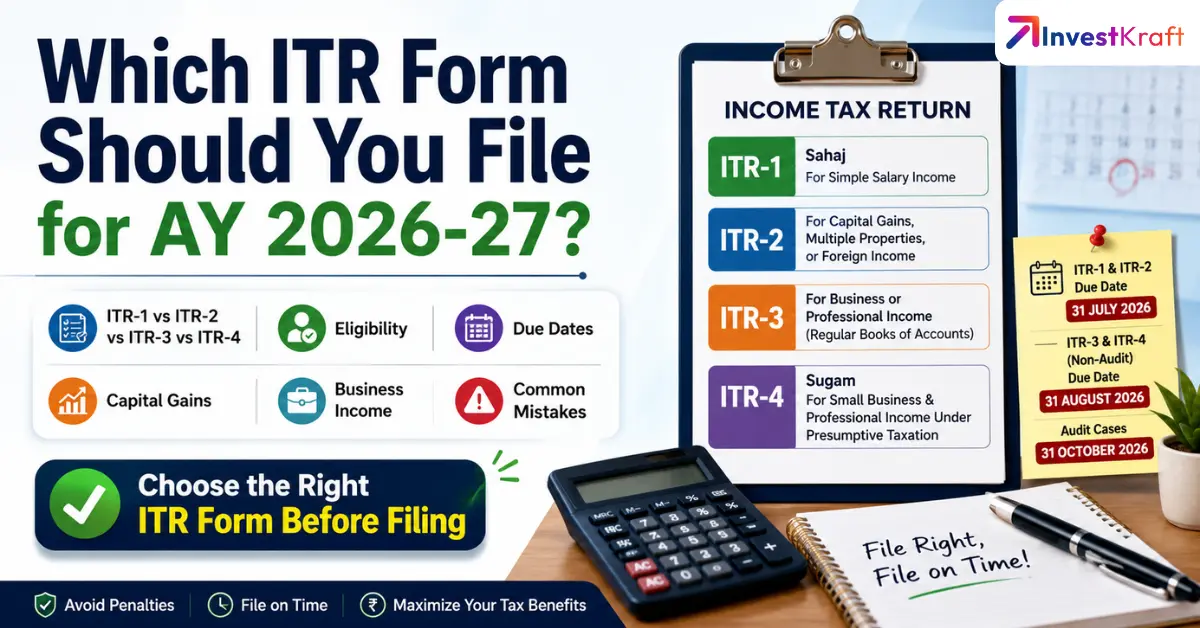
ITR-1 and ITR-2 filers must file by 31st July 2026. ITR-3 and ITR-4 (non-audit) filers get an extra month, until 31st August 2026.
If you assume You are an ITR-2 filer and miss the July deadline, only to realise later you actually qualified for ITR-1, You have lost nothing. But if you assume the reverse - and miss your actual due date because you thought you had until August - You are looking at a late fee under Section 234F, interest under Section 234A, and the permanent loss of your right to carry forward capital losses or business losses.
So before you open the e-filing portal, spend five minutes here. It'll save you a lot more than five minutes later.
Latest Highlights Related to ITR Forms
Key Change AY 2026-27
Details
ITR-1 & ITR-2 Due Date
31 July 2026
ITR-3 & ITR-4 (Non-audit)
31 August 2026
Audit Cases
31 October 2026
House Properties Allowed
Up to 2
LTCG under Section 112A
Up to ₹1.25 lakh in ITR-1 & ITR-4
Note: Picking the wrong form doesn't just risk a defective return notice - it can mean You are tracking the wrong deadline entirely.
ITR-1 (Sahaj): For Simple Salary Income
ITR-1 is the most commonly used form, and this year it covers more people than before. You can file ITR-1 if all of these apply:
You are a Resident and Ordinarily Resident (ROR) individual - not an NRI or RNOR
Your total income for FY 2025-26 doesn't exceed ₹50 lakh
Your income comes only from: salary or pension, up to two house properties (new this year), interest and other simple sources (savings account, FD - excluding lottery or racehorse winnings), agricultural income up to ₹5,000, and LTCG under Section 112A up to ₹1.25 lakh with no losses to carry forward.
You cannot use ITR-1 if:
You are a company director or hold unlisted equity shares
You have any business or professional income
Your capital gains exceed the ₹1.25 lakh LTCG limit, or include any short-term gains
You have foreign income or foreign assets
Due date: 31st July 2026
ITR-2: For Capital Gains, Multiple Properties, or Foreign Income - No Business Income
If your finances are a step beyond ITR-1 but you don't run a business, ITR-2 is your form. File ITR-2 if you have:
Capital gains beyond the ITR-1 LTCG exception - short-term gains, larger long-term gains, or gains from property, gold, or unlisted shares
Income from more than two house properties, or brought-forward losses on property
Foreign income, foreign assets, or signing authority on a foreign account
Total income above ₹50 lakh (with no business income)
You are an NRI or RNOR with income from these sources
Important: Even if You are eligible for ITR-1, You are allowed to file ITR-2 instead - it's just not necessary. If you also have business or professional income, ITR-2 is not for you; you'll need ITR-3.
Due date: 31st July 2026
ITR-3: For Business or Professional Income (Regular Books of Accounts)
ITR-3 is for individuals and HUFs running a business or profession where you maintain regular books of accounts - and don't qualify for, or haven't opted into, presumptive taxation. File ITR-3 if you are:
A proprietor, or a professional (doctor, lawyer, consultant) in independent practice, maintaining full books
A partner in a firm, reporting your share of partnership income
An F&O or intraday trader - this income is treated as business income, not capital gains, and filing ITR-1 or ITR-2 for it will trigger a defective return notice
Someone who opted for presumptive taxation but declared profit below the prescribed rate while your income crosses the basic exemption limit (You are pushed into ITR-3 along with a mandatory tax audit)
ITR-3 also captures everything else in one form - salary, house property, capital gains, crypto/VDA income, and foreign assets - alongside your business income.
Due date: 31st August 2026 (non-audit) | 31st October 2026 (audit cases)
ITR-4 (Sugam): For Small Business & Professional Income Under Presumptive Taxation
ITR-4 is the simplified business form - built for small businesses and professionals who don't want the compliance load of maintaining detailed books. File ITR-4 if:
You are a resident individual, HUF, or firm (not LLP) with total income up to ₹50 lakh
You have opted for presumptive taxation under:
Section 44AD (traders/manufacturers, turnover up to ₹2 crore, or ₹3 crore if 95%+ receipts are digital) or
Section 44ADA (professionals - including freelancers, bloggers, digital marketers - gross receipts up to ₹50 lakh, or ₹75 lakh if 95%+ digital) or
Section 44AE (goods carriage operators)
You also have income from up to two house properties (new this year) and LTCG under Section 112A up to ₹1.25 lakh
You cannot use ITR-4 if you declare profit below the presumptive rate and your income crosses the basic exemption limit - you'll need ITR-3 with a tax audit instead.
Due date: 31st August 2026 (non-audit)
Comparison Table for ITR-1 vs ITR-2 vs ITR-3 vs ITR-4
Now, let us understand the differences clearly between these ITR forms from the table below:
Criteria
ITR-1
ITR-2
ITR-3
ITR-4
Who it's for
Salaried, simple income
Capital gains, foreign income, no business
Business/profession, regular books
Small business/profession, presumptive
Income limit
₹50 lakh
No limit
No limit
₹50 lakh
House properties
Up to 2
Any number
Any number
Up to 2
Business income
Not allowed
Not allowed
Required
Required (presumptive)
LTCG (Sec 112A)
Up to ₹1.25L only
Any amount
Any amount
Up to ₹1.25L only
F&O/Intraday trading
No
No
Yes
No
NRI/RNOR allowed
No
Yes
Yes
No
Due date (AY 2026-27)
31 Jul 2026
31 Jul 2026
31 Aug / 31 Oct
31 Aug 2026
Common Mistakes That Can Cause a Defective Return Notice
The following are some of the mistakes that may result in causing a defective return notice:
Filing ITR-1 for F&O or intraday trading income - this is business income and needs ITR-3, regardless of how small the amount
Staying on ITR-1 despite having capital losses to carry forward - even ₹1 of LTCG under 112A disqualifies you from ITR-1 if there's a loss to carry forward
Choosing ITR-4 after declaring a presumptive loss - a loss under Section 44AD/44ADA automatically requires ITR-3 and a tax audit
Ignoring foreign assets or foreign income - even a single foreign bank account with signing authority rules out ITR-1 and ITR-4
Assuming last year's form still applies - the ITR-1/ITR-4 eligibility expanded this year (2 house properties, LTCG up to ₹1.25 lakh), so some taxpayers who needed ITR-2 last year can simplify to ITR-1 now
Frequently Asked Questions
> Can I file ITR-2 even if I'm eligible for ITR-1?
Yes. It's not mandatory to use the simplest form you qualify for, though ITR-1 is faster and easier.
> What happens if I file the wrong ITR form?
The Income Tax Department issues a defective return notice under Section 139(9), and you must refile correctly within the given time or the return is treated as invalid.
> Is the ITR-1 due date really different from ITR-3?
Yes, for AY 2026-27. ITR-1 and ITR-2 are due 31st July 2026; ITR-3 and ITR-4 (non-audit) are due 31st August 2026.
> Can a freelancer file ITR-1?
No. Freelance or professional income is business income and requires ITR-3 or ITR-4, depending on whether you opt for presumptive taxation.
> Does owning two house properties still require ITR-2?
Not anymore. From AY 2026-27, ITR-1 and ITR-4 allow up to two house properties.
> Can NRIs file ITR-1?
No. NRIs and RNOR taxpayers must use ITR-2 or ITR-3, depending on their income sources.
> What if I have both salary and F&O trading income?
You must file ITR-3. F&O income is business income, and combining it with salary still requires the more detailed form.
> Is there a penalty for missing my specific ITR form's deadline?
Yes - late filing fees under Section 234F (up to ₹5,000) and interest under Section 234A apply, regardless of which form you use.
Disclaimer: This article is for general guidance only and should not be treated as tax or legal advice. Please consult a qualified Chartered Accountant for advice specific to your financial situation.
Author: Diwakar Kumar Singh
Diwakar Kumar Singh is a BFSI specialist and finance writer with over 7 years of hands-on experience in financial research, content creation, and analysis.
A Gold Medalist in MBA (Marketing) from IMT, he combines deep analytical skills with practical insights gained from evaluating companies, IPOs, unlisted shares, financial ratios, and investment opportunities. Diwakar has personally analysed hundreds of financial instruments and market scenarios, which he uses to break down complex topics into clear, actionable advice.
He has authored numerous in-depth finance articles, published multiple books internationally, and contributed to research publications. His work focuses on helping everyday investors and readers make better-informed financial decisions through well-researched, evidence-based explanations that are always grounded in real-world application rather than theory alone.


 care@investkraft.com
 +91-9599071040
 +91-9797971876











.webp)