If you have ever checked your bank passbook or net banking profile, you may have noticed a term called CIF number. Many people confuse CIF with IFSC or account number, but it serves a completely different purpose. In this guide, we explain what a CIF number is, why banks use it, and how you can easily find your CIF number in SBI, Central Bank of India, Indian Bank, and other Indian banks.
What is CIF Number in Banking?
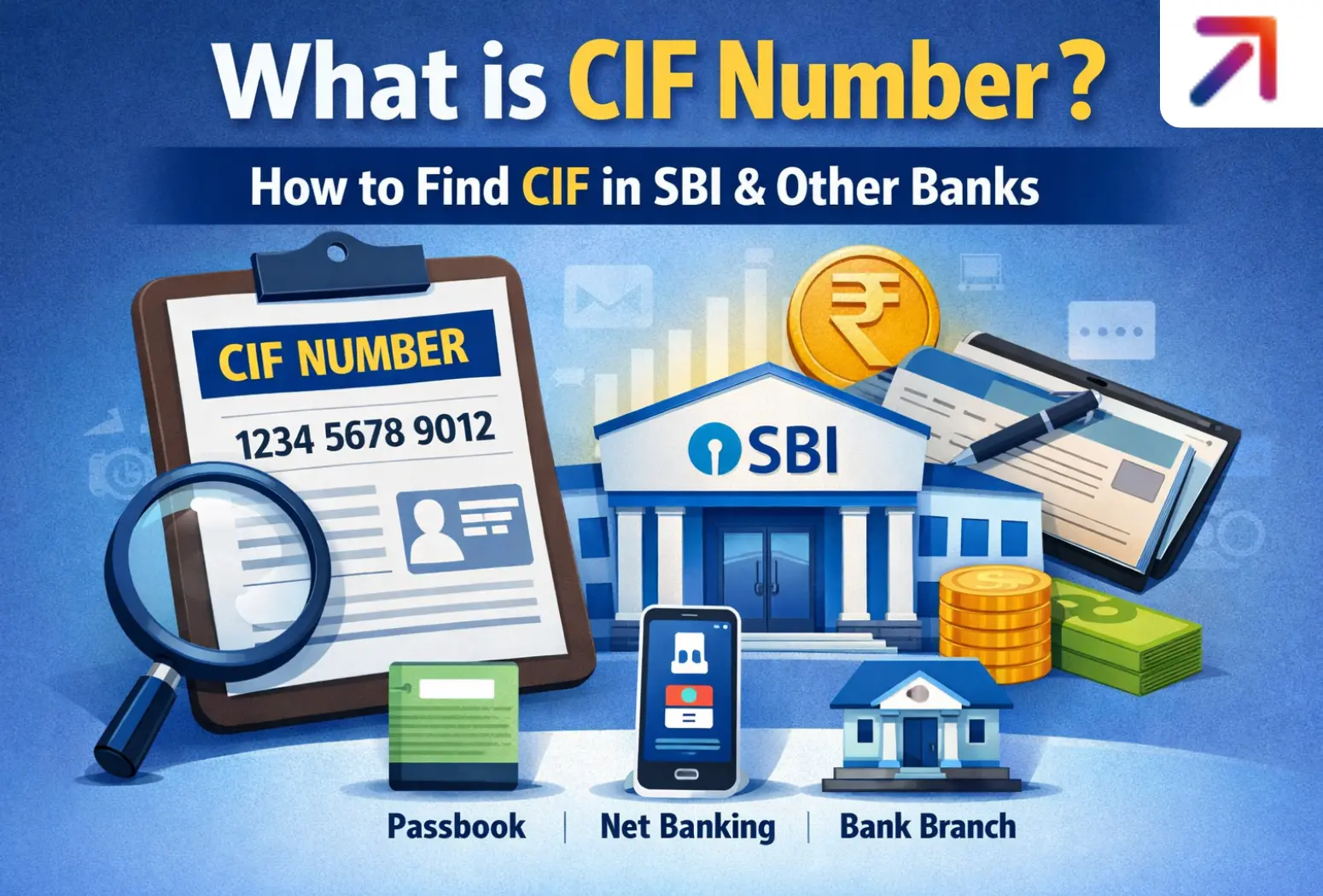
CIF full form is Customer Information File (sometimes you’ll see it called Customer Identification File). It is a unique identifier (usually 8–11 digits depending on the bank) that a bank creates for you, the customer, and links all your accounts and banking relationships (savings, current, fixed deposits, loans, demat, nominee details, KYC documents, etc.) under a single profile.
This makes it easier for the bank to manage your records and offer services tied to your overall relationship, not just one account.
How is CIF Number Assigned by Banks?
Banks create a CIF at account opening to centrally store your customer data.
When you open an account (or multiple accounts) with a bank, the bank creates a digital Customer Information File for you and issues a CIF number. That number is then attached to all products you hold with that bank. The main reasons banks assign a CIF are:
Central Record-Keeping: one place for KYC, addresses, PAN, nominee, and contact details.
Faster Servicing: loans, inward/outward requests, product offers and limits can be processed using your CIF.
Cross-product Linking: the bank can see all your deposits, loans, cards, and investments under one customer profile.
Example: How One CIF Links Multiple Accounts
Raj has a savings account, a recurring deposit (RD), and a fixed deposit (FD) with the same bank. All three accounts will be tied to the same CIF number. The account numbers are different, but the CIF remains identical because it identifies the customer, not the individual accounts.
Importance of CIF Number
The following are some of the most important reasons as why CIF number is important:
KYC and Identity: CIF holds your KYC documents and identity details and banks use it to verify you.
Service Efficiency: It helps customer-care staff pull your complete profile quickly.
Loan & Credit Checks: Banks link loans and credit history to the CIF for underwriting and monitoring.
One Customer: Simplifies linking multiple products under one customer id (useful for consolidated statements, product offers).
How to Find CIF Number?
The following are the three methods through which you can find your CIF number:
Online Methods: Netbanking, mobile apps, e-statements, registered SMS/e-statement.
Netbanking / Internet Banking: Log in → Account/Profile → Account Summary or View Nomination & PAN (menu labels vary). CIF is commonly shown in profile/account summary pages.
Bank mobile app (YONO / iMobile / bank apps): Log in → Services / Profile / Account details → look for CIF or Account Summary.
E-statement or downloaded PDF statement: CIF often appears in the header/first page of e-statements. Request e-statement if needed.
Registered SMS/e-statement requests: Some banks let you send a fixed SMS from your registered number to receive an e-statement, the PDF will show CIF. (Process differs by bank.)
Customer care (phone): Call the bank’s helpline from your registered mobile, complete verification, and request CIF.
Method 2: Offline Ways to Check CIF Number
First page of passbook: CIF is typically printed near account details on the passbook front page.
First page of chequebook: Many banks print CIF on the chequebook’s first leaf.
Printed account statement: Physical statements mailed by banks often include CIF.
Visit the branch with ID: The branch can provide the CIF after verifying identity.
How to Find CIF Number for a Particular Bank
Let us find how you can check CIF number for popular banks like CIF number SBI and other Indian banks.
State Bank of India CIF Number
SBI Netbanking: Log in → My Account → Profile → Account Summary → View Nomination & PAN. CIF shows on that screen.
Passbook / Chequebook: CIF printed on the first page (See image above for reference)
Customer Care: Call SBI helpline 1800 425 3800 from the registered number; after verification, ask for CIF.
Central Bank of India CIF Number
Mobile app / Cent Mobile: App pages and registration screens often show the CIF. You can also check the CIF number on the Central Bank of India official website.
Passbook / Chequebook: check the first page of your passbook or cheque book. (See the image above)
Branch / Customer Service: The branch staff can provide CIF after verification. You can reach them at 1800 3030.
Indian Bank CIF Number
Indian Bank website / CIF forms: Indian Bank provides CIF forms and guidance on its official Indian Bank website.
Passbook / Chequebook / Account statement: CIF is usually printed on the first page. (See the image above)
Call or branch Visit: Customer care/branch can confirm CIF after document verification. You can contact Indian Bank at 1800 1700
Axis Bank: NetBanking profile, account statement, and branch.
Please note that each bank’s labels vary slightly. Search within the app/profile for account details, Profile, Account Summary or Nomination & PAN/
CIF Number vs IFSC vs MICR – Key Differences
There are certain terms that always confuse people when it comes to CIF number, we will clear the confusion once and for all:
CIF (Customer Information File): Identifies the customer. Used internally by the bank to link all products, KYC, loan history, etc. Not used for routing online transfers. The typical format is numeric (8–11 digits, bank dependent).
IFSC (Indian Financial System Code): Identifies the bank branch for electronic fund transfers (NEFT/RTGS/IMPS). Format: 11 alphanumeric characters (e.g., SBIN0000123). This number is available to public and is used for transfers.
MICR (Magnetic Ink Character Recognition): 9-digit code used primarily for cheque clearing; printed in magnetic ink on cheques. It identifies the branch, but for cheque/ECS processing
Quick comparison:
Code
Purpose
Used For
CIF
Identifies customer
Internal banking records
IFSC
Identifies branch
NEFT / RTGS / IMPS
MICR
Identifies branch
Cheque clearing
Risks Associated With CIF Number
CIF is sensitive and should be treated like other banking identifiers. Share only with trusted bank channels and for legitimate reasons. The following are some of the most important points related to the CIF number:
CIF number is linked to your KYC and bank accounts, so in the wrong hands, it could help a fraudster assemble details about you. Do not post your CIF publicly (social media, public forums) or share it with unknown callers.
CIF alone is generally not enough to permit transactions. Banks require multi-factor verification (OTP, registered mobile, ID proofs) before allowing changes or payments. But CIF can make social engineering easier, so keep it private.
You can share your CIF number with your own bank branch, authorised bank staff (after verification), or in secured bank forms/portals when requested.
Always confirm the channel (official app/website/branch phone number) before sharing.
Summary: CIF Number Explained
CIF (Customer Information File) is your bank’s unique customer ID that links all your accounts and KYC. You can find CIF in passbooks, chequebooks, netbanking, mobile apps, e-statements, or from branch/customer care.
For CIF number SBI, use SBI NetBanking, YONO, passbook or call SBI customer care. For central bank of India CIF number and indian bank cif number, check the passbook/chequebook, bank app/website or visit the branch. Treat CIF as sensitive information and share only through official bank channels after verification.
FAQs on CIF Number
Where do I find my CIF number?
On the first page of your passbook or chequebook, in your e-statement, inside netbanking/mobile app profile pages, or by calling/visiting the branch after verification.
Is CIF and IFSC code the same?
No. CIF identifies a customer (your profile). IFSC identifies a bank branch and is used for online fund transfers (NEFT/RTGS/IMPS).
Is CIF number the same as customer ID?
Yes, CIF is the customer identification file number (often called Customer ID in casual terms), though exact labels vary by bank.
What is CIF in SBI?
In SBI, CIF is your unique Customer Information File number (usually 11 digits) that links all your SBI accounts and KYC details. You can see it in SBI NetBanking, YONO, passbook or account statements.
Can someone open an account or transfer money using my CIF only?
No. CIF alone won’t let someone operate your account. Banks require account numbers, OTPs, passwords, and in-branch verification. But CIF can be used to assemble more details, so keep it private.
What if I can’t find my CIF in the app or documents?
Call your bank’s official helpline from your registered mobile number or visit the branch with ID. After verification, they will provide the CIF.
How many digits is a CIF?
It varies by bank (commonly 8–11 digits). SBI commonly uses 11 digits; other banks use different lengths.
Is CIF needed to get loans or change KYC?
Banks use CIF internally during loan processing and while updating KYC. It helps them locate your entire customer record quickly.
Author: Komal Bhatt
Komal Bhatt is a finance content writer at InvestKraft, specialising in well-researched articles on financial products, stock markets, and investment opportunities, with a particular focus on unlisted shares.
She holds a Master’s degree in Commerce from the University of Delhi, which gives her a solid academic foundation in finance and business. With over three years of hands-on experience in creating digital finance content, Komal has developed a clear understanding of investor needs through her work on wealth management, NISM certification programs, and market education materials.
Komal is passionate when it comes to breaking down complex financial concepts into simple, accurate and actionable insights. Her goal is to help everyday investors understand markets better and make more informed decisions based on reliable, research-backed information.


 care@investkraft.com
 +91-9599071040
 +91-9797971876

 What is CIF Number in Banking?










.webp)


