Want to know a risk-free investment option with a high monthly return? Then we strongly recommend that you read this blog till the end. Let us first understand what POMIS or Post Office Monthly Income Scheme is, and then we will explain the details.
What is Post Office Monthly Income Scheme (POMIS)?
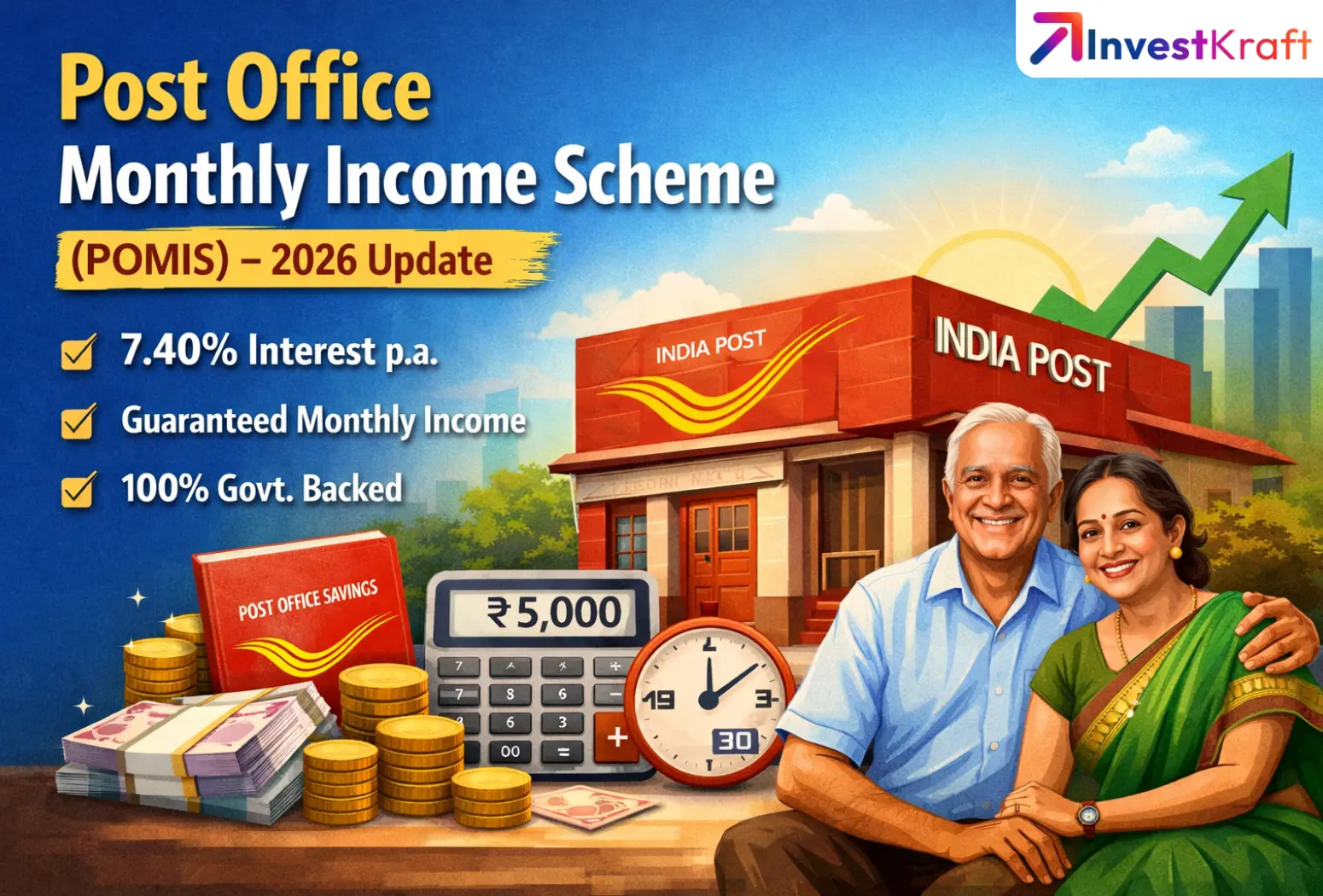
The Post Office Monthly Income Scheme (POMIS) is one of the most popular government-backed monthly income schemes in India. It offers guaranteed monthly interest, zero market risk, and stable returns, making it ideal for retirees, senior citizens, and conservative investors.
In this article, we explain the POMIS interest rate for 2026, eligibility, monthly income calculation, tax rules, benefits, and how to apply, with simple examples.
POMIS Interest Rate & Key Details (January 2026)
The following is the summary of the Post Office Monthly Income Scheme as of January 2026:
Parameter
POMIS Details (January 2026)
Scheme Name
Post Office Monthly Income Scheme (POMIS)
Type of Scheme
Government-backed monthly income savings scheme
Tenure / Lock-in Period
5 years
Interest Rate
7.40% per annum
Interest Payout
Monthly
Interest Calculation
Calculated yearly, paid every month
Minimum Investment
₹1,000
Investment Multiples
In multiples of ₹1,000
Maximum Investment – Single Account
₹9 lakh
Maximum Investment – Joint Account
₹15 lakh
Number of Account Holders
Single or Joint (up to 3 adults)
Eligibility
Resident Indian individuals
Minor Eligibility
Minor aged 10 years or above
Guardian Account
Allowed for a minor or person of unsound mind
NRIs Allowed
Not allowed
Tax Benefit (80C)
No tax deduction
Tax on Interest
Interest is taxable
TDS on Interest
No TDS deducted
Premature Withdrawal
Allowed after 1 year
Penalty (1–3 years)
2% of deposit
Penalty (3–5 years)
1% of deposit
Extension Facility
Not allowed
Reinvestment After Maturity
Allowed by opening a new MIS account
Nomination Facility
Available
Mode of Interest Payment
Cash, Cheque, or Auto-credit to PO Savings Account
Online Account Opening
Yes (via India Post e-Banking), but the submission needs to be done physically at post office)
Note: Please note that the above information is as of January 2026. Kindly check the official website of India Post to get the latest information.
Let us understand some of the important features of post office monthly scheme in detail:
Post Office Monthly Income Scheme Payout
You deposit a lump sum (minimum ₹1,000, in multiples of ₹1,000), and the Post Office pays out interest at 7.40% p.a. at the end of each month.
For example, ₹1,00,000 yields about ₹617 per month (1,00,000×0.074/12). If you don’t collect a month’s interest, it does not earn extra interest later.
Deposit Limits
The minimum opening deposit is ₹1,000. The maximum is ₹9 lakh for a single account and ₹15 lakh for a joint account. (Any excess amount above these caps must be refunded by the post office; only the allowed maximum earns MIS interest.) Multiple POMIS accounts are allowed as long as your combined deposits respect these caps.
Interest Payout
Interest is paid monthly, usually on the last day of the month. If that day is a Sunday or a bank holiday, the interest payment is credited on the previous working day. You can collect interest in cash at the post office or choose auto-credit: have it deposited to your linked Savings Bank account via ECS (Electronic Clearing Service).
For post offices on Core Banking, it can go to any CBS post office SB account.) Interest earned is fully taxable as “income from other sources”.
Eligibility Criteria for POMIS
POMIS is available to resident Indians. The following are the key eligibility criteria:
Any adult individual, or jointly up to 3 adults. NRIs are not eligible.
Minor accounts: A minor aged 10 or above may open an account in their own name. Alternatively, a natural guardian (father/mother) or a legal guardian can open an account on behalf of a minor or a person of unsound mind. Joint accounts among adults are also allowed. If a minor operates the account, the minor’s photo/signature is taken.
Guardian accounts: If a guardian opens the account for a minor or person of unsound mind, updated KYC rules require the guardian’s photo and signature on the account. Likewise, if a minor operates the account, the minor’s photo/signature is taken. (These are standard KYC norms.
Age & Citizenship: You must be a resident Indian (citizenship proof needed). No age limit for adults; minors below 10 cannot open an MIS account even via a guardian.
In summary, single, joint (up to 3 people), or minor accounts (with a guardian) are allowed, subject to the deposit limits.
For reference, official guidelines state: “A guardian is permitted to open an account on behalf of a minor or a person of unsound mind. Minors aged 10 years and above have the eligibility to open an account in their own name”.
Features & Benefits of Post Office MIS
The following are the features and benefits of the post office monthly income scheme:
Guaranteed Monthly Income: You get a fixed interest each month, providing a reliable cash flow. (Interest is paid one month after deposit.) Unlike market-linked schemes, POMIS income is assured by the Govt of India.
Zero Risk: Your principal is 100% government-guaranteed. POMIS is operated by India Post under the Ministry of Finance, making it a very low-risk option.
Easy Operations: Open and manage POMIS at any post office branch. The process is simple (see next section). You can have multiple POMIS accounts (within deposit limits) to diversify. A nominee can be appointed to claim the funds if something happens to you. (Nominees can be updated later, too.)
Flexible Interest Collection: Collect interest in cash at the counter OR link it to your Post Office Savings Account and get monthly credits automatically. This means you can have the money directly in your bank account each month.
Reinvestment option: At maturity (5 years), you get back your principal plus the last month’s interest. You can then reinvest the entire corpus in a new 5-year MIS account if you wish. There’s no automatic extension, but opening a fresh MIS is straightforward.
Nomination facility: You can nominate a beneficiary (family member) for easy claims upon the investor’s death. (Nominees can be added or changed as needed.)
Overall, POMIS is popular for its stability and simplicity. It provides an assured monthly payout (7.40% p.a. currently) while keeping your money safe with the sovereign.
Perfect. Below are two clean, website-ready tables you can directly use on InvestKraft.
POMIS Monthly Income Calculator (₹3,000 – ₹10,000 Examples)
Interest is calculated annually and paid monthly. We will use the interest rate as 7.40% as of January 2026.
Formula used: Monthly Income = (Investment × 7.40%) ÷ 12
Target Monthly Income
Approx. Investment Required
Annual Interest Earned
₹3,000 per month
₹4.85 - ₹5.00 lakh
Approximately ₹36,000
₹5,000 per month
₹8.00 - ₹8.20 lakh
Approximately ₹60,000
₹10,000 per month
Not possible in a single POMIS
-
Important Notes:
Maximum investment in a single POMIS account is ₹9 lakh
Even at ₹9 lakh, the monthly income is approx ₹5,550
To reach a higher income, investors usually combine a joint POMIS with other schemes
Now, let us compare POMIS with other popular investment options in India like Fixed Deposit and Senior Citizen Savings Scheme.
Post Office Timings
Post Office Timings in India can vary depending on the branch, but most regular post offices (like Head Post Offices or Sub Post Offices) follow standard hours: 9:00 AM to 5:00 PM on weekdays (Monday to Friday), with some starting as early as 8:00 AM and closing around 4:00 PM or later.
Saturdays are usually half-day or similar timings (often till 2:00 PM or 4:00 PM), and most are closed on Sundays and public holidays.
Big update in Post Office Timings
India Post has rolled out 24/7 operations at select branches across the country for urgent mails, parcels, and Speed Post/booking services. This means some post offices (check your local one via the India Post app/site or locator) are now open round-the-clock to make things easier for everyone.
In Delhi, timings might lean toward the standard 9 AM–5 PM range, but extended or 24x7 services are coming soon.
Always double-check your nearest branch because it can differ by location, type (urban vs rural), or specific services like financial transactions (often limited to core hours, say 10 AM–4 PM). If you're heading out soon, give a quick call to the post office customer care number 1800 266 6868 for exact details.
Comparison Table: Post Office Monthly Income Scheme vs Fixed Deposit vs Senior Citizen Savings Scheme
The following table compares some of the most popular investment schemes in India with the Post Office Monthly Income Scheme:
Feature
Post Office Monthly Income Scheme (POMIS)
Bank Fixed Deposit (FD)
Senior Citizen Savings Scheme (SCSS)
Issuer
Government of India (Post Office)
Banks / NBFCs
Government of India
Interest Rate (2026)
7.40% p.a.
6.5% - 8.0% (varies by bank)
8.20% p.a.
Income Frequency
Monthly
Monthly / Quarterly / Cumulative
Quarterly
Tenure
5 years
1-10 years (flexible)
5 years
Minimum Investment
₹1000
₹1000 - ₹10,000
₹1000
Maximum Investment
₹9 lakh (single)₹15 lakh (joint)
No fixed limit (bank-specific)
₹30 lakh
Eligibility
Resident Indians
Resident Indians
Only senior citizens (60+)
Risk Level
Very Low (Govt-backed)
Low–Moderate (bank dependent)
Very Low (Govt-backed)
Premature Withdrawal
After 1 year (with penalty)
Allowed (penalty varies)
Allowed (penalty applies)
Tax Benefit under 80C
No
No
Yes
Tax on Interest
Taxable
Taxable
Taxable
TDS on Interest
No TDS
TDS applicable
No TDS
Best Suited For
Monthly income seekers
Flexible investors
Retired / senior citizens
Which One Should You Choose? (Quick Guidance)
Choose POMIS if you want a fixed monthly income, zero risk, and government safety.
Choose FD if you want flexibility, liquidity, or short-term parking of money.
Choose SCSS if you are a senior citizen and want a higher interest with tax benefits.
How to Apply for Post Office Monthly Income Scheme (Step-by-Step)
There are two ways by which you can apply for the Post Office Monthly Income Scheme - offline and online. Let us look at both the methods in detail:
Offline (At a Post Office Branch)
Have a Savings Account: First, you must have (or open) a Post Office Savings Bank Account. It’s mandatory for any new POMIS. If you don’t have one, visit the post office to open a regular savings account.
Get the Form: At the post office, ask for the POMIS account opening form (often called Form A for POMIS).
Fill and Attach Documents: Complete the form and attach required KYC documents: proof of identity (Aadhaar, PAN, Voter ID, etc.), proof of address (utility bill, etc.), and two recent passport-size photos. If opening as a guardian, you’ll also give the minor’s details and provide your (guardian’s) photo. Get a nominee/witness signature on the form as required.
Initial Deposit: Deposit at least ₹1,000 (and multiples of ₹1,000 thereafter). You can pay in cash or by cheque. (If paying by cheque, the date on the cheque is considered the account’s opening date for interest purposes.)
Submit & Confirm: Hand over the form, documents, and deposit to the Postmaster. They will process it and give you a POMIS passbook or receipt. Interest starts accruing from the deposit date.
That’s it! Once opened, you can collect monthly interest or have it credited to your linked savings account.
Online (Via India Post e-Banking Portal)
India Post now offers an e-banking service for small savings. To open online:
First, you need to make sure that you have an active Post Office Savings Account with KYC done. You need to fill MIS account opening form.
Please note that you can also download the MIS account opening form and KYC form here.
Visit the official India Post e-Banking website and log in with your PO savings account credentials. (You may need to register first using your SB account number and mobile number.)
Under the menu “General Services” → “Service Request”, select MIS Account Opening (or Small Savings Scheme application). Fill in the MIS application form online and upload the scanned KYC documents (ID proof, photo, PAN, etc.).
Specify nominee details and deposit amount. The system may allow you to transfer funds from your savings account to fund the MIS.
Submit the application. You will get an application number. The post office will verify and open your account.
Note: The exact steps on the portal may vary; if needed, contact your post office or visit the e-banking help section.
Using the India Post e-banking portal lets you open a POMIS without paperwork or queueing. But remember: you still need a linked post office savings account first.
Terms & Conditions of POMIS
The following are some of the important terms and conditions you must know before opening your monthly income account at India Post:
Lock-in period: 5 years from the opening date. You cannot close or withdraw within the first 12 months at all.
Premature withdrawal: Allowed after 1 year, with a small penalty. According to current rules:
If you close after 1 year but before 3 years, a penalty of 2% of the principal is deducted.
If you close after 3 years but before 5 years, the penalty is 1% of the principal.
If you close exactly at 5 years (maturity), there’s no penalty; you receive the full principal plus final interest.
Early Closing: Submit a prescribed withdrawal form (often Form C or Form 2) along with the passbook to your post office. The amount (minus penalty, if any) will be paid in cash or credited to your linked SB account.
On maturity (5 years): Your original deposit is paid back with the last month’s interest. Example: If you invested ₹5 lakh, you’d get ₹5.37 lakh after 5 years (since 5L + 5L×7.4%×5 yrs). If you forget to withdraw, the money stays in the account and will then earn Post Office Savings Account interest (currently ~4%) for up to 2 more years. So withdraw or re-invest timely to avoid extra hassle.
Extension: POMIS cannot be “extended” in place. To continue, you must open a new 5-year MIS account upon maturity (reinvest the corpus). This is straightforward – just apply again with Form A or online.
Excess deposit interest: If you accidentally deposit more than the allowed maximum, the post office will refund the extra. The refunded portion earns only the Savings Account rate (not MIS rate) from deposit date till refund.
Cheque deposits: If you fund via post-dated cheque, the cheque date is taken as the account opening date for interest calculation.
Nomination: You can nominate one or more persons for your account. This is a key feature: in case of your death, nominees can claim the amount with minimal paperwork. (Nominee details can be updated even after account opening.)
In all cases, ensure you collect the final interest along with principal at closure. Note that no TDS is deducted from POMIS (though interest is fully taxable, you must declare it).
Additional Notes
KYC for Minors: When a minor (10+) opens an MIS, it’s under a guardian’s guidance. Once the minor turns 18, they must convert the account to a self-held account. This requires submitting a new application form with adult KYC at the post office.
Interest Rounding: Monthly interest is calculated on the deposit and rounded to the nearest rupee. So you get a whole rupee amount each month.
Holiday payouts: If the interest date falls on a Sunday or a post office holiday, the payment is credited on the previous working day, as per postal rules.
Nomination Rule Update: As per recent KYC norms, a guardian’s photo is now mandatory on minor accounts. This helps prevent fraud and simplifies nominee claims.
Sources: Official scheme circulars and reputable finance publications. (Rates and rules as of 2026.)
Frequently Asked Questions (FAQs)
What is Post Office Monthly Income Scheme?
Post Office Monthly Income Scheme (POMIS) or Post Office MIS Scheme is a monthly income scheme that gives guaranteed returns at 7.40% per annum interest, paid monthly. You can check the details on the official website of India Post or on the Indian Post Office App.
Which is the best monthly income scheme in the post office?
The Post Office Monthly Income Scheme (POMIS) is the best monthly income scheme in the post office for guaranteed returns, as it offers 7.40% per annum interest paid monthly. Other post office schemes pay quarterly or yearly, but for pure monthly income, POMIS is the most suitable option.
How can I get ₹5,000 interest every month from the post office monthly income scheme?
To earn ₹5,000 monthly income from the Post Office Monthly Income Scheme (POMIS), you need to invest around ₹8–8.5 lakh. At 7.40% annual interest, a deposit of approximately ₹8.1 lakh generates about ₹5,000 per month, which is within the POMIS investment limit of ₹9 lakh.
Which bank gives 9.5% interest on fixed deposits compared to Post Office MIS?
Currently, no major bank offers 9.5% interest on fixed deposits. Most bank FDs offer 6.5%–8% interest, whereas the Post Office Monthly Income Scheme (POMIS) continues to offer 7.40% with government backing, making it a safer alternative for monthly income seekers.
Can I open multiple Post Office Monthly Income Scheme (POMIS) accounts?
Yes, you can open multiple Post Office Monthly Income Scheme (POMIS) accounts, but the total investment across all POMIS accounts must not exceed ₹9 lakh for single accounts or ₹15 lakh for joint accounts.
Is nomination allowed in the Post Office Monthly Income Scheme, and can it be changed later?
Yes, nomination is allowed in the Post Office Monthly Income Scheme (POMIS). Nominee details can be added at the time of account opening or changed later by submitting the prescribed form at the post office.
What happens to my Post Office Monthly Income Scheme if I move to another city?
If you move cities, your Post Office Monthly Income Scheme (POMIS) account can be transferred to another post office by submitting a transfer request. Your investment and monthly income remain uninterrupted.
Is the Post Office Monthly Income Scheme suitable for senior citizens?
Yes, the Post Office Monthly Income Scheme (POMIS) is highly suitable for senior citizens, as it provides a stable monthly income with zero market risk. Many seniors also combine POMIS with SCSS for a higher overall income.
Author: Diwakar Kumar Singh
Diwakar Kumar Singh is a BFSI specialist and finance writer with over 7 years of hands-on experience in financial research, content creation, and analysis.
A Gold Medalist in MBA (Marketing) from IMT, he combines deep analytical skills with practical insights gained from evaluating companies, IPOs, unlisted shares, financial ratios, and investment opportunities. Diwakar has personally analysed hundreds of financial instruments and market scenarios, which he uses to break down complex topics into clear, actionable advice.
He has authored numerous in-depth finance articles, published multiple books internationally, and contributed to research publications. His work focuses on helping everyday investors and readers make better-informed financial decisions through well-researched, evidence-based explanations that are always grounded in real-world application rather than theory alone.


 care@investkraft.com
 +91-9599071040
 +91-9797971876

 What is Post Office Monthly Income Scheme (POMIS)?