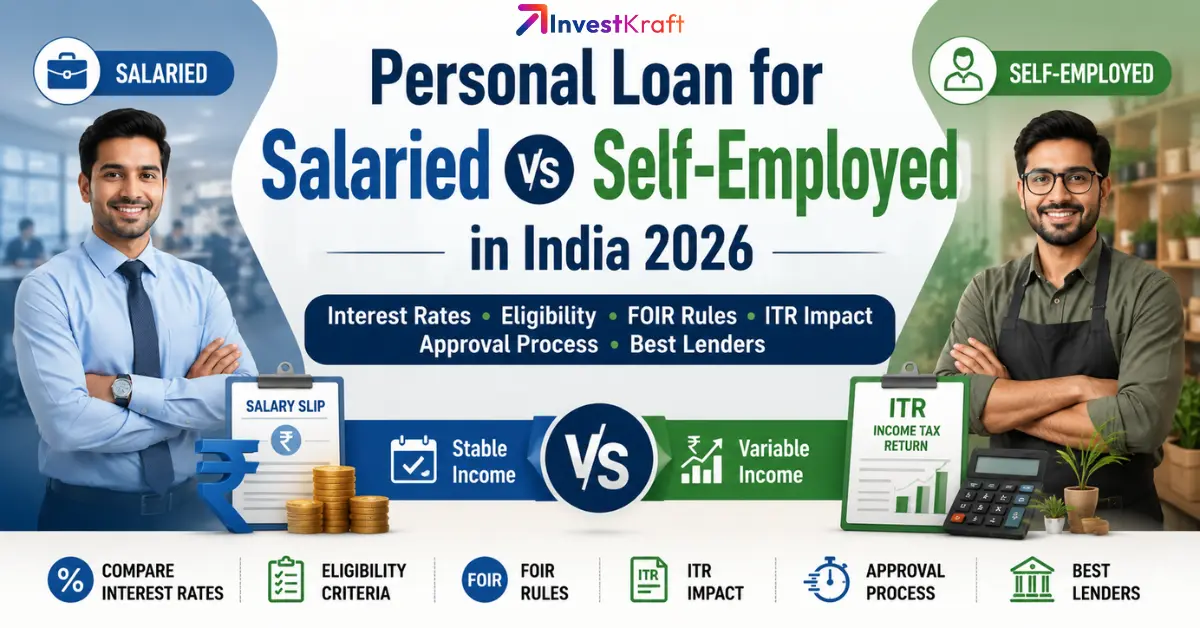
Same bank. Same loan amount. Same CIBIL score of 760. Same monthly income of ₹1.5 lakh.
One person gets a personal loan at 12.5% per annum. The other gets 16% to 18%.
The only difference? One is salaried. The other runs their own business.
The gap is real, it is significant, and it is not going away anytime soon. Understanding why this gap exists is the first step to narrowing it.
Let us understand what the major differences are and how to reduce the gap. Before we begin, let us see some of the major highlights of salaried vs self-employed loans in 2026.
Latest Highlights: Salaried vs Self-Employed Loans in 2026
The following are the latest updates for salaried vs self-employed loans:
The Core Reason for the Gap: How Banks Think
Banks always see the risk. Salaried income is predictable - the same amount hits the same account on the same date every month. Banks can verify it easily with 3 months of salary slips and a bank statement. Self-employed income is variable. A business that is profitable today may have a slow quarter tomorrow.
Lenders usually offer preferential interest rates to salaried individuals as compared to self-employed applicants due to the former's higher income security.
Within salaried applicants, government and PSU employees are offered lower interest rates than private sector employees due to the former's higher job security.
This single difference in income predictability drives every downstream difference in rates, documentation, approval speed, and loan amounts.
Differences in Salaried vs Self-Employed Personal Loan in 2026
Now, let us understand the differences from the following table:
Interest Rate Comparison
Personal loan interest rates in 2026 typically range from 9.98% to 44% per annum. While government-sector banks offer lower rates (SBI 11.15%+, HDFC 10.50%+), NBFCs and fintech lenders may charge higher interest rates at 15% to 44%, depending on the applicant's credit profile.
Lender
Salaried Rate
Self-Employed Rate
HDFC Bank
From 9.99%
From 10.75%
ICICI Bank
From 9.99%
From 10.75%
Kotak Mahindra Bank
From 9.99%
From 11.00%
SBI Xpress Credit
10.00% to 15.05%
N/A (salary product)
Axis Bank
9.99% to 22%
From 11.50%
Bajaj Finserv
From 11%
From 12% to 14%
NBFCs / Fintech
12% to 28.5%
15% to 36%
The EMI impact of this gap: The self-employed borrower pays ₹25,884 more in interest over the loan tenure on a comparable loan. On larger amounts, this gap widens significantly.
Documents Required: Salaried vs Self-Employed
Getting your documents right is the biggest controllable factor in approval speed and rate for both categories.
Salaried Employees
Aadhaar Card and PAN Card
Last 3 months' salary slips
Last 6 months' bank statements (salary account)
Form 16 for the last 1 to 2 years
Employee ID or appointment letter
Self-Employed Individuals and Business Owners
Aadhaar Card and PAN Card
ITR for last 2 to 3 years (mandatory - and CA-certified)
Profit and Loss statement
Balance Sheet for the last 2 to 3 years
Last 6 months' business bank account statements
Business registration proof (GST certificate, Shop Act licence, or Udyam certificate)
Professional qualification certificate (for doctors, CAs, architects - their own category)
Key difference in processing
Salaried applications go through automated underwriting - the algorithm checks salary credits, CIBIL score, and employer category in minutes. Self-employed applications require manual underwriting - a credit analyst reviews business financials, ITR trends, and cash flow patterns. This takes 3 to 7 days.
The ITR Trap That Many Self-Employed Borrowers Fall Into
This is the single most important warning for self-employed borrowers:
If your ITR shows lower income than your actual income because of tax planning, your loan eligibility and rate will be based on the ITR income. This catches many self-employed borrowers off guard - showing ₹8 lakh in ITR to save tax means the bank treats you as a ₹8 lakh annual income borrower, regardless of what you actually earn.
A self-employed professional earning ₹18 lakh per year but reporting ₹9 lakh in ITR after deductions will be assessed on ₹9 lakh - cutting their eligible loan amount roughly in half and placing them in a higher-risk bracket.
The fix: There is no quick workaround. This takes 2 to 3 years of consistently filing ITR with realistically declared income. It is the most impactful long-term strategy for self-employed borrowers who want competitive loan rates.
FOIR Calculation: How It Differs for Each Category
FOIR (Fixed Obligation to Income Ratio) determines how much of your income is already committed to existing EMIs - and therefore how much new EMI the lender will allow.
For salaried borrowers: Income used = Net monthly take-home salary (salary credits in bank statement). Maximum FOIR allowed = 50% to 55% of net monthly income. Simple, verifiable, automated
For self-employed borrowers: Income used = Average monthly net income derived from ITR (annual ITR figure ÷ 12). Business expenses, depreciation, and tax planning deductions reduce this figure. Maximum FOIR = 40% to 50% (stricter, because income is already seen as variable)
CIBIL Score: Same Minimum, Different Impact
Both categories require a minimum CIBIL score of 700, with 750+ recommended for the best rates. But the score plays a more powerful compensating role for self-employed borrowers.
Self-employed applicants may face slightly higher rates unless they can prove consistent profitability and business vintage.
More than 25% of salaried borrowers have an excellent credit score of 770 and above, while only 14% of self-employed consumers have such strong credit score profiles.
For a self-employed borrower with a 780+ CIBIL score, 3+ years of clean ITR, and stable bank statements, several lenders will match or come very close to salaried rates. The score compensates for the inherent income variability.
For a self-employed borrower with a 680 score, options are essentially limited to NBFCs at 14% to 20%+.
Which Lenders Are Best for Self-Employed Borrowers?
Self-employed borrowers may still get good eligibility if their income is stable and their credit score is strong. Banks are more flexible with dedicated self-employed products.
Lender
Why is Good for Self-Employed
Bajaj Finserv
Dedicated self-employed product; accepts GST-based income
HDFC Bank
Self-employed professional category at near-salaried rates
ICICI Bank
Strong NBFC self-employed underwriting experience
IDFC FIRST Bank
More flexible income assessment for business owners
NBFCs (Tata Capital, Poonawalla)
More flexible documentation; accept 2-year ITR
Tips on How Self-Employed Borrowers Can Close the Rate Gap
If you are self-employed, then the following tips can help you get the lowest interest rates for a personal loan:
File ITR consistently - and accurately: Three years of ITRs showing stable or growing income is the single most powerful credibility builder for any self-employed borrower.
Use a business bank account: Keep personal and business transactions separate. A clean, high-volume business account statement demonstrates cash flow better than a mixed personal account.
Register your business (GST, Udyam, or Trade Licence): Formal registration converts you from an "informal earner" to a documented business entity, which most lenders treat significantly more favourably.
Build your CIBIL score to 750+. At this score, the premium for being self-employed shrinks considerably. Pay all existing obligations on time, reduce credit card utilisation below 30%, and avoid multiple loan applications simultaneously.
Approach your primary banker first: If you have a long-standing current account with healthy balances at a bank, that bank has seen your financial behaviour for years. Use this relationship - relationship managers have discretion on rate pricing for known customers.
Summary
The fundamental difference lies in the predictability of income. Lenders perceive salaried employees as lower-risk borrowers due to their steady monthly income, whilst self-employed individuals face additional scrutiny because of fluctuating business revenues.
Here is the complete recap:
Interest rate gap: 2% to 3% - same CIBIL score, same income, different rate.
Approval speed: Hours for salaried; 3 to 7 days for self-employed.
Key document difference: Salary slips for salaried vs 2 to 3 years ITR for self-employed.
FOIR calculation: Both capped at 40% to 55% of income - but income is assessed differently.
The ITR trap: Under-reporting income for tax purposes directly reduces your loan eligibility and worsens your rate.
Closing the gap: 750+ CIBIL, 3 years clean ITR, GST registration, and primary bank relationship.
Neither profile is disqualified - but understanding the lens through which your lender sees your application is the most powerful tool you have.
Recommended Articles from InvestKraft;
Explore more expert guides, tips, and insights to make smarter financial decisions
Is it harder to get a personal loan if you are self-employed?
Yes - not impossible, but harder; lenders require more documentation, take longer to process, and typically charge 2% to 3% higher interest rates than for salaried applicants with equivalent profiles.
Can I get a personal loan if I am self-employed?
Yes - self-employed applicants, including business owners, freelancers, and professionals, are eligible, but require 2 to 3 years of business vintage, a minimum annual income of ₹2 to ₹2.5 lakh ITR-based, and a good CIBIL score.
What is the difference between a salary loan and a personal loan?
A salary loan (like SBI Xpress Credit or HDFC salary-based loan) is a personal loan specifically designed for salaried employees - often with pre-approval based on salary credits; a standard personal loan is available to both salaried and self-employed borrowers with different eligibility criteria for each.
How much personal loan can I get on a ₹70,000 salary?
With a net monthly salary of ₹70,000, no existing EMIs, and a CIBIL score of 750+, you are typically eligible for ₹18 to ₹28 lakh from leading banks - use InvestKraft's free EMI calculator for your exact figure.
Why do self-employed borrowers get higher interest rates?
Salaried income is predictable - the same amount hits the same account on the same date every month; self-employed income is variable, and a business that is profitable today may have a slow quarter tomorrow - this uncertainty is the direct cause of the rate premium.
What documents does a self-employed person need for a personal loan?
ITR for last 2 to 3 years (CA-certified), P&L statement and balance sheet, last 6 months' business bank account statements, GST certificate or business registration proof, Aadhaar, and PAN - all are typically required.
Which is the best bank for a self-employed personal loan in India in 2026?
Bajaj Finserv, HDFC Bank, ICICI Bank, and IDFC FIRST Bank consistently offer the most accessible personal loan products for self-employed borrowers with dedicated underwriting processes and competitive rates for strong profiles.
Sources
Airtel Finance - Personal Loan for Salaried vs Self-Employed (April 3, 2026): airtel.in/blog/personal-loan/personal-loan-for-salaried-vs-self-employed
Paisabazaar - Personal Loan Interest Rates (May 2026): paisabazaar.com/personal-loan/interest-rates
Paisabazaar - Personal Loan Overview (1 week ago, May 2026): paisabazaar.com/personal-loan
BankBazaar - Personal Loan Interest Rates (May 2026): bankbazaar.com/personal-loan-interest-rate.html
Business Standard - Lenders Prefer Salaried Individuals for Personal Loans: business-standard.com
RBI - Personal Loan Disbursement Data 2024–25: rbi.org.in
Disclaimer: Interest rates and eligibility criteria are as of May 2026 and vary by lender and individual profile. This article is for informational purposes only and does not constitute financial advice.
Author: Diwakar Kumar Singh
Diwakar Kumar Singh is a BFSI specialist and finance writer with over 7 years of hands-on experience in financial research, content creation, and analysis.
A Gold Medalist in MBA (Marketing) from IMT, he combines deep analytical skills with practical insights gained from evaluating companies, IPOs, unlisted shares, financial ratios, and investment opportunities. Diwakar has personally analysed hundreds of financial instruments and market scenarios, which he uses to break down complex topics into clear, actionable advice.
He has authored numerous in-depth finance articles, published multiple books internationally, and contributed to research publications. His work focuses on helping everyday investors and readers make better-informed financial decisions through well-researched, evidence-based explanations that are always grounded in real-world application rather than theory alone.


 care@investkraft.com
 +91-9599071040
 +91-9797971876