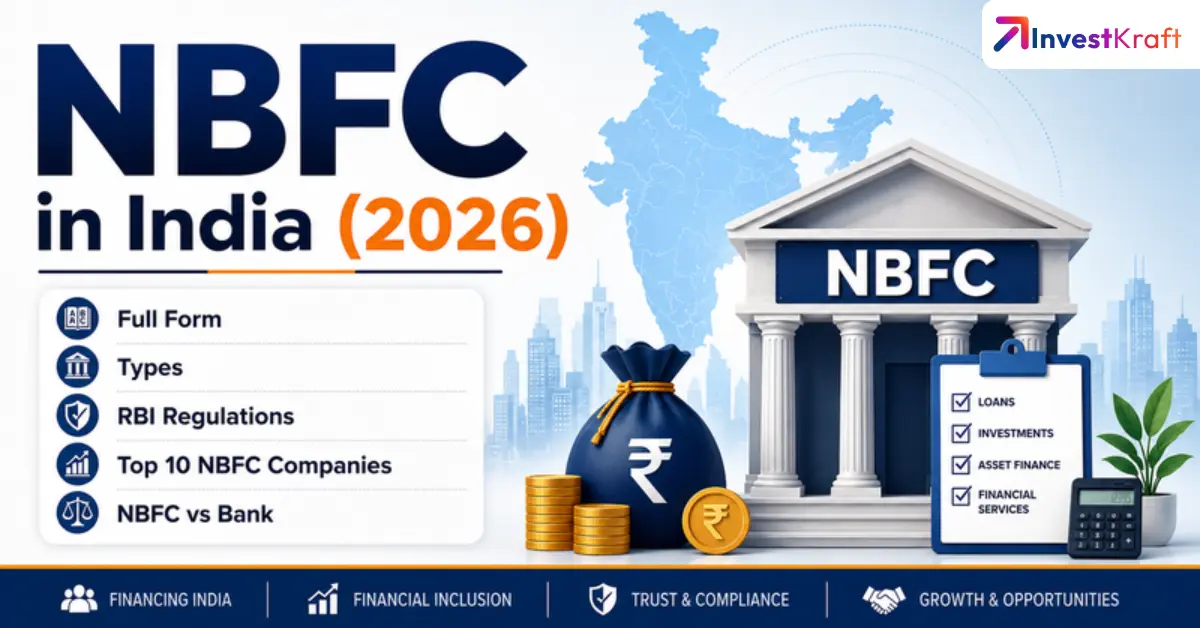
India's financial ecosystem extends far beyond traditional banks. While banks remain the primary source of deposits and lending, Non-Banking Financial Companies (NBFCs) have become an essential pillar of the country's financial system. From personal loans and home loans to vehicle finance, gold loans, MSME funding, and microfinance, NBFCs help bridge the credit gap for millions of individuals and businesses who may not have easy access to conventional banking services.
Over the past decade, NBFCs have played a crucial role in promoting financial inclusion, particularly in semi-urban and rural India. Their faster loan approval process, flexible eligibility criteria, and digital-first approach have made them an attractive choice for borrowers.
However, many people still have common questions such as:
What is an NBFC?
What is the full form of NBFC?
Is an NBFC a bank?
How are NBFCs regulated by the RBI?
Which are the top NBFC companies in India?
How can you verify whether an NBFC is RBI-registered?
This comprehensive guide answers these questions while explaining the different types of NBFCs, their role in India's economy, how they differ from banks, and how to choose a trusted NBFC for your financial needs.
What is an NBFC?
NBFC stands for Non-Banking Financial Company. It is a financial institution registered under the Companies Act, 2013 that provides various financial services similar to banks but does not hold a banking licence.
In simple terms, an NBFC lends money, finances vehicles, provides home loans, offers gold loans, finances businesses, invests in securities, leases assets, and delivers several other financial services. However, unlike banks, most NBFCs cannot accept demand deposits such as savings accounts or current accounts, nor can they issue cheques drawn on themselves.
The Reserve Bank of India (RBI) regulates NBFCs under the Reserve Bank of India Act, 1934, ensuring that these institutions comply with prudential norms, governance standards, capital adequacy requirements, and customer protection guidelines.
Today, NBFCs contribute significantly to India's credit ecosystem by serving customer segments that are often underserved by traditional banks, including:
First-time borrowers
Self-employed professionals
Small businesses and MSMEs
Rural borrowers
Individuals with limited credit history
Customers seeking quicker loan approvals
As India's digital lending market continues to grow, NBFCs are increasingly partnering with fintech companies to offer faster, paperless, and technology-driven financial solutions.
NBFC Full Form
The full form of NBFC is Non-Banking Financial Company.
An NBFC is a company engaged in financial activities such as:
Lending
Investment
Asset financing
Housing finance
Vehicle finance
Gold loans
Microfinance
Infrastructure finance
Although NBFCs perform many functions similar to banks, they are legally different because they do not operate as licensed banks.
NBFC Meaning in Simple Words
A simple way to understand an NBFC is:
An NBFC is a financial company that lends money and provides financial services without being a traditional bank.
Many well-known financial institutions in India operate as NBFCs and have built strong reputations for offering specialized lending products tailored to different customer needs.
Why Are NBFCs Important in India?
India has one of the world's fastest-growing credit markets. However, many individuals and businesses face challenges in obtaining loans from banks due to strict documentation requirements, limited credit history, or geographic constraints.
This is where NBFCs play an important role.
They help extend credit to sectors that may not always be adequately served by banks, supporting entrepreneurship, consumption, housing, transportation, agriculture, and small business growth.
Some of the major reasons why NBFCs are important include:
1. Faster Loan Processing
Most NBFCs have digital application processes that allow quicker loan approvals compared to traditional banks.
2. Better Financial Inclusion
NBFCs reach underserved regions and customer groups, helping improve access to formal financial services.
3. Flexible Eligibility Criteria
Many NBFCs assess borrowers using alternative credit evaluation methods, making loans more accessible to self-employed individuals, freelancers, and small business owners.
4. Specialized Loan Products
Unlike banks that often offer standardized lending products, NBFCs frequently design products for specific customer segments, such as:
Gold loans
Used vehicle finance
Consumer durable loans
MSME loans
Education loans
Loan against property
5. Supporting India's Economic Growth
NBFCs contribute significantly to sectors such as infrastructure, housing, transportation, agriculture, and small businesses, making them an important component of India's financial system.
Key Features of NBFCs
Understanding the characteristics of NBFCs helps borrowers differentiate them from traditional banks.
Feature
NBFC
Regulated by RBI
Yes
Can provide loans
Yes
Can invest in securities
Yes
Can finance vehicles and equipment
Yes
Can provide housing finance
Yes
Savings account facility
No
Current account facility
No
Cheque issuance
No
Payment settlement system
No
Banking licence
No
Although NBFCs do not function as banks, they play a complementary role by improving access to credit across different segments of the economy.
Types of NBFCs in India 2026
The Reserve Bank of India classifies NBFCs based on the nature of their activities. Each type focuses on serving specific financial requirements.
1. Investment and Credit Company (NBFC-ICC)
Investment and Credit Companies are among the most common types of NBFCs. They provide a wide range of lending and investment services, including:
Personal loans
Business loans
Vehicle loans
Consumer finance
Working capital finance
Many leading NBFCs in India fall under this category.
These institutions play an important role in improving home ownership across India.
3. Infrastructure Finance Company (IFC)
Infrastructure Finance Companies focus on financing long-term infrastructure projects, including:
Roads
Railways
Airports
Renewable energy
Power projects
Ports
Their funding supports India's infrastructure development and economic growth.
4. Micro Finance Institution (NBFC-MFI)
NBFC-MFIs provide small-ticket loans to low-income households, women entrepreneurs, self-help groups (SHGs), and micro-enterprises. Their primary objective is to promote financial inclusion by offering access to credit in areas where traditional banking services may be limited.
These institutions primarily offer:
Micro business loans
Income-generating loans
Rural finance
Women entrepreneur loans
5. Infrastructure Debt Fund (IDF-NBFC)
Infrastructure Debt Funds raise long-term funds to refinance completed infrastructure projects. They help improve liquidity in the infrastructure sector and support India's long-term economic development.
6. Core Investment Company (CIC)
Core Investment Companies primarily hold investments in group companies rather than providing retail loans. These entities are commonly found within large corporate groups managing investments across subsidiaries.
7. Account Aggregator (NBFC-AA)
Account Aggregators are a relatively new category of NBFC regulated by the RBI. They do not lend money. Instead, they securely collect and share a customer's financial information between banks, insurers, mutual funds, lenders, and other financial institutions—only after receiving the customer's explicit consent.
This framework enables faster and more efficient loan approvals while ensuring customers retain control over their financial data.
Difference Between NBFC and Bank 2026
One of the most common questions people ask is whether an NBFC is the same as a bank. While both provide financial services and loans, they differ significantly in terms of regulation, functions, and services.
Neither is universally better. The right choice depends on your financial requirements.
A bank may be more suitable if you need:
Savings or current accounts
Payment services
Lower borrowing costs (subject to eligibility)
Comprehensive banking facilities
An NBFC may be a better option if you need:
Faster loan approvals
Flexible documentation
Specialized financing products
Financing despite a limited credit history (subject to lender policies)
Digital-first loan applications
Borrowers should compare interest rates, processing fees, repayment terms, customer service, and RBI compliance before choosing any financial institution.
RBI Regulation of NBFCs
The Reserve Bank of India (RBI) is responsible for regulating and supervising NBFCs operating in India.
The RBI issues regulations covering areas such as:
Capital adequacy requirements
Corporate governance
Fair lending practices
Risk management
Customer grievance redressal
Digital lending norms
Prudential regulations
In recent years, the RBI has also strengthened oversight through a scale-based regulatory framework, classifying NBFCs into different layers based on their size and systemic importance.
The framework broadly includes:
Base Layer
Middle Layer
Upper Layer
Top Layer (to be populated if required)
This approach ensures that larger NBFCs with greater systemic importance are subject to stricter regulatory requirements.
How to Check Whether an NBFC Is RBI Registered
Before applying for a loan or investing in an NBFC's financial products, always verify whether the company is registered with the Reserve Bank of India.
Follow these steps:
Visit the official RBI website.
Navigate to the section listing registered NBFCs.
Search using the company's name.
Verify that its registration is active.
Cross-check the company's official website, contact details, and regulatory disclosures.
Avoid borrowing from or investing in entities that falsely claim to be RBI-approved but are not listed in the RBI's records.
Important: RBI registration means the company is regulated by the RBI. It should not be interpreted as a guarantee of returns, financial performance, or complete protection against business risks.
Top 10 NBFC Companies in India (2026)
India has hundreds of registered NBFCs, but a few stand out because of their scale, diversified product offerings, customer reach, and market presence.
NBFC
Key Products
Bajaj Finance Limited
Personal loans, consumer finance, business loans, EMI financing
Shriram Finance Limited
Commercial vehicle finance, personal loans, MSME finance
Tata Capital Limited
Personal loans, home loans, business finance, wealth services
Aditya Birla Finance Limited
Corporate lending, personal loans, SME finance
Mahindra Finance
Rural finance, vehicle loans, SME lending
Cholamandalam Investment and Finance Company
Vehicle finance, home loans, business loans
L&T Finance Limited
Rural finance, home loans, personal loans
Poonawalla Fincorp
Personal loans, business finance, professional loans
Muthoot Finance
Gold loans, personal finance
Manappuram Finance
Gold loans, vehicle finance, MSME loans
These companies are among the leading players in India's NBFC sector and cater to millions of customers across retail, rural, and business segments.
Note: The "best" NBFC depends on your borrowing needs, eligibility, loan amount, repayment capacity, and the terms offered at the time of application.
Factors to Consider Before Choosing an NBFC
Before selecting an NBFC, compare the following:
RBI registration status
Interest rate
Processing fee
Loan tenure
Prepayment and foreclosure charges
Customer reviews
Digital application process
Transparency of charges
Customer support
Claim settlement and grievance mechanisms (where applicable)
Comparing multiple lenders can help you find an option that best suits your financial needs.
Advantages of NBFCs
NBFCs have become an integral part of India's financial ecosystem by offering flexible and accessible financing solutions. Their customer-centric approach makes them an attractive alternative for borrowers who may not meet traditional banking requirements.
1. Faster Loan Approval
Many NBFCs use digital onboarding, e-KYC verification, and automated credit assessment to process loan applications quickly. Depending on the lender and applicant profile, approvals can often be faster than traditional banking processes.
2. Flexible Eligibility Criteria
Unlike banks that primarily rely on conventional credit parameters, some NBFCs also consider factors such as business cash flow, bank statements, income stability, and repayment capacity. This can improve access to credit for eligible self-employed individuals, professionals, and first-time borrowers.
3. Wide Range of Financial Products
NBFCs provide financing across multiple categories, including:
This broad product range allows customers to choose financing based on their specific requirements.
4. Better Financial Inclusion
NBFCs have expanded credit access in semi-urban and rural areas by serving customers who may have limited access to traditional banking services. They play an important role in supporting small businesses, farmers, transport operators, and micro-enterprises.
5. Digital Customer Experience
Many leading NBFCs now offer:
Online loan applications
Paperless documentation
Digital KYC
Mobile apps
Online EMI management
Customer self-service portals
These services improve convenience and reduce turnaround times.
Limitations of NBFCs
Although NBFCs provide several benefits, borrowers should also understand their limitations before choosing a lender.
Higher Interest Rates
Depending on the borrower's profile and loan type, some NBFCs may charge higher interest rates than banks due to their different risk assessment models.
Limited Banking Services
NBFCs generally cannot offer:
Savings accounts
Current accounts
Cheque facilities
Payment and settlement services
Customers requiring complete banking services should consider a bank.
Processing Charges
Some NBFCs may levy processing fees, documentation charges, foreclosure charges, or other applicable fees. Always review the loan agreement carefully before signing.
Borrow Responsibly
Regardless of whether you choose a bank or an NBFC, borrow only what you can comfortably repay. Compare multiple lenders, understand the total borrowing cost, and read all terms and conditions before accepting a loan.
Role of NBFCs in India's Economy
NBFCs have become one of the key pillars of India's financial system by complementing the banking sector and expanding access to formal credit.
They contribute to the economy by:
Supporting MSMEs with working capital and business financing.
Financing commercial vehicles, passenger vehicles, and equipment.
Increasing home ownership through housing finance.
Providing education loans that support higher education.
Offering credit in rural and underserved regions.
Promoting entrepreneurship through business loans.
Partnering with fintech companies to deliver digital lending solutions.
Their contribution helps improve financial inclusion, encourages entrepreneurship, supports employment generation, and strengthens overall economic growth.
How to Choose the Right NBFC
Choosing the right NBFC requires more than comparing interest rates. Consider the following factors before applying:
Verify that the NBFC is registered with the RBI.
Compare interest rates and Annual Percentage Rate (APR).
Check processing fees and other applicable charges.
Review repayment flexibility and loan tenure.
Read customer reviews and service ratings.
Evaluate digital services such as online applications and EMI tracking.
Understand foreclosure and prepayment policies.
Ensure all terms and conditions are transparent.
Taking the time to compare lenders can help you find a financing solution that aligns with your financial goals and repayment capacity.
Conclusion
Non-Banking Financial Companies (NBFCs) have transformed India's lending landscape by making credit more accessible, faster, and customer-focused. Whether you are an individual seeking a personal loan, a homebuyer, or a small business owner looking for working capital, NBFCs offer a wide range of financing options designed to meet diverse needs.
While NBFCs perform many functions similar to banks, they are not banks. Understanding the differences between the two, verifying RBI registration, and comparing loan terms carefully can help you make informed financial decisions.
As India's financial ecosystem continues to evolve through digital lending, fintech partnerships, and regulatory reforms, NBFCs are expected to remain an important driver of financial inclusion and economic growth.
Frequently Asked Questions (FAQs)
Q. What is the full form of NBFC?
NBFC stands for Non-Banking Financial Company. It is a company that provides financial services such as loans, investments, and asset financing but does not operate as a licensed bank.
Q. What is an NBFC?
An NBFC is a financial institution registered under the Companies Act and regulated by the Reserve Bank of India (RBI). It offers various lending and financial services but generally cannot accept demand deposits like savings or current accounts.
Q. Is an NBFC a bank?
No. Although NBFCs provide loans and other financial services, they are not banks and do not offer many core banking services such as savings accounts, current accounts, or cheque issuance.
Q. What is the difference between an NBFC and a bank?
Banks can accept demand deposits, provide payment and settlement services, and issue cheques. NBFCs primarily focus on lending and other financial services and generally do not provide these banking facilities.
Q. Who regulates NBFCs in India?
NBFCs are regulated and supervised by the Reserve Bank of India (RBI) under the Reserve Bank of India Act, 1934.
Q. How can I check if an NBFC is RBI registered?
You can verify an NBFC's registration by searching the official list of registered NBFCs available on the Reserve Bank of India's website.
Q. Which are the top NBFC companies in India?
Some of the leading NBFCs in India include Bajaj Finance, Shriram Finance, Tata Capital, Mahindra Finance, Cholamandalam Investment and Finance Company, Aditya Birla Finance, L&T Finance, Poonawalla Fincorp, Muthoot Finance, and Manappuram Finance.
Q. Are NBFC loans safe?
Borrowing from an RBI-registered NBFC is generally considered safer than dealing with unregulated entities. However, borrowers should always compare interest rates, fees, repayment terms, and read the loan agreement carefully before proceeding.
Q. Can NBFCs offer home loans and personal loans?
Yes. Many NBFCs provide home loans, personal loans, business loans, vehicle loans, education loans, gold loans, and loan against property, subject to their product offerings and eligibility criteria.
Q. Which is better: an NBFC or a bank?
The choice depends on your needs. Banks may be suitable for customers looking for complete banking services and traditional lending, while NBFCs may be preferred by borrowers seeking faster processing, specialized loan products, or more flexible eligibility criteria.
Author: Diwakar Kumar Singh
Diwakar Kumar Singh is a BFSI specialist and finance writer with over 7 years of hands-on experience in financial research, content creation, and analysis.
A Gold Medalist in MBA (Marketing) from IMT, he combines deep analytical skills with practical insights gained from evaluating companies, IPOs, unlisted shares, financial ratios, and investment opportunities. Diwakar has personally analysed hundreds of financial instruments and market scenarios, which he uses to break down complex topics into clear, actionable advice.
He has authored numerous in-depth finance articles, published multiple books internationally, and contributed to research publications. His work focuses on helping everyday investors and readers make better-informed financial decisions through well-researched, evidence-based explanations that are always grounded in real-world application rather than theory alone.


 care@investkraft.com
 +91-9599071040
 +91-9797971876