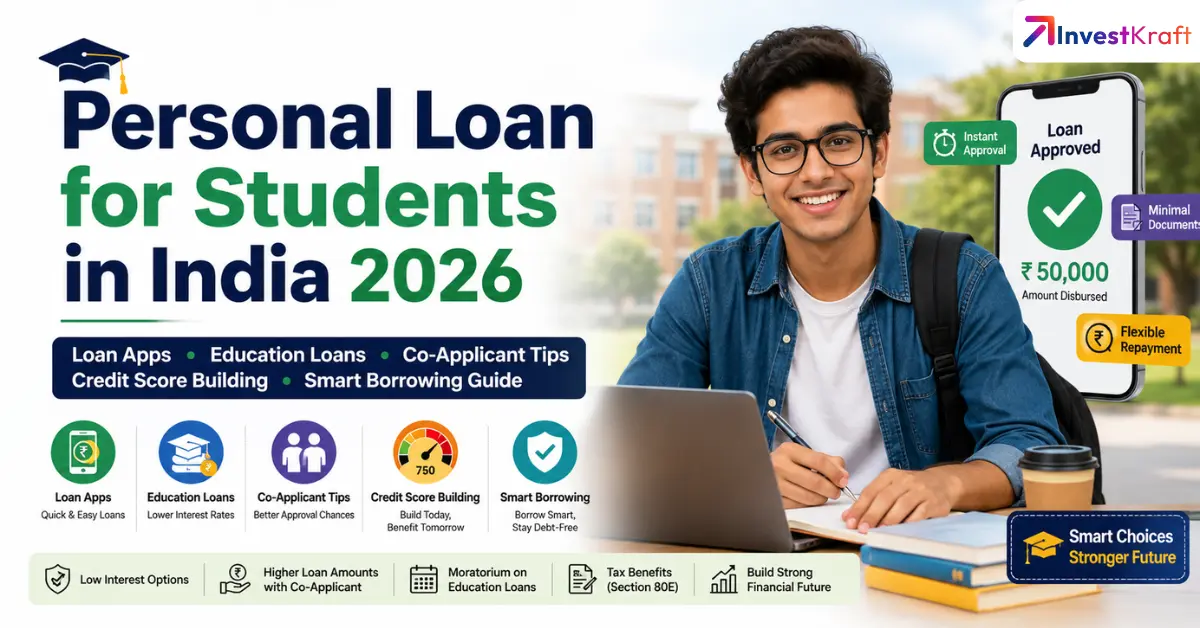
You are 21 years old, sitting in your hostel room in Pune, staring at a ₹15,000 laptop repair bill.
Or maybe it is the ₹45,000 exam registration fee for an international certification course.
Or a flight ticket home for a medical emergency.
Your own savings are already almost dried up. Your parents or siblings are not immediately reachable. No source of immediate funds is visible.
You need money now!
Student life in India is full of financial gaps that neither your pocket money nor a formal salary can bridge.
The good news is in 2026, getting a personal loan as a student is more accessible than ever - from ₹500 micro-loans that approve in minutes to ₹85 lakh education loans with 15-year tenures. The challenge is knowing which option to use, when, and how to avoid the traps that come with easy credit.
This guide gives you every actionable tip with updated 2026 data to borrow smart, build your credit score, and stay out of a debt spiral. Before we begin, let us take a look at the latest updates related to personal loan for students in India in 2026:
Latest Highlights: Student Loans in India 2026
The following are some of the prominent and updated news for student personal loans in India:
Now, let us start with the article.
First - Understand Why Banks Hesitate to Give Students Personal Loans
Standard personal loans are generally not available for students with no income in India. Indian citizens who are salaried or self-employed professionals - typically parents or guardians - aged 21 to 58 years with a minimum net monthly income of ₹15,000 are the target profile for most personal loan products.
This is the core challenge.
Personal loan lenders need three things:
Income (to assess repayment capacity),
CIBIL score (to assess repayment behaviour)
Identity (KYC). Most students have only the third.
But in 2026, there are well-designed workarounds for each gap - and knowing them is the difference between a rejected application and a disbursed loan.
10 Smart Tips to Get a Personal Loan for Students in India 2026
Let us understand these tips one by one.
Tip 1: Know Which Type of Loan You Actually Need
The biggest mistake students make is applying for the wrong loan product. Here is a clear map:
The golden rule: If the need is education-related and above ₹50,000 - always explore a dedicated education loan first. Education loans offer moratorium periods (no repayment until course completion), lower rates, and tax benefits. A personal loan charges you from Day 1.
Tip 2: Use a Co-Applicant - The Single Most Effective Strategy
Students with no income should apply with a parent or guardian as a co-applicant. Lenders assess the co-applicant's income and CIBIL score - and the student's identity and enrollment confirm the purpose of the loan.
This one tip unlocks:
Lower interest rates (the co-applicant's strong CIBIL score directly reduces your rate)
Higher loan amounts (based on the parent's income and FOIR)
Access to formal bank loans (instead of being limited to high-rate fintech apps)
Education loan moratorium period (no EMI until after graduation)
Low FOIR (existing EMIs below 50% of monthly income)
Important: The co-applicant is equally responsible for repayment. If you miss EMIs, your credit score is also damaged. Discuss repayment responsibility clearly before applying.
Tip 3: Choose Education Loans Over Personal Loans for Large Amounts
Traditional personal loans come with high interest rates and mandate immediate EMI repayments. Dedicated education loans offer a moratorium period - no repayment until the course is completed - making them far more suitable for students.
3.1: Comparison: Education Loan vs Personal Loan for Students
Tax benefit note: The Section 80E deduction allows the full interest paid on an education loan to be deducted from taxable income - with no upper limit - for up to 8 years. This benefit is not available on personal loans.
Tip 4: Use Student-Specific Loan Apps for Small Amounts
For daily expenses, exam fees, or a sudden ₹5,000 to ₹25,000 crunch - student-specific loan apps are the fastest, most accessible option in 2026.
Some apps require minimum income proof or a co-applicant
Check the annual interest rate and processing fees clearly
Ensure the app offers amounts suitable for student needs.
For amounts under ₹10,000: StuCred (0% interest) is your best bet - apply there first before going to any other app.
Tip 5: Start Building Your Credit Score Now - Even as a Student
Timely repayments through student loan apps can help students build a positive credit history, which becomes critical for larger education loans (master's, abroad) and career-stage personal loans later.
Your CIBIL score starts being built the moment you take your first loan or credit card - and the earlier you start, the better your financial life looks at 25.
5.1: 3 practical ways to build credit as a student:
Secured credit card against FD: If your parents have a fixed deposit, ask the bank to issue a credit card against it (even ₹20,000 FD works). Use it for small monthly expenses. Pay the full bill every month. Within 6 to 12 months, you have a CIBIL history - without any income requirement.
Small loan from mPokket or StuCred: Borrow ₹2,000 to ₹5,000. Repay on time. Repeat once or twice. You have created 2 to 3 positive credit entries before you graduate. By the time you apply for a personal loan with your first salary, your CIBIL score is already 680 to 720.
Become an authorised user on a parent's credit card: Some banks allow students to be added as authorised users on a parent's card. The parents' good repayment history can positively reflect on your profile, without you having independent income.
Tip 6: Always Compare Before You Apply
Never apply to the first lender you find. Here is what to compare:
Interest rate (APR - not just monthly rate): A 3% monthly rate sounds small, but is 36% annually - nearly as expensive as a credit card. Always ask for the Annual Percentage Rate, including all fees.
Processing fee: 1% to 5% of the loan amount is charged upfront. On a ₹50,000 loan, 3% means ₹1,500 deducted before you even receive the money.
Prepayment charges: Can you repay early without penalty? For student loans, where a semester ending or a part-time job can create surplus cash, prepayment flexibility matters.
Moratorium availability: For education loans, is there a repayment holiday until course completion?
Tip 7: Never Borrow More Than You Can Repay
This sounds obvious. But for a student who has never managed debt, it is the most important financial lesson.
Borrowing more than needed increases EMI burden and can lead to debt traps. Applying to multiple lenders simultaneously results in multiple hard inquiries that lower your credit score and signal financial desperation.
The student borrowing rule: Borrow only what you need for a specific, identified purpose. Never borrow because the app has approved a higher limit.
7.1: Before accepting any loan offer, answer three questions:
What exactly am I spending this on? (specific purpose)
When will I have the money to repay it? (specific repayment source)
What happens if I cannot repay on time? (risk assessment)
If you cannot answer all three clearly, do not take the loan.
Tip 8: Understand the Red Flags - Protect Yourself From Predatory Apps
Student borrowers are the primary target of fraudulent loan apps. Here is what to watch for:
Loan approval without any verification: No legitimate lender approves loans without an identity check
Upfront fee demanded before disbursal: Always a fraud signal
Request to access your contact list: Used to harass family members for recovery
Interest rates not disclosed: Hidden charges are a predatory tactic
No NBFC partner named on the app: Means it is unregulated
Verify before downloading: Go to the official RBI website → Digital Lending Apps Directory → Search the app name. If it is not listed - do not install it.
Tip 9: Use Government Schemes if You Have a Business Idea
If you are a student with an entrepreneurial idea - even a small one - government schemes can provide capital at subsidised rates:
PM Mudra Yojana (PMMY): Loans up to ₹20 lakh for micro-enterprises. The Shishu category (up to ₹50,000) is ideal for students starting a small side business. Apply at Udaymimitra Portal
Stand-Up India: For SC/ST and women student entrepreneurs - loans from ₹10 lakh to ₹1 crore for greenfield ventures.
Startup India Seed Fund: For students with registered startups - equity-free seed funding up to ₹20 lakh via incubators.
These are not emergency personal loans - but if you have a business vision and are planning ahead, these are far cheaper and more powerful than any fintech app.
Tip 10: Know the Tax Benefit - Section 80E Is Exclusively for Students
If you or your parents take an education loan from a scheduled bank or approved financial institution, the entire interest paid is deductible under Section 80E of the Income Tax Act - with no upper limit.
This benefit is available for up to 8 consecutive years from the year you start repaying the loan. There is no equivalent tax benefit on personal loans.
Summary
Getting a personal loan as a student in India in 2026 requires the right product, the right lender, and the right amount - not just the fastest approval. Here is the complete recap:
No income or CIBIL: Add a co-applicant. A parent with 750+ CIBIL and a stable income is your best leverage.
Small urgent needs (₹500 to ₹30,000): Student loan apps like mPokket, StuCred (0% interest!), Pocketly - instant, minimal docs, no CIBIL required.
Build credit early: Small loans & timely repayment. Even ₹2,000 repaid on time creates a CIBIL entry that compounds into a 700+ score by graduation.
Always compare: Multiple offers, one application, no multiple hard enquiries.
Never overborrow: Only borrow for a specific purpose with a clear repayment plan.
Safety first. Always verify any loan app on the RBI DLA Directory before installing.
Recommended Articles from InvestKraft;
Explore more expert guides, tips, and insights to make smarter financial decisions
Students can get personal loans through co-applicant loans (parents' income backing), dedicated student loan apps like mPokket and StuCred, or education loans from banks - the right option depends on the amount needed and purpose.
Is 700 a bad CIBIL score for a student?
No - 700 is a good score for most students, who often start with no score at all; a 700 score gets approval at most NBFCs and banks, though 750+ unlocks the best interest rates.
How much personal loan can I get on a ₹20,000 salary?
On a minimum net monthly income of ₹15,000 to ₹20,000, eligible applicants can get personal loans of ₹2 to ₹4 lakh from most NBFCs and private banks - the exact amount depends on CIBIL score, existing EMIs, and employer profile.
What are the 4 C's in a loan for students?
Character (CIBIL score - or co-applicant's), Capacity (income to repay - parent's if student has none), Capital (savings or down payment), and Collateral (not required for unsecured personal loans) - lenders assess all four even for student applications.
Can I get an instant ₹10,000 loan as a student at 18 years?
Yes - mPokket, Pocketly, and StuCred accept students aged 18+ with just a college ID, Aadhaar, PAN, and bank account - with no CIBIL score required for amounts up to ₹10,000 to ₹15,000.
What is the best loan app for students without a credit score?
StuCred is the best - 0% interest (processing fee only), up to ₹15,000, no CIBIL required, and 18+ eligible; mPokket is the best for amounts from ₹500 to ₹30,000 with equal simplicity.
Should a student take a personal loan or an education loan?
Always prefer an education loan for tuition or course-related expenses above ₹50,000 - it offers lower interest, moratorium period (no EMI during study), and Section 80E tax benefit; reserve personal loans for small urgent needs under ₹50,000 that cannot wait for the longer education loan process.
Sources
All information verified from official and authoritative sources:
HeroFinCorp - Education / Personal Loan for Students up to ₹5 Lakh (March 2, 2026): herofincorp.com/personal-loans/education-loan
Income Tax Department - Section 80E Education Loan Deduction: incometaxindia.gov.in
PM Vidyalaxmi Portal - Education Loan Single Application: vidyalakshmi.co.in
RBI - Digital Lending Apps Directory and Guidelines 2025: rbi.org.in
Disclaimer: Interest rates, loan amounts, and eligibility criteria are as of May 2026 and subject to change. Always verify the NBFC partner on the RBI DLA Directory before applying. This article is for informational purposes only. Borrow responsibly - only what you can repay.
Author: Diwakar Kumar Singh
Diwakar Kumar Singh is a BFSI specialist and finance writer with over 7 years of hands-on experience in financial research, content creation, and analysis.
A Gold Medalist in MBA (Marketing) from IMT, he combines deep analytical skills with practical insights gained from evaluating companies, IPOs, unlisted shares, financial ratios, and investment opportunities. Diwakar has personally analysed hundreds of financial instruments and market scenarios, which he uses to break down complex topics into clear, actionable advice.
He has authored numerous in-depth finance articles, published multiple books internationally, and contributed to research publications. His work focuses on helping everyday investors and readers make better-informed financial decisions through well-researched, evidence-based explanations that are always grounded in real-world application rather than theory alone.


 care@investkraft.com
 +91-9599071040
 +91-9797971876