Your washing machine breaks down the night before Diwali. Your child's school demands a large fee advance. You need to fund a wedding three months before your annual bonus arrives.
Life does not wait for your savings to catch up.
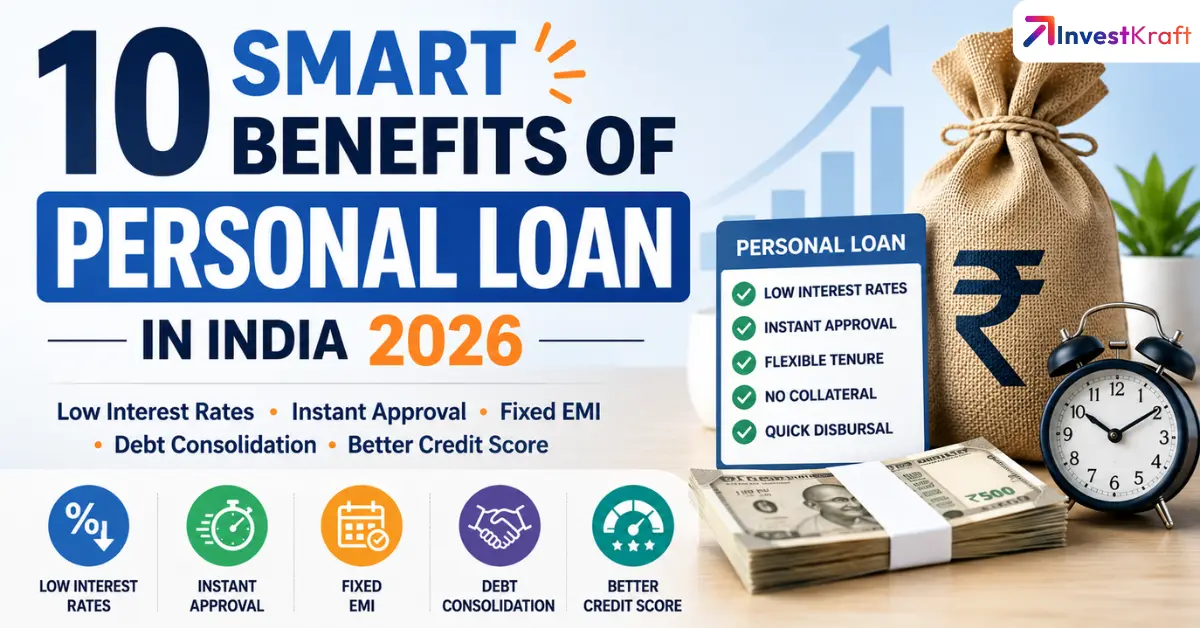
A personal loan is designed precisely for moments like these - and in 2026, it has never been easier, faster, or more competitively priced to get one.
Personal loan interest rates in April 2026 start from as low as 8.75% at prominent banks such as Union Bank of India and Bank of Maharashtra. Among private lenders, Axis Bank offers rates from 9.50%, while HDFC Bank and ICICI Bank start from 9.99%.
Yet most people either avoid personal loans out of vague fear or take them without understanding the full range of benefits available. This guide covers every major benefit, including short-term benefits with real numbers, current interest rates, practical examples, and clear comparisons - so you can decide whether a personal loan is the right tool for your specific need.
What is a Personal Loan?
A personal loan is an unsecured loan - meaning no collateral, no property pledge, no gold required. You borrow a fixed amount, repay it in fixed monthly instalments (EMIs) over a chosen tenure, and use the money for virtually anything you need.
PSU banks are usually cheaper for salaried and government employees. In May 2026, PSU banks still offer the cheapest personal loans in India, with rates starting around 8.75% for top profiles.
Personal Loan Interest Rates - May 2026
The following table shows personal loan interest rates as of May 2026:
Rates are subject to change. These are approximate as per the various data sources available on the internet. Your actual rate depends on CIBIL score, income, employer profile, and lender policy.
Now, let us understand the short-term benefits of a personal loan as well as some of the other benefits as well.
Benefit 1: No Collateral Required - Borrow Without Risking Any Asset
This is the defining feature of a personal loan - and the most liberating.
You do not pledge your home. You do not deposit your gold. You do not put your car at risk. A personal loan is 100% unsecured - the only thing backing the loan is your creditworthiness.
No risk of losing a family asset if repayment becomes difficult
No lengthy property valuation process
No title documents, legal checks, or technical inspections
Faster approval because asset verification is skipped entirely
Compare this to a home loan (property pledged), gold loan (gold pledged), or loan against property (real estate at risk). With a personal loan, your assets remain entirely yours throughout the borrowing period.
Best for: Anyone who needs funds but does not want to put a hard-earned asset on the line.
Benefit 2: No End-Use Restriction - Spend It on Whatever You Need
Unlike a home loan (must buy property), a car loan (must buy a vehicle), or an education loan (must pay tuition), a personal loan comes with zero restriction on end use.
2.1: You can use a personal loan for:
Medical emergency or hospitalisation bills
Wedding expenses - venue, catering, jewellery
Home renovation or interior decoration
International or domestic travel
Consumer electronics - laptop, phone, appliance
Child's school or college fees (when an education loan is not practical)
Debt consolidation - paying off high-interest credit card debt
Business working capital (for individuals)
Emergency family expenses
You do not have to explain to the bank what you are spending it on. There is no bill submission, no receipt requirement, and no end-use audit.
Best for: Any financial need that does not fit neatly into a specific loan category.
Benefit 3: Lower Interest Rate Than Credit Cards - Save Thousands Every Month
This is one of the most financially impactful benefits - and most people do not act on it.
Credit Type
Typical Interest Rate (2026)
Credit Card Revolving Balance
36% to 42% per annum
Personal Loan (top private banks)
9.99% to 16% per annum
Personal Loan (PSU banks)
8.75% to 15% per annum
3.1: Example
If you are carrying ₹2 lakh on a credit card at 40% per annum, you are paying approximately ₹6,667 per month just in interest, going nowhere.
Taking a personal loan at 12% to repay the card saves you approximately ₹4,667 per month in interest and gives you a clear repayment timeline.
The benefit of opting for a fixed interest rate is that you know exactly how much you will be charged during the loan tenure, making financial planning straightforward.
Best for: Anyone carrying a large credit card balance or revolving debt at 36%+ interest.
Benefit 4: Debt Consolidation - Simplify Your Financial Life
This is the strategic benefit that most borrowers overlook.
If you have multiple outstanding debts - a credit card balance, a small personal loan, a buy-now-pay-later outstanding, and a consumer durable EMI - you are managing multiple due dates, multiple interest rates, and multiple lenders simultaneously.
Missing any one payment affects your CIBIL score.
A debt consolidation personal loan lets you pay off all of these with one loan, at one interest rate, with one monthly EMI, to one lender.
4.1: Debt Consolidation Example
Let us understand the advantage of debt consolidation from the following table:
Benefit 5: Quick Disbursal - Money When You Actually Need It
Emergencies do not wait for bank processing cycles.
Personal loan applications worth ₹2,73,923 crore were received in 2026
This number reflects how central instant personal loans have become to Indian financial lives.
In 2026, the disbursal speed from leading lenders is remarkable:
For a medical emergency, a time-sensitive business opportunity, or a family crisis - this speed is invaluable.
Benefit 6: Fixed EMIs and Predictable Repayment - Plan Your Budget With Certainty
Unlike a credit card bill that fluctuates every month based on spending, a personal loan has a fixed EMI for the entire tenure. You know on day one exactly how much you will pay every month - and exactly when the loan will end.
6.1: This predictability is powerful for financial planning:
Your monthly budget has one clear, unchanging obligation
You can plan all other savings and investments around it
There are no surprises, no minimum payment tricks, no revolving debt traps
6.2: Example of EMI Table - ₹5 Lakh Personal Loan at 12% Per Annum:
Tenure
Monthly EMI
Total Interest Paid
1 year
₹44,424
₹33,088
2 years
₹23,536
₹64,864
3 years
₹16,607
₹97,852
4 years
₹13,166
₹1,31,968
5 years
₹11,122
₹1,67,320
Use the free Personal Loan EMI Calculator. All you need to do is enter your loan amount, rate, and tenure to instantly see your exact EMI and total interest cost.
Benefit 7: Improves Your Credit Score When Repaid on Time
A personal loan, repaid responsibly, is one of the most effective ways to build or strengthen your CIBIL score - for three reasons:
Adds a new credit type (credit mix): CIBIL rewards borrowers who manage different types of credit. If you only have credit cards, adding a personal loan diversifies your mix, which accounts for approximately 10% of your score.
Builds repayment history: Payment history is the largest component of your CIBIL score (~35%). Every on-time EMI payment is a positive entry that compounds over time.
Reduces credit utilisation: Using a personal loan to pay off a large credit card balance immediately reduces your credit utilisation ratio - which can improve your score within 1 to 2 billing cycles.
If your CIBIL score is more than 800, you can get a 0.25% basis point drop on your personal loan interest rate - meaning maintaining and building a strong score pays back directly in lower borrowing costs.
Benefit 8: Flexible Tenure - Choose What Fits Your Budget
Most personal loans in India offer tenure options from 12 months to 60 months (1 to 5 years) - with some lenders like Bajaj Finserv extending to 84 months (7 years).
8.1: This flexibility is powerful because:
Shorter tenure means higher EMI but lower total interest.
Longer tenure means lower EMI but higher total interest.
The choice is entirely yours based on what your monthly budget can comfortably accommodate.
The right question to ask: What is the maximum EMI I can pay without stress - and what tenure achieves that? Use the EMI calculator to answer this before applying.
One important tip: If you do not mind a fluctuating interest rate, opt for a floating rate personal loan - when interest rates drop (as the RBI has been cutting in 2025 to 2026), your repayment amount reduces automatically.
Benefit 9: Minimal Documentation - Especially for Salaried Borrowers
A personal loan application in 2026 requires remarkably little paperwork - particularly for salaried individuals at reputed organisations.
9.1: Standard documents required:
KYC: Aadhaar and PAN (mandatory)
Income proof: Last 3 months' salary slips & 6 months' bank statements
Employment proof: ID card or appointment letter
Photographs: Passport-size
That is it. No property documents. No title deed. No legal opinion. No technical valuation. For pre-approved offers from your salary bank, often just Aadhaar OTP verification is required. The entire process is paperless and digital.
Benefit 10: Available to Both Salaried and Self-Employed Borrowers
Unlike some secured loans that require strong asset backing or formal income documentation, personal loans are available across a wide spectrum of borrower profiles:
Salaried individuals: Any employer type - government, PSU, MNC, or private firm - with a minimum net monthly salary of ₹15,000 to ₹25,000 (varies by lender).
Self-employed professionals and business owners: With 2 to 3 years of ITR and bank statement evidence showing stable income.
Government employees: Many leading banks in India offer special personal loan interest rates to government employees due to higher job stability - often 0.25% to 0.5% below the standard rate.
NRIs: Several private banks and NBFCs offer personal loans to NRIs with Indian income sources.
Advantages vs Disadvantages of a Personal Loan
Now, let us compare the advantages and disadvantages of a personal loan,
How Much Personal Loan Can You Get on Your Salary?
Now, if you are thinking about the loan amount based on your salary, then here is the approximate amount of a personal loan you are eligible for:
Monthly Net Salary
Approximate Loan Eligibility (No Existing EMIs)
₹20,000
₹2 lakh to ₹4 lakh
₹30,000
₹4 lakh to ₹7 lakh
₹50,000
₹8 lakh to ₹15 lakh
₹1,00,000
₹20 lakh to ₹35 lakh
Use the Personal Loan Eligibility Calculator on BankBazaar, Paisabazaar, or your bank's website for accurate figures based on your income, existing EMIs, and CIBIL score.
How much personal loan can I get on a ₹20,000 salary?
Most lenders approve ₹2 to ₹4 lakh for a net monthly salary of ₹20,000 with no existing EMIs and a CIBIL score above 700.
How much loan can I get on a ₹1 lakh salary?
With ₹1 lakh monthly take-home and no existing EMIs, eligibility ranges from ₹20 to ₹35 lakh at leading private banks - subject to CIBIL score and employer profile.
Which Reason Is Best for a Personal Loan?
Lenders rarely scrutinise your reason for a personal loan - but if asked, the following reasons are universally accepted and flag no concerns:
Medical emergency or hospitalisation - most accepted by all lenders
Home renovation - widely accepted; some banks have dedicated products
Wedding expenses - standard, widely approved
Debt consolidation - viewed positively by lenders as financially responsible
Education expenses - accepted; large amounts may need specific documentation
Travel - accepted for smaller amounts
Avoid stating business investment or property purchase - lenders have specific products for those purposes and may decline a personal loan for these uses.
Summary
A personal loan in India in 2026 is one of the most versatile, accessible, and fast financial tools available to both salaried and self-employed individuals. Here is the complete recap of every benefit:
No collateral: Borrow without risking any asset.
No end-use restriction: Use for any legitimate need.
Lower rate than credit cards: 9.99% to 16% vs 36% to 42% on credit cards.
Debt consolidation: Replace multiple high-interest debts with one manageable EMI. Fast disbursal: Same day to 72 hours - ideal for emergencies.
Fixed EMIs: Predictable monthly outgo; easy to budget.
Credit score improvement: Consistent repayments build a strong CIBIL history.
Flexible tenure: 12 to 84 months - choose what your budget supports.
Minimal documentation: Aadhaar, PAN, salary slips, bank statements - nothing more.
Wide eligibility: Salaried, self-employed, government employees, and NRIs.
The golden rule for personal loans: borrow only what you need, choose the shortest tenure your budget can support, repay on time without fail, and never take multiple personal loans simultaneously.
Used strategically - a personal loan is a powerful financial ally, not a debt trap.
Recommended Articles from InvestKraft;
Explore more expert guides, tips, and insights to make smarter financial decisions
Yes, when used for a specific, planned purpose at a lower rate than alternatives like credit cards, a personal loan is beneficial if you can comfortably repay the EMI, and the interest cost is less than the alternative.
How much personal loan can I get on a ₹20,000 salary?
Most lenders approve ₹2 to ₹4 lakh for a ₹20,000 net monthly salary with no existing EMIs and a CIBIL score above 700.
How much loan can I get if my salary is ₹1,00,000?
With a strong CIBIL score above 800 and ₹1 lakh monthly income, you can typically qualify for ₹20 to ₹35 lakh from leading private banks at the lowest available interest rates.
Which reason is best for a personal loan?
Medical emergency, home renovation, wedding expenses, and debt consolidation are the most widely accepted and fastest-approved reasons. Stated reasons rarely impact approval, but choosing a legitimate purpose is always advisable.
What is the lowest personal loan interest rate in India in May 2026?
PSU banks in May 2026 offer the cheapest personal loans in India, with rates starting around 8.75% for top profiles at Union Bank of India and Bank of Maharashtra - private banks like HDFC, ICICI, and Axis start from 9.99%.
Does taking a personal loan affect my CIBIL score?
Taking a loan triggers a hard enquiry (minor temporary dip of 5 to 10 points) - but consistent on-time EMI repayment builds your CIBIL score over time, making the net long-term impact positive for responsible borrowers.
What are the disadvantages of a personal loan?
The main disadvantages are higher interest rates than secured loans, processing fees of 0.5% to 3%, prepayment charges at some lenders, shorter tenure leading to higher EMIs, and no tax deduction on interest for salaried borrowers - always compare the total cost of borrowing before deciding.
Sources
All information verified from official and authoritative sources:
BankBazaar - Personal Loan Interest Rates (Updated May 7, 2026): bankbazaar.com/personal-loan-interest-rate.html
Paisabazaar - Personal Loan Interest Rates (May 2026): paisabazaar.com/personal-loan/interest-rates
Dailyhunt / Mint - Personal Loan Interest Rates April 2026 Comparison (April 15, 2026): dailyhunt.in
Dailyhunt - Personal Loan Rates May 2026: PSU Banks Comparison: dailyhunt.in
Axis Bank - Personal Loan Interest Rates and Charges (May 2026): axis.bank.in/loans/personal-loan/interest-rates-charges
HDFC Bank - Personal Loan Benefits and Features: hdfc.bank.in/blogs/personal-loan/6-personal-loan-benefits
ICICI Bank - Benefits of Applying for Personal Loan Online: icici.bank.in/personal-banking/blogs/loan/personal-loan
RBI - Digital Lending Guidelines and Prepayment Rules: rbi.org.in
Disclaimer: Interest rates, loan amounts, and eligibility criteria are as of May 2026 and subject to change based on lender policy and RBI guidelines. EMI examples and savings calculations are illustrative only. This article is for informational purposes only and does not constitute financial advice. Always compare multiple lenders and verify current terms before applying.
Author: Diwakar Kumar Singh
Diwakar Kumar Singh is a BFSI specialist and finance writer with over 7 years of hands-on experience in financial research, content creation, and analysis.
A Gold Medalist in MBA (Marketing) from IMT, he combines deep analytical skills with practical insights gained from evaluating companies, IPOs, unlisted shares, financial ratios, and investment opportunities. Diwakar has personally analysed hundreds of financial instruments and market scenarios, which he uses to break down complex topics into clear, actionable advice.
He has authored numerous in-depth finance articles, published multiple books internationally, and contributed to research publications. His work focuses on helping everyday investors and readers make better-informed financial decisions through well-researched, evidence-based explanations that are always grounded in real-world application rather than theory alone.


 care@investkraft.com
 +91-9599071040
 +91-9797971876