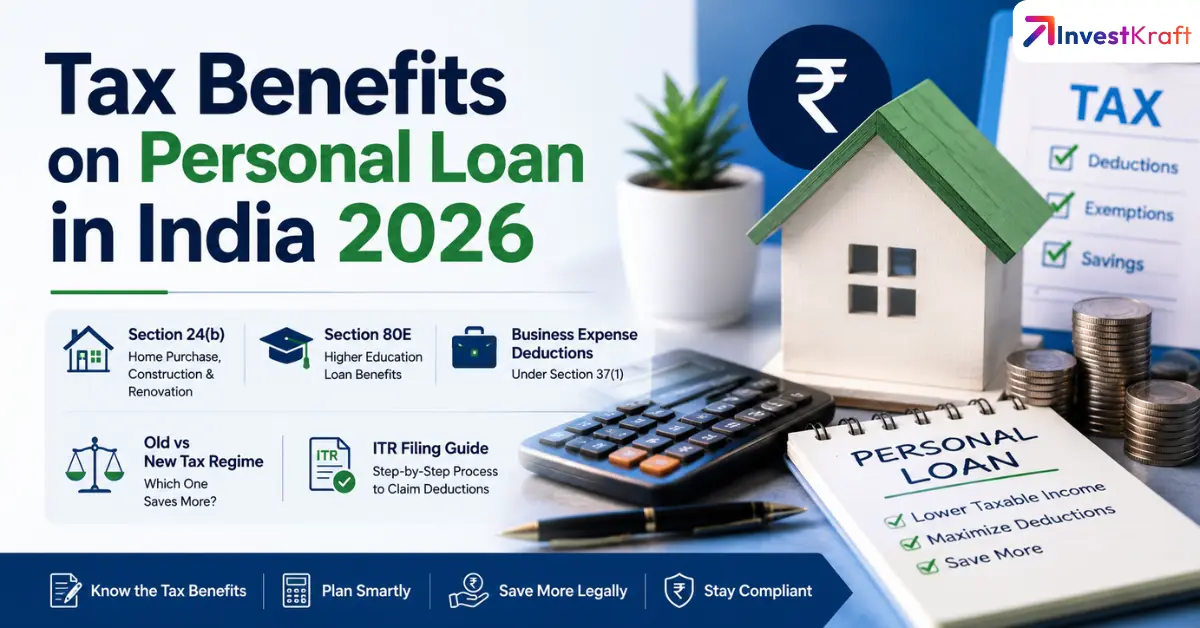
Most people assume personal loans are tax-neutral - you borrow, you repay, the government takes no interest.
Not quite.
The truth: The personal loan amount is generally not taxable as the loan borrowed for meeting personal expenses is not considered income.
However, taking personal loans can come with tax benefits on the basis of the end-use of the loan amount.
That last part is the key. What you do with the money determines whether you can claim a tax deduction on the interest you pay - not the loan itself.
This guide covers every tax benefit available on personal loans in India in FY 2026-27 - which sections apply, who can claim them, what documents you need, and exactly how to file. Before we begin, let us see what are the latest highlights related to personal loan tax rules in 2026 in India
Latest Highlights: Personal Loan Tax Rules in 2026
The Golden Rule: Tax Benefit Depends 100% on End-Use
Personal loans have no blanket tax exemption. The deductibility of interest is determined entirely by what you spend the money on.
End-Use
Tax Section
Deduction Available
Regime
Home purchase/construction
Section 24(b)
Up to ₹2 lakh/year (self-occupied)
Old only
Home renovation/repair
Section 24(b)
Up to ₹30,000/year (self-occupied)
Old only
Rented-out property (interest)
Section 24(b)
Full interest - no limit
Both regimes
Business investment
Section 37(1)
Full interest - no limit
Both regimes
Higher education
Section 80E
Full interest for 8 years
Old only
Investment in shares / MFs
Section 57
Interest deductible against investment income
Old only
Capital asset purchase
Section 48
Indexed with the cost of acquisition at sale
At the time of sale
Wedding, vacation, medical, personal
None
No deduction
N/A
Now, let us read about these benefits in detail:
Benefit 1: Home Renovation or Property Purchase - Section 24(b)
This is the most commonly used personal loan tax benefit and applies to a large number of borrowers.
If a personal loan is used to buy, construct, or renovate a house, the interest paid is eligible for tax deduction under Section 24(b): deduction up to ₹2 lakh per year if the house is self-occupied, and no upper limit if the house is rented out.
1.1: For renovation specifically
The limit is ₹30,000 per year for a self-occupied property repaired or renovated using a personal loan - lower than the ₹2 lakh limit for purchase or construction.
For home repairs, the limit is ₹30,000; for construction or purchase, it is ₹2 lakh under Section 24(b).
1.2: Important distinction from a home loan
Unlike a regular home loan, a personal loan used for property does NOT get you the Section 80C deduction on principal repayment. Only the interest portion qualifies under Section 24(b).
1.3: Tax-saving example
Personal loan interest for home renovation: ₹1,80,000 in FY 2026-27
Claimable deduction: ₹30,000 (renovation cap)
Tax saved at 30% bracket: ₹9,000
For construction or purchase:
Same ₹1,80,000 interest
₹1,80,000 deductible (within ₹2 lakh cap)
Tax saved at 30% bracket: ₹54,000
Benefit 2: Business Investment - Section 37(1)
This is the most powerful tax benefit on a personal loan - particularly for self-employed individuals, business owners, and MSMEs.
The interest portion can be deducted as a business expense under Section 37(1). It reduces taxable profit. For business owners, business loan interest is fully deductible with no fixed upper limit, effectively lowering tax liability.
If you take a personal loan of ₹10 lakh at 13% per annum and use it entirely for business - purchasing stock, upgrading equipment, paying vendor advances, or funding working capital - you can deduct the full ₹1,30,000 annual interest from your business income.
At 30% tax bracket, that is ₹39,000 in annual tax savings - with no cap.
This is particularly useful for MSMEs obtaining funds from regulated NBFCs - the interest paid on a personal loan used for business is treated identically to interest on a formal business loan for tax purposes, as long as the end-use is demonstrably business-related.
Key requirement: You must be able to demonstrate - through bank transfers, invoices, or business account transactions - that the personal loan proceeds were used specifically for business purposes, not mixed with personal spending.
Benefit 3: Higher Education - Section 80E
If a personal loan is used to fund higher education, the interest paid can be claimed under Section 80E. This benefit applies for 8 years from the start of loan repayment.
Traditionally, Section 80E applies to dedicated education loans from banks and approved financial institutions. However, if a personal loan is taken specifically to fund higher education and you can demonstrate the end-use, the interest may still qualify.
3.1: Key conditions
The education must be for the borrower, spouse, children, or a student for whom the borrower is the legal guardian
The course must be pursued after completing Class 12
No upper limit on the deduction amount
Available for up to 8 consecutive assessment years
Important: Section 80E is not available under the New Tax Regime.
Benefit 4: Investment in Shares or Mutual Funds - Section 57
If a personal loan is used for investing in shares, mutual funds, or other assets, the interest paid can be claimed as a deduction under Section 57.
This section allows you to deduct expenses incurred to earn income, including interest paid on a loan used to generate investment income. The interest is deducted against income received from that investment (dividends, capital gains, or other returns).
4.1: Example
Take a ₹5 lakh personal loan at 12%
Invest in stocks
Earn dividends of ₹40,000
Annual interest paid: ₹60,000
Deductible against investment income: ₹60,000
Net taxable investment income: ₹40,000 - ₹60,000 = Net loss (carry forward subject to rules)
Caution: This is a complex area of tax law. The deduction applies only against income from the specific investment - not general income. Consult a CA before claiming this for large amounts.
Benefit 5: Capital Asset Purchase - Section 48
If you take a personal loan to buy a non-residential asset - gold, commercial property, or shares (where Section 57 is not claimed) - you cannot deduct annual interest payments. However, you can add the interest paid to the cost of acquisition when calculating capital gains tax at the time of selling the asset.
This is called the "indexed cost of acquisition" - adding the loan interest to your purchase price reduces your capital gain and therefore your capital gains tax when you eventually sell.
5.1: Example
Bought gold at ₹5 lakh using a personal loan, paid ₹80,000 interest over 2 years
Effective cost of acquisition for capital gains = ₹5,80,000
Sold gold for ₹8 lakh
Capital gain = ₹8L - ₹5.8L = ₹2.2 lakh (vs ₹3 lakh without interest adjustment)
Tax saved on the difference at 20% LTCG(Long-Term Capital Gains) = ₹16,000
When You CANNOT Claim Any Tax Benefit
No deduction is available if the personal loan is used for:
Wedding or celebration expenses
International or domestic vacation
Medical bills (though Section 80D covers medical insurance premiums separately)
Purchasing consumer electronics for personal use
Any purely personal expense with no business or property link
Tax savings should never be the sole reason for borrowing. Always evaluate EMI affordability, total interest cost, and repayment ability before taking any loan.
Personal Loan Tax Benefit in the New Tax Regime
Now, it is important to understand the personal loan tax benefits under the old and new tax regimes. Let us understand the same from the table below:
If you have a significant personal loan interest that qualifies for deduction, compare your tax liability under both regimes before choosing. For large home renovations or business loans, the old regime typically saves more.
How to Claim Personal Loan Tax Benefits in ITR - Step by Step
Now, let us see the process through which you can claim ITR. As we have already mentioned, always consult your CA before filing these claims.
Step 1 - Obtain your interest certificate: Request an annual interest certificate from your lender showing total interest paid in FY 2026-27. Most banks and NBFCs provide this digitally via their app or net banking portal in April each year.
Step 2 - Compile end-use proof: You must provide clear evidence - invoices, receipts, or construction certificates - that the loan was used for the declared tax-saving purpose.
For home renovation: contractor invoices, material purchase bills, bank transfers to vendor accounts
For business use: bank transfers showing loan proceeds credited to business account, purchase invoices
For education: fee receipts from the institution, admission letter
Step 3 - Choose the Old Tax Regime (if claiming 24b, 80E, or 57): At the beginning of ITR filing at incometax.gov.in, select Old Tax Regime under Section 115BAC to enable these deductions.
Step 4 - Select the correct ITR form: Salaried with property income, choose ITR-2. For Self-employed with business income, choose ITR-3 or ITR-4
Step 5 - Enter the deduction in the correct schedule:
Section 24(b): Enter under “Schedule HP - Income from House Property”
Section 37(1): Business then Enter under "Schedule BP - Profit and Gains from Business" Section 80E then Enter under “Chapter VI-A Deductions - 80E”
Only the person legally responsible for repaying the loan can claim the deduction. In joint borrowing, both parties can claim benefits in proportion to their repayment, provided they share the asset's ownership.
Documents You Must Keep for Personal Loan Tax Claims
The following are the documents that are mandatory for filing your personal loan tax benefits:
Document
Purpose
Annual interest certificate from the lender
Proves total interest paid
Loan agreement/sanction letter
Shows the loan purpose declared
Contractor invoices/receipts
Proves home renovation end-use
Bank statements showing transfers
Links loan disbursement to end-use
Property registration/ownership documents
Required for Section 24(b) claim
Business account statements
Links loan to business use for Section 37
University fee receipts
Required for Section 80E claim
3 Common Myths Related to Personal Loan Tax Benefits
Now, let us bust some of the most common myths related to taxation on personal loans:
Myth 1: Personal loans have tax exemption on principal repayment.
Fact: No, only the interest portion is eligible for deduction under specific sections.
Myth 2: All personal loans are tax-deductible.
Fact: Only loans used for qualifying purposes - home, business, education, investment - qualify. Purely personal expenses get zero benefit.
Myth 3: You must declare the loan purpose at the time of application.
Fact: Lenders do not restrict the end-use of personal loans. The tax claim is your responsibility - proven through documentation at ITR filing time, not at loan application.
Summary
Personal loans offer conditional but meaningful tax benefits in 2026 - entirely dependent on how you use the funds. Here is the complete recap:
Section 24(b): Up to ₹2 lakh/year on interest for home purchase or construction; ₹30,000/year for renovation (self-occupied); unlimited for let-out property - old regime only.
Section 37(1): Full interest deductible as business expense - no cap, available under both regimes.
Section 80E: Full interest deductible for higher education for up to 8 years - old regime only.
Section 57: Interest deductible against investment income from shares or MFs - old regime only.
Section 48: Interest added to cost of acquisition, reducing capital gains at time of asset sale.
No benefit for: Wedding, vacation, medical bills, or any purely personal expense.
Key action: Always collect your lender's interest certificate in April, maintain clear proof of end-use, choose the old tax regime if your qualifying deductions are significant, and file under the correct ITR schedule.
Recommended Articles from InvestKraft;
Explore more expert guides, tips, and insights to make smarter financial decisions
Can you get tax relief on a personal loan in India?
Yes - but only if the loan is used for specific purposes: home purchase or renovation (Section 24b), business investment (Section 37), higher education (Section 80E), or investment in assets (Section 57 or 48).
Can I claim personal loan interest on my taxes?
Yes - only the interest paid on the personal loan is eligible for tax benefits in specific cases, not the principal amount; the applicable section depends on what the loan funds were used for.
Does a personal loan count as taxable income?
No - the personal loan amount is generally not taxable as it is not considered income; however, if the loan is obtained from unrecognised sources not approved by the government, it can be treated as income and charged to tax.
Can I claim 80EEB every year?
Section 80EEB - for interest on electric vehicle loans - was available for loans sanctioned between April 2019 and March 2023; existing borrowers can continue claiming annually until the 8-year window closes, but no new claims are allowed for loans after March 2023.
Is personal loan interest tax-deductible in the new tax regime?
Most deductions, such as Section 24(b) for self-occupied property and Section 80E, are restricted or unavailable under the new tax regime; only business expense deductions under Section 37 and let-out property interest under Section 24(b) remain available.
What documents do I need to claim personal loan tax benefits?
You need the annual interest certificate from your lender, proof of end-use (contractor invoices for renovation, bank transfers for business use, fee receipts for education), and property ownership documents where applicable - keep all of these safely for potential tax scrutiny.
Sources
HeroFinCorp - Tax Benefits on Personal Loan - Deductions, Sections and Rules 2026: herofincorp.com/blog/personal-loan-tax-benefits
Income Tax Department - Salaried Individuals ITR Help for AY 2026-27: incometax.gov.in
PNB Housing - Section 24 of Income Tax Act: pnbhousing.com/blog/section-24-of-income-tax-act
ClearTax - Tax Benefits on Personal Loan: cleartax.in/s/tax-benefits-on-personal-loan
ICICI Bank - Tax Exemptions on Personal Loans: icici.bank.in/personal-banking/blogs/loan/personal-loan
Axis Bank - 3 Tax Benefits of Taking a Personal Loan: axis.bank.in/blogs/personal-loan/3-tax-benefits-of-taking-a-personal-loan
Disclaimer: Tax provisions mentioned are for FY 2026-27 (AY 2027-28) under the Income Tax Act, 1961 as applicable. Tax rules are subject to amendment. Always consult a qualified Chartered Accountant before claiming any deduction. This article is for informational purposes only.
Author: Diwakar Kumar Singh
Diwakar Kumar Singh is a BFSI specialist and finance writer with over 7 years of hands-on experience in financial research, content creation, and analysis.
A Gold Medalist in MBA (Marketing) from IMT, he combines deep analytical skills with practical insights gained from evaluating companies, IPOs, unlisted shares, financial ratios, and investment opportunities. Diwakar has personally analysed hundreds of financial instruments and market scenarios, which he uses to break down complex topics into clear, actionable advice.
He has authored numerous in-depth finance articles, published multiple books internationally, and contributed to research publications. His work focuses on helping everyday investors and readers make better-informed financial decisions through well-researched, evidence-based explanations that are always grounded in real-world application rather than theory alone.


 care@investkraft.com
 +91-9599071040
 +91-9797971876