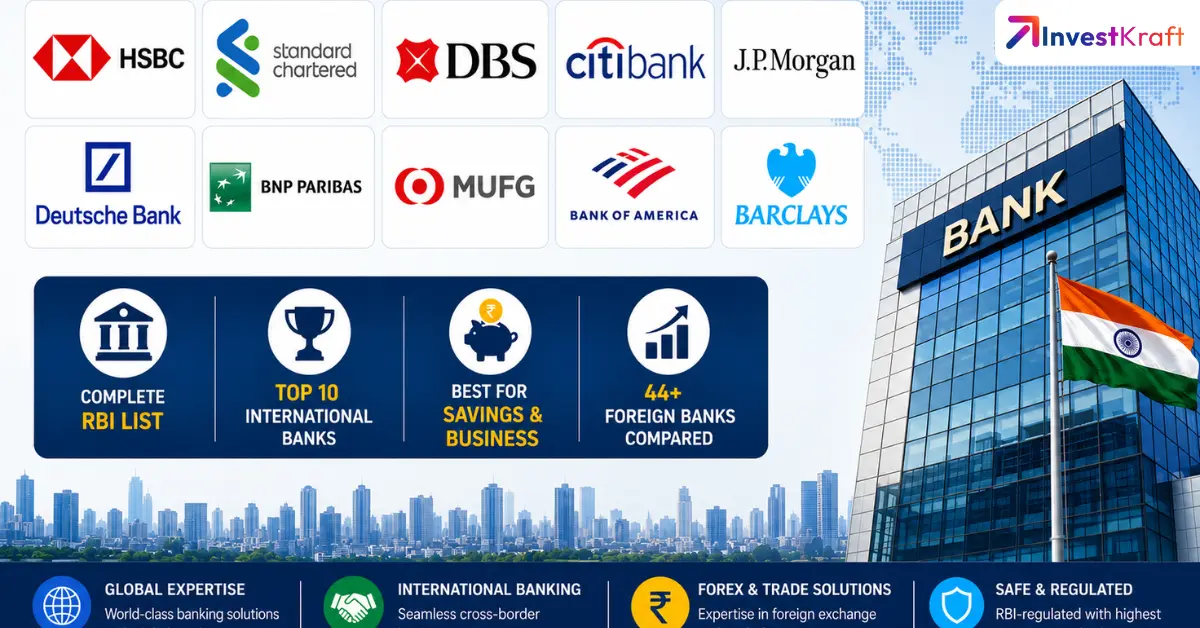
Foreign banks have become an important part of India's banking ecosystem, offering world-class financial services to multinational companies, institutional investors, high-net-worth individuals (HNIs), Non-Resident Indians (NRIs), and businesses involved in international trade. While Indian banks dominate retail banking, many foreign banks bring global expertise, advanced financial products, and strong international networks to the country.
If you've ever searched for foreign banks in India, international banks in India, or wondered whether banks like HSBC, Citibank, Standard Chartered, or Bank of America operate in India, this guide will answer all your questions.
In this comprehensive guide, you'll learn:
What foreign banks are and how they operate in India
The latest list of foreign banks operating in India
The top international banks in India
Benefits and limitations of banking with foreign banks
Whether Indians can open accounts with foreign banks
How foreign banks differ from Indian banks
Which Indian banks have an international presence
Whether you're looking for a savings account, planning to expand your business globally, or simply curious about international banking in India, this guide will help you make an informed decision.
What Are Foreign Banks in India?
A foreign bank is a bank that is incorporated and headquartered outside India but operates within the country after obtaining approval and a banking licence from the Reserve Bank of India (RBI).
Unlike Indian banks, foreign banks are owned by overseas banking institutions. They establish their presence in India through branches or wholly owned subsidiaries and must comply with RBI regulations while conducting banking operations.
Simple Definition
A foreign bank in India is a bank whose parent company is located in another country, but it provides banking services to customers in India under RBI supervision.
For example:
Bank
Home Country
HSBC
United Kingdom
Standard Chartered
United Kingdom
Bank of America
United States
Citibank
United States
Deutsche Bank
Germany
DBS Bank
Singapore
BNP Paribas
France
MUFG Bank
Japan
Although these banks operate branches in India, their headquarters and ownership remain outside the country.
How Do Foreign Banks Operate in India?
Foreign banks cannot simply start operations in India on their own. They must first receive approval from the Reserve Bank of India (RBI) and comply with Indian banking laws, including capital adequacy, liquidity, governance, and reporting requirements.
Generally, foreign banks operate in India through one of the following models:
1. Branch Model: Under this model, the Indian branch is an extension of the foreign bank's head office. The branch follows RBI regulations for its Indian operations but remains legally part of the overseas parent bank.
This model is commonly used by global banks that primarily serve multinational corporations, exporters, importers, and institutional clients.
2. Wholly Owned Subsidiary (WOS): Some foreign banks choose to establish a wholly owned subsidiary in India. In this structure, the Indian entity is incorporated as a separate company under Indian laws, although it is fully owned by the foreign parent bank.
A WOS generally enjoys greater operational flexibility, including the ability to expand branch networks more easily, subject to RBI regulations.
Why Do Foreign Banks Operate in India?
India is one of the world's fastest-growing economies and an important destination for international trade and investment. Foreign banks play a significant role by supporting cross-border financial activities and facilitating global business transactions.
Some of their key functions include:
Financing multinational corporations operating in India
Supporting exporters and importers through trade finance
Providing foreign exchange (Forex) services
Managing treasury and investment banking operations
Offering wealth management services to high-net-worth individuals
Assisting foreign companies investing in India
Supporting mergers, acquisitions, and capital market transactions
While some foreign banks also offer retail banking services such as savings accounts, credit cards, home loans, and personal loans, many focus primarily on corporate and institutional banking.
Who Should Consider a Foreign Bank?
Foreign banks may be a suitable choice for customers who need international banking services or frequently deal with overseas transactions.
They are commonly preferred by:
Businesses engaged in international trade
Multinational corporations (MNCs)
Startups receiving foreign investments
High-net-worth individuals (HNIs)
Non-Resident Indians (NRIs)
Professionals working with international employers
Customers requiring foreign currency accounts or global banking services
For individuals looking for basic savings accounts, rural banking, or extensive branch access across India, large Indian banks may often be a more practical option.
Key Features of Foreign Banks in India
Foreign banks differ from domestic banks in several ways. Some of their notable features include:
Global banking network across multiple countries
Strong expertise in international trade and foreign exchange
Advanced digital banking platforms
Premium wealth management and private banking services
Corporate and institutional banking capabilities
International debit and credit card offerings
Multi-currency banking solutions
Cross-border fund transfer services
Global investment and treasury products
Because of these strengths, foreign banks are widely used by companies with international operations and customers who require seamless global banking services.
Are Foreign Banks Safe in India?
Yes. Foreign banks operating in India are regulated by the Reserve Bank of India and must comply with Indian banking regulations. They are also subject to periodic inspections, prudential norms, and risk management requirements prescribed by the RBI.
However, the products, branch network, customer eligibility, and deposit offerings may differ from those of Indian public sector banks and private sector banks. Before opening an account, customers should compare factors such as branch availability, minimum balance requirements, service charges, digital banking features, and the types of banking services offered.
What's Next?
Now that you understand what foreign banks are and how they operate in India, let's explore:
How many foreign banks currently operate in India
The complete list of foreign banks in India
Their countries of origin, headquarters, and banking services
Which foreign banks offer retail banking in India
The top international banks for individuals and businesses
These sections will help you compare different foreign banks and choose the one that best meets your financial needs.
How Many Foreign Banks Are There in India?
Foreign banks have been operating in India for over a century and play a significant role in corporate banking, international trade, foreign exchange, investment banking, and wealth management.
As per the latest data published by the Reserve Bank of India (RBI), there are around 44 foreign banks operating in India through nearly 300 branches spread across major cities such as Mumbai, New Delhi, Bengaluru, Chennai, Hyderabad, Kolkata, Pune, Ahmedabad, and Gurugram.
Unlike Indian public and private sector banks that have thousands of branches nationwide, most foreign banks maintain a selective presence and primarily focus on metro cities where multinational companies, exporters, importers, financial institutions, and affluent customers are concentrated.
Most foreign banks offer:
Corporate Banking
Trade Finance
Treasury Services
Foreign Exchange (Forex)
Investment Banking
Wealth Management
NRI Banking
Credit Cards
Limited Retail Banking (selected banks only)
It is important to note that not every foreign bank provides savings accounts or personal loans. Several foreign banks in India exclusively serve businesses, financial institutions, and corporate clients.
Complete List of Foreign Banks Operating in India 2026
The table below includes some of the major foreign banks currently operating in India, along with their country of origin and the primary banking services they offer.
Foreign Bank
Country
Headquarters
Retail Banking
Corporate Banking
HSBC India
United Kingdom
London
✅ Yes
✅ Yes
Standard Chartered Bank
United Kingdom
London
✅ Yes
✅ Yes
DBS Bank India
Singapore
Singapore
✅ Yes
✅ Yes
Citibank India*
United States
New York
Limited
✅ Yes
Bank of America
United States
Charlotte
❌ No
✅ Yes
JPMorgan Chase Bank
United States
New York
❌ No
✅ Yes
Deutsche Bank
Germany
Frankfurt
Limited
✅ Yes
BNP Paribas
France
Paris
❌ No
✅ Yes
Société Générale
France
Paris
❌ No
✅ Yes
Crédit Agricole CIB
France
Montrouge
❌ No
✅ Yes
MUFG Bank
Japan
Tokyo
❌ No
✅ Yes
Mizuho Bank
Japan
Tokyo
❌ No
✅ Yes
Sumitomo Mitsui Banking Corporation (SMBC)
Japan
Tokyo
❌ No
✅ Yes
Bank of China
China
Beijing
❌ No
✅ Yes
Industrial and Commercial Bank of China (ICBC)
China
Beijing
❌ No
✅ Yes
Mashreq Bank
United Arab Emirates
Dubai
❌ No
✅ Yes
First Abu Dhabi Bank
United Arab Emirates
Abu Dhabi
❌ No
✅ Yes
Emirates NBD
United Arab Emirates
Dubai
❌ No
✅ Yes
Doha Bank
Qatar
Doha
❌ No
✅ Yes
Qatar National Bank
Qatar
Doha
❌ No
✅ Yes
Shinhan Bank
South Korea
Seoul
Limited
✅ Yes
Woori Bank
South Korea
Seoul
Limited
✅ Yes
Kookmin Bank
South Korea
Seoul
❌ No
✅ Yes
Krung Thai Bank
Thailand
Bangkok
❌ No
✅ Yes
CTBC Bank
Taiwan
Taipei
❌ No
✅ Yes
Australia and New Zealand Banking Group (ANZ)
Australia
Melbourne
❌ No
✅ Yes
Commonwealth Bank of Australia
Australia
Sydney
❌ No
✅ Yes
Barclays Bank
United Kingdom
London
❌ No
✅ Yes
Credit Suisse**
Switzerland
Zurich
❌ No
Investment Banking
UBS AG
Switzerland
Zurich
Limited
Wealth Management
NatWest Markets
United Kingdom
London
❌ No
Investment Banking
Commerzbank AG
Germany
Frankfurt
❌ No
✅ Yes
ING Bank
Netherlands
Amsterdam
❌ No
✅ Yes
Rabobank
Netherlands
Utrecht
❌ No
✅ Yes
Coöperatieve Rabobank U.A.
Netherlands
Utrecht
❌ No
✅ Yes
KEB Hana Bank
South Korea
Seoul
❌ No
✅ Yes
Sberbank***
Russia
Moscow
Limited Operations
Corporate
Industrial Bank of Korea
South Korea
Seoul
❌ No
✅ Yes
Notes:
Citibank sold its consumer banking business in India to Axis Bank. It continues to provide institutional and corporate banking services.
Credit Suisse is now part of UBS Group after the global merger.
Some foreign banks may change their operational status based on RBI approvals, restructuring, or global business decisions. Always check the bank's official website before opening an account or availing services.
Which Foreign Banks Offer Retail Banking in India?
Although more than 40 foreign banks operate in India, only a handful provide banking services to individual customers.
Some of the major foreign banks offering retail banking include:
Bank
Savings Account
Credit Card
Home Loan
Personal Loan
HSBC India
✅
✅
✅
✅
Standard Chartered
✅
✅
✅
✅
DBS Bank India
✅
✅
Limited
Limited
Deutsche Bank
Limited
Limited
Limited
Limited
Shinhan Bank
Selected Customers
Limited
No
No
If your primary requirement is a savings account, salary account, or credit card, these banks are generally the most suitable options among foreign banks in India.
Top 10 Foreign Banks in India 2026
While dozens of international banks operate in India, the following institutions are among the most recognised due to their reputation, financial strength, customer base, and range of services.
HSBC is one of the oldest and largest foreign banks operating in India. It serves retail customers, NRIs, multinational corporations, SMEs, and institutional clients.
Key Services
Savings & Salary Accounts
Premium Banking
Wealth Management
Home Loans
Personal Loans
Credit Cards
NRI Banking
Trade Finance
Forex Services
Best For: Individuals looking for premium banking and businesses involved in international trade.
DBS is known for its strong digital banking platform and innovative banking solutions. After acquiring Lakshmi Vilas Bank, DBS significantly expanded its retail presence in India.
Key Services
Digital Savings Accounts
Fixed Deposits
Personal Banking
Business Banking
SME Loans
Digital Payments
Wealth Management
Best For: Customers who prefer mobile-first and digital banking.
Bank of America primarily serves multinational corporations, financial institutions, exporters, and large enterprises rather than individual retail customers.
Key Services
Corporate Banking
Treasury Services
Capital Markets
Trade Finance
Investment Banking
Best For: Large corporations and multinational companies.
One of the leading banks from the UAE, offering corporate banking, trade finance, and treasury solutions in India.
Which Is the Best Foreign Bank in India?
The answer depends on your banking requirements.
Requirement
Recommended Foreign Bank
Best Overall
HSBC India
Best Retail Banking
Standard Chartered
Best Digital Banking
DBS Bank India
Best Credit Cards
HSBC & Standard Chartered
Best for Corporate Banking
Bank of America
Best for Investment Banking
JPMorgan Chase
Best for International Trade
HSBC
Best for SMEs
DBS Bank
Best for Wealth Management
HSBC
Best for Multinational Companies
Bank of America & JPMorgan
There is no single "best" foreign bank for everyone. Individuals may prioritise digital banking, credit cards, or savings accounts, while businesses often value international trade expertise, treasury services, and global banking networks.
Best Foreign Banks in India for Savings Accounts
While many foreign banks operate in India, only a few offer retail banking products such as savings accounts, salary accounts, debit cards, and credit cards. If you're looking to open a personal bank account with an international bank, the following options are worth considering.
Bank
Best For
Key Highlights
HSBC India
Premium Banking
Global account access, wealth management, international transfers
Standard Chartered
Everyday Banking
Wide branch network, credit cards, home loans, digital banking
Note: The availability of savings accounts and other retail products may vary by city and customer profile. Always check the bank's eligibility criteria before applying.
HSBC India
HSBC is one of the most preferred foreign banks for individuals in India due to its extensive range of personal banking services.
Key Features
Savings and salary accounts
International debit and credit cards
Global money transfers
Multi-currency banking
Wealth management
NRI banking
Mobile and internet banking
Ideal For:
Frequent international travellers
Professionals working for multinational companies
NRIs
High-income individuals
Standard Chartered Bank
Standard Chartered offers one of the most comprehensive retail banking portfolios among foreign banks in India.
Key Features
Savings accounts
Salary accounts
Fixed deposits
Personal loans
Home loans
Credit cards
Investment products
Digital banking
Ideal For:
Salaried employees
Families
Customers looking for international banking with a strong presence in India
DBS Bank India
DBS has become a popular choice for customers who prefer digital banking.
Key Features
Paperless account opening
Mobile banking
UPI
Fixed deposits
Personal banking
SME banking
Instant fund transfers
Ideal For:
Young professionals
Tech-savvy customers
Startup founders
Best Foreign Banks in India for Businesses
Foreign banks have built a strong reputation for serving multinational corporations, exporters, importers, and businesses involved in cross-border trade.
Business Requirement
Recommended Bank
International Trade
HSBC
Corporate Banking
Bank of America
Investment Banking
JPMorgan Chase
Treasury Services
BNP Paribas
Japanese Companies
MUFG Bank
Singapore Business Links
DBS Bank
Trade Finance
Standard Chartered
Foreign Exchange
HSBC
These banks provide specialised services such as:
Working capital finance
Trade finance
Export and import financing
Treasury management
Foreign exchange services
International cash management
Corporate loans
Syndicated loans
Investment banking
Capital market advisory
American Banks in India
Several leading American banks have a presence in India, although most focus on institutional and corporate banking rather than retail customers.
Bank
Headquarters
Primary Services
Bank of America
Charlotte, USA
Corporate Banking, Treasury, Trade Finance
JPMorgan Chase
New York, USA
Investment Banking, Asset Management
Citibank*
New York, USA
Institutional Banking, Corporate Banking
Bank of New York Mellon
New York, USA
Custody and Asset Servicing
Do American Banks Offer Savings Accounts in India?
Most American banks operating in India do not provide retail savings accounts to the general public.
Citibank previously offered consumer banking services but transferred its retail banking business in India to Axis Bank. Today, its focus is primarily on institutional and corporate clients.
UK Banks in India
The United Kingdom has one of the strongest banking footprints in India.
Bank
Services
HSBC
Retail, Corporate, Wealth Management
Standard Chartered
Retail & Corporate Banking
Barclays
Investment Banking
NatWest Markets
Corporate & Capital Markets
Among these, HSBC and Standard Chartered are the two most popular choices for individual customers.
European Banks in India
Europe is home to several globally recognised banking institutions that operate in India.
Bank
Country
Main Focus
Deutsche Bank
Germany
Corporate & Investment Banking
BNP Paribas
France
Corporate Banking
Société Générale
France
Investment Banking
Crédit Agricole CIB
France
Corporate Banking
ING Bank
Netherlands
Corporate Banking
Rabobank
Netherlands
Food & Agriculture Financing
UBS
Switzerland
Wealth Management
Commerzbank
Germany
Corporate Banking
Most European banks primarily serve businesses and institutional investors rather than retail customers.
Japanese Banks in India
Japan is one of India's largest investment partners, and several Japanese banks support businesses operating in both countries.
Major Japanese banks include:
Bank
Main Services
MUFG Bank
Corporate Banking
Mizuho Bank
Corporate Banking
Sumitomo Mitsui Banking Corporation (SMBC)
Trade Finance
SBI Shinsei Bank*
Selected Corporate Services
These banks mainly cater to Japanese multinational companies, automobile manufacturers, and exporters.
Chinese Banks in India
Chinese banks have a relatively limited presence in India.
Some notable names include:
Bank
Headquarters
Bank of China
Beijing
Industrial and Commercial Bank of China (ICBC)
Beijing
These banks largely focus on corporate banking, trade finance, and cross-border transactions.
Middle East Banks in India
Banks from the Middle East play an important role in facilitating India-Gulf trade and serving businesses engaged in international commerce.
Major banks include:
Bank
Country
Mashreq Bank
UAE
Emirates NBD
UAE
First Abu Dhabi Bank
UAE
Doha Bank
Qatar
Qatar National Bank
Qatar
Foreign Banks in Major Indian Cities
Most foreign banks operate in India's leading commercial and financial centres rather than smaller towns.
Foreign Banks in Mumbai
Mumbai is India's financial capital and has the highest concentration of foreign bank branches.
Some major foreign banks in Mumbai include:
HSBC
Standard Chartered
DBS Bank
Bank of America
JPMorgan Chase
Deutsche Bank
BNP Paribas
MUFG Bank
Barclays
UBS
Foreign Banks in Delhi NCR
Delhi, Gurugram, and Noida are home to many multinational companies and financial institutions.
Popular foreign banks include:
HSBC
Standard Chartered
DBS Bank
Bank of America
JPMorgan Chase
Deutsche Bank
Mashreq Bank
Foreign Banks in Bengaluru
As India's technology hub, Bengaluru hosts several foreign banks that support IT companies, startups, and multinational corporations.
Major banks include:
HSBC
Standard Chartered
DBS Bank
Bank of America
Deutsche Bank
JPMorgan Chase
Foreign Banks in Chennai
Chennai has a strong presence of automobile, manufacturing, and export-oriented industries.
Foreign banks operating here include:
HSBC
Standard Chartered
DBS Bank
MUFG Bank
Mizuho Bank
Bank of America
Foreign Banks in Hyderabad
Hyderabad is home to numerous pharmaceutical, biotechnology, and IT companies.
Some foreign banks with branches in Hyderabad include:
HSBC
DBS Bank
Standard Chartered
Deutsche Bank
Foreign Banks in Kolkata
Kolkata remains an important commercial centre for eastern India.
Foreign banks with operations include:
HSBC
Standard Chartered
Bank of China
Foreign Banks in Pune
Pune's growing IT and manufacturing sectors attract several foreign banks.
Examples include:
HSBC
Standard Chartered
DBS Bank
Deutsche Bank
Foreign Banks in Gurugram
Gurugram has emerged as one of India's largest corporate hubs, making it a preferred location for foreign banks.
Major names include:
Bank of America
JPMorgan Chase
HSBC
Standard Chartered
Deutsche Bank
BNP Paribas
Which Foreign Bank Has the Largest Presence in India?
Among foreign banks, Standard Chartered and HSBC have one of the largest retail banking networks and customer bases in India. They operate multiple branches across major metropolitan cities and offer a broad range of personal as well as corporate banking products.
By contrast, banks such as Bank of America, JPMorgan Chase, MUFG Bank, and BNP Paribas have a more limited branch network because they primarily focus on corporate, institutional, and investment banking rather than retail customers.
Can Indians Open an Account in a Foreign Bank?
Yes. Indian residents can open an account with a foreign bank operating in India, provided they meet the bank's eligibility criteria and complete the required Know Your Customer (KYC) formalities.
However, it's important to understand that not all foreign banks offer retail banking services. Many international banks in India primarily serve corporate clients, multinational companies, financial institutions, and high-net-worth individuals (HNIs).
If you're looking to open a savings account, salary account, or fixed deposit, your options are generally limited to banks such as:
HSBC India
Standard Chartered Bank
DBS Bank India
Selected branches of Deutsche Bank and Shinhan Bank (subject to product availability)
Before applying, always verify whether the bank offers retail banking services in your city.
Eligibility Criteria to Open an Account
The eligibility requirements may differ from one bank to another, but most foreign banks require applicants to:
Be at least 18 years of age
Be an Indian resident or eligible NRI (depending on the account type)
Complete KYC verification
Meet the minimum balance requirement (if applicable)
Submit valid identity and address proof
Some premium banking products may also require a minimum monthly income or relationship value.
Documents Required
Generally, you'll need the following documents:
Document
Purpose
PAN Card
Tax Identification
Aadhaar Card / Passport / Voter ID
Identity Proof
Utility Bill / Passport / Aadhaar
Address Proof
Passport-size Photograph
Account Opening
Income Proof (if required)
Premium Banking Products
Visa/OCI/PIO Documents (for NRIs, if applicable)
NRI Banking
Many banks also offer online KYC for eligible customers.
Benefits of Foreign Banks in India 2026
Foreign banks are known for their international expertise, advanced banking technology, and premium financial services. Depending on your needs, they can offer several advantages over traditional banks.
1. Global Banking Network
One of the biggest advantages is access to an international banking network. Customers who travel frequently or conduct business overseas can benefit from seamless cross-border banking services.
2. Better International Money Transfers
Foreign banks often provide faster and more efficient international fund transfers, making them suitable for:
Exporters
Importers
NRIs
Students studying abroad
Professionals working overseas
3. Strong Foreign Exchange (Forex) Services
Many foreign banks specialise in:
Foreign currency accounts
Forex transactions
Currency exchange
Hedging solutions
International remittances
This makes them popular among businesses involved in global trade.
4. Premium Wealth Management
Leading foreign banks offer personalised wealth management services, including:
Portfolio management
Investment advisory
Global investment products
Estate planning
Private banking
These services are generally targeted at affluent customers and HNIs.
5. Advanced Digital Banking
Most international banks invest heavily in technology and provide features such as:
Mobile banking
Online account opening
Instant fund transfers
Card controls
Digital customer support
Global account management
6. International Credit Cards
Many foreign banks issue globally accepted premium credit cards with benefits like:
Airport lounge access
Travel insurance
Reward points
Hotel and airline partnerships
Cashback offers
7. Corporate Banking Expertise
Foreign banks are widely recognised for serving multinational corporations and businesses involved in international trade.
Their services include:
Trade finance
Treasury management
Supply chain finance
Foreign exchange
Capital markets
Cash management
Limitations of Foreign Banks in India
Despite their strengths, foreign banks may not be the right choice for everyone.
Here are some factors to consider before opening an account.
Limited Branch Network
Unlike Indian public sector banks, foreign banks have relatively few branches and ATMs.
Most branches are located in:
Mumbai
Delhi NCR
Bengaluru
Chennai
Hyderabad
Kolkata
Pune
Ahmedabad
Gurugram
Customers living in smaller towns may find access to branches and in-person services limited.
Higher Minimum Balance Requirements
Premium savings accounts offered by some foreign banks may require maintaining a higher average monthly balance compared to many Indian banks.
Limited Retail Products
Several foreign banks do not offer:
Savings accounts
Personal loans
Home loans
Vehicle loans
Instead, they focus primarily on corporate and institutional banking.
Fewer Rural Branches
Foreign banks generally do not have a significant presence in rural or semi-urban India.
Premium Customer Focus
Some international banks primarily cater to:
High-income individuals
Wealth management clients
Corporate customers
NRIs
Multinational companies
As a result, certain products may not be available to all customers.
Foreign Banks vs Indian Banks
Understanding the differences between foreign and Indian banks can help you choose the right banking partner.
Feature
Foreign Banks
Indian Banks
Ownership
Foreign Parent Company
Indian Government or Private Companies
Headquarters
Outside India
India
RBI Regulation
Yes
Yes
Branch Network
Limited
Extensive
Rural Presence
Very Limited
Strong
Corporate Banking
Excellent
Excellent
International Banking
Excellent
Moderate to Strong
Trade Finance
Excellent
Good
Forex Services
Excellent
Good
Retail Banking
Limited (Selected Banks)
Extensive
Savings Accounts
Selected Banks
Widely Available
Digital Banking
Excellent
Excellent
Wealth Management
Strong
Varies by Bank
Which Should You Choose?
Choose a foreign bank if you:
Frequently travel abroad
Need international banking services
Receive foreign income
Run an export or import business
Require premium wealth management
Work for a multinational company
Choose an Indian bank if you:
Need easy access to branches across India
Want lower minimum balance requirements
Require government banking services
Prefer a wider range of retail banking products
Live in a tier-2 or tier-3 city
Is SBI an International Bank?
This is one of the most searched questions online.
Although it has overseas branches and subsidiaries in countries such as the United Kingdom, Canada, Singapore, the UAE, and the United States, it remains an Indian bank.
The same applies to:
HDFC Bank
Axis Bank
Bank of Baroda
Punjab National Bank
Canara Bank
Indian Overseas Bank
Having overseas branches does not make these banks foreign banks.
Which Indian Banks Have an International Presence?
Several Indian banks have expanded their operations globally to serve NRIs, businesses, and international customers.
Some of the leading Indian banks with overseas branches include:
Indian Bank
International Presence
State Bank of India (SBI)
25+ countries
Bank of Baroda
Multiple countries across Asia, Europe, Africa, and North America
ICICI Bank
UK, Canada, Singapore, UAE, USA and others
HDFC Bank
Representative offices in select countries
Punjab National Bank
International branches in Asia and Europe
Indian Overseas Bank
Overseas branches in selected countries
Bank of India
Global branch network
Union Bank of India
Representative offices abroad
These are Indian banks with international operations, not foreign banks.
Frequently Asked Questions (FAQs)
1. What is a foreign bank?
A foreign bank is a bank incorporated outside India that operates in India with approval from the Reserve Bank of India (RBI).
2. How many foreign banks are operating in India?
According to recent RBI data, around 44 foreign banks operate in India through nearly 300 branches, primarily in major cities.
3. Which is the best foreign bank in India?
For retail banking, HSBC, Standard Chartered, and DBS Bank India are among the most popular choices. For corporate banking, Bank of America, JPMorgan Chase, and BNP Paribas are widely recognised.
4. Can Indians open an account in a foreign bank?
Yes. Indian residents can open accounts with foreign banks that offer retail banking services, subject to eligibility criteria and KYC requirements.
5. Are foreign banks regulated by the RBI?
Yes. All foreign banks operating in India must obtain RBI approval and comply with Indian banking regulations.
6. Which foreign banks offer savings accounts in India?
HSBC India, Standard Chartered, DBS Bank India, and a few other foreign banks offer savings accounts and other retail banking products.
7. Which is the largest foreign bank in India?
HSBC and Standard Chartered are generally considered among the largest foreign banks in India in terms of retail presence and customer base.
9. Do foreign banks provide home loans and personal loans?
Some foreign banks, such as HSBC and Standard Chartered, offer home loans and personal loans. However, many foreign banks focus solely on corporate banking.
10. Are foreign banks safe in India?
Yes. Foreign banks operating in India are regulated by the RBI and are required to follow Indian banking laws and prudential norms.
Conclusion
Foreign banks play an important role in India's banking ecosystem by supporting international trade, cross-border investments, treasury operations, and corporate finance. They also offer premium banking services, global wealth management, and advanced digital banking solutions for eligible retail customers.
While banks such as HSBC India, Standard Chartered, and DBS Bank India provide a range of personal banking products, many other international banks focus exclusively on corporate and institutional clients.
Before choosing a foreign bank, compare factors such as branch availability, digital banking features, minimum balance requirements, fees, customer service, and the specific products you need. If your financial requirements involve international transactions, overseas investments, or global business operations, a foreign bank can be an excellent choice. For everyday banking and wider branch access across India, an Indian public or private sector bank may be more suitable.
Ultimately, the right bank depends on your personal or business banking needs, financial goals, and the level of international banking support you require.
Author: Diwakar Kumar Singh
Diwakar Kumar Singh is a BFSI specialist and finance writer with over 7 years of hands-on experience in financial research, content creation, and analysis.
A Gold Medalist in MBA (Marketing) from IMT, he combines deep analytical skills with practical insights gained from evaluating companies, IPOs, unlisted shares, financial ratios, and investment opportunities. Diwakar has personally analysed hundreds of financial instruments and market scenarios, which he uses to break down complex topics into clear, actionable advice.
He has authored numerous in-depth finance articles, published multiple books internationally, and contributed to research publications. His work focuses on helping everyday investors and readers make better-informed financial decisions through well-researched, evidence-based explanations that are always grounded in real-world application rather than theory alone.


 care@investkraft.com
 +91-9599071040
 +91-9797971876