The proposed framework introduces IDE, IDP and MII as a new structure for insurance distribution.
Product-wise commission caps have been proposed to regulate distributor commissions.
Motor insurance may see changes in commission structures and buying options.
Customer transparency is expected to improve, with key policy details available before lead capture.
Stricter mis-selling controls and proposed commission claw-backs aim to strengthen accountability.
Bima Sugam is proposed as a digital platform for comparing and purchasing insurance.
EoM limits have been proposed to regulate insurers’ management expenses.
Simpler registration norms and lower capital requirements have been proposed for insurance distributors.
“If you buy insurance, sell it, or work in the industry, IRDAI's new proposals could change how insurance works for you.”
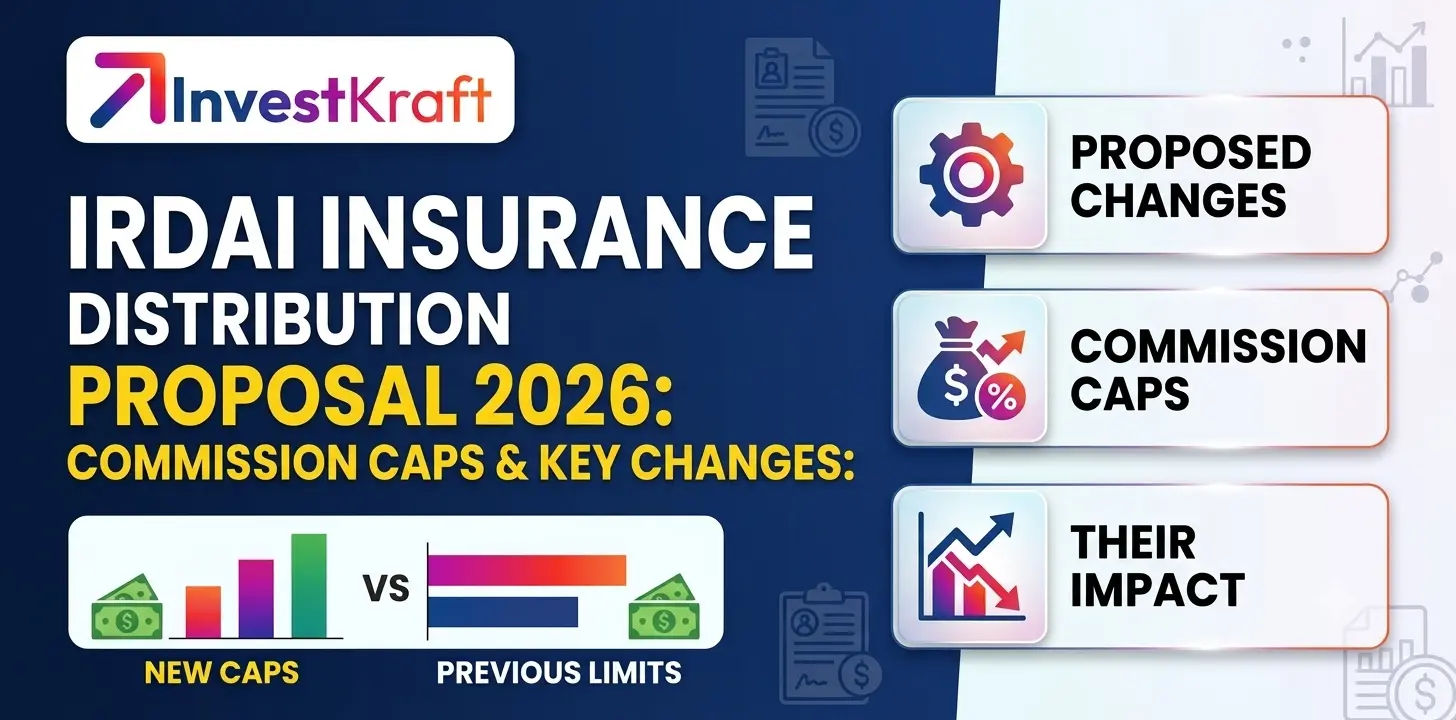
On 23 September 2026, the Insurance Regulatory and Development Authority of India released a public consultation paper titled “Recalibrating Economics of Insurance Distribution". It is a draft plan that states some new guidelines on how insurance is sold in India, how much sellers earn, and how customers are treated.
These are the IRDAI insurance distribution proposal 2026, and they could affect agents, brokers, banks, car dealers, online platforms, and, most importantly, someone who buys a policy. The blog below explains what is being proposed, why, and what it may mean for you as a customer, insurer, or an agent.
What are the major Changes Proposed by IRDAI?
IRDAI insurance distribution reforms 2026 cover almost every part of insurance. Here are the major proposals by IRDAI:
1. New Insurance Distribution Structure: IDE, IDP and MII
Today, India's insurance distribution runs multiple entity-level and individual categories of intermediaries. Now, IRDAI wants to replace this with only three categories, which are:
Insurance Distribution Entity (IDE): Institutional insurance distributors such as a bank, a broker, or corporate agents, etc
Insurance Distribution Person (IDP): Individual sellers, with proposed sub-categories such as insurance agents, associates, specified persons, and Point of Sale Persons (POSP).
Market Infrastructure Institution (MII): Digital market infrastructure that supports wider distribution and comparison.
Besides this, it is also proposed to simplify the eligibility criteria for insurance distribution, such that capital requirements for many IDEs would drop significantly (around ₹10 lakh, plus a small additional deposit linked to the previous year’s insurance income). Registration could become permanent with an annual fee instead of fixed three-year renewals.
2. Insurance Commission Caps for Agents and Distributors
As per the proposal, the commission caps would vary by product complexity, effort required, insurance channel, and whether it is first-year or renewal business. Additionally, all forms of payment (rewards, incentives, gifts, trips, reimbursements) would count toward the commission cap.
Key changes regarding commission:
Individual health insurance (first year): Up to 15% for distribution entities and 20% for agents/associates; lower on renewals.
Life insurance with longer premium-payment terms (10+ years): Around 20% for entities and 25% for agents in the first year, with lower renewal rates.
3. Commission Rules for Motor Insurance Distribution
Motor insurance has high commissions, so the motor insurance distribution reforms include:
Very low commission on compulsory cover: For a new vehicle, third-party insurance would carry no commission for distribution businesses (up to 2.5% for individual agents).
Digital buying option: Customers should get the choice to buy motor insurance through a digital platform.
Cashless repairs: A customer should not be denied cashless repair just because the policy was bought from a different seller than the dealer.
4. EoM Limits for Insurance Companies
Expenses of Management cover commissions plus other operating costs. IRDAI proposes a phased reduction after the proposed rules get implemented:
Life insurers: For Life Insurers, it shall move toward 15% of Gross Direct Premium Income within two years and 12.5% within five years.
General insurers: For General Insurers, the base shall be shifted from Gross Written Premium to domestic Gross Direct Premium Income (GDPI) and move from 30% of GWP to 20% of GDPI within five years
5. More Transparency for Customers
Many insurance websites ask for your name, phone number, and email before they show you the policy’s key details and premium, and this simple input of personal information turns into sales calls. IRDAI calls this a "dark pattern" and wants it stopped. Under the proposal, product information sheets, brochures, FAQs, premium rates, and performance details should be available without sharing any personal details by the customers or buyers.
6. Stronger Mis-Selling Rules
IRDAI consultation paper 2026 has proposed stronger insurance mis-selling rules. If a policy is forcefully sold to a customer, the commission paid to the seller can be taken back (claw-back). Additionally, banks and NBFCs will not be allowed to make insurance compulsory with loans. They can still offer benefits like a lower interest rate on loans if insurance is taken, but they must clearly show the interest rate with and without insurance and give the customers full liberty to decide.
7. Bima Sugam and Public Insurance Registry
IRDAI has proposed Bima Sugam to be a part of its digital infrastructure where customers can compare and buy insurance themselves based on price and quality, and a Public Insurance Registry (PIR) would hold verified details of insurers, products, and distributors to make it easier for customers to check information and compare options.
To understand the proposed reforms in a simpler way, you can also go through our detailed video on IRDAI Insurance Distribution Reforms 2026.
Why is IRDAI Proposing Changes to Insurance Distribution?
But why is IRDAI bringing such proposals? In the past few years, it has been observed that insurance sellers seem to be earning much more than the business they bring in. IRDAI compared the period from 2022-23 to 2024-25 and found a big gap:
General insurance sold through brokers: Premiums grew 37%, but commissions grew 173%.
Life insurance sold through corporate agents (including banks): New-business premiums grew 28%, but total payments to sellers, which include commissions, rewards and incentives, grew 125%.
Motor insurance: Motor manufacturer-linked brokers and motor insurance service providers brought in about ₹29,000 crore of premium in 2024-25 and received almost ₹7,050 crore as commission.
IRDAI has said that heavy dependence on commission-led selling, along with poor transparency on price and quality, has weakened real competition and can push sellers towards higher-commission products instead of the ones that suit the customer best.
How Could the Reforms Affect Insurance Agents, Distributors & Customers?
The IRDAI proposed insurance reforms 2026 may affect each one differently. Here is how to understand it:
Individual Agents
Under the proposed IRDAI insurance agent reforms, individual agents are expected to receive higher commission caps than distribution entities (such as banks and brokers) on several products. Extra incentives are also indicated for business sourced from smaller towns and rural areas. However, renewal commissions are proposed to be significantly lower than first-year commissions.
Insurance Distributors
They would face limits on commissions, and volume-linked or reward-linked incentives for bank and NBFC staff who sell insurance would be restricted. The seller's identity would be linked to each policy, and commissions can be taken back in cases of mis-selling.
Insurance Customers
For most insurance customers, the effects of these reforms can be identified as follows:
Easy-to-compare information: Product, price, and quality details in a standard, simple format under the Bima Sugam platform
Commission disclosure: Insurers and large distributors would have to explain their commission policies, and specified commercial policies would carry commission disclosures, so you know how much distribution cost is included in the price.
Key details before buying the policy: If the reforms are implemented, you could check the key details, like the premium, without filling in a form first.
Conclusion
The IRDAI insurance distribution reforms 2026 are aimed at providing a simpler distributor structure (IDE, IDP, MII), effort-linked commission caps, lower overall expense limits for insurers, tighter mis-selling and bundling rules, and better digital infrastructure. These proposals will make insurance more affordable, transparent, and customer-driven while keeping the distribution network simplified.
Entry into the distribution business is also expected to become easier with lower capital requirements and simpler registration. Training and qualification standards for new distributors are proposed to be raised so that customers receive better guidance.
Disclaimer: This blog is based on the IRDAI consultation paper on insurance distribution reforms released in September 2026. These are consultation proposals only, and feedback is open until 25 October 2026. After reviewing the comments, IRDAI will finalise the regulations, and the possible effective dates under consideration are 1 January 2027 or 1 April 2027. Readers are advised to refer to the official IRDAI notifications for the latest updates.
Frequently Asked Questions
These are proposed changes released by IRDAI on 23 September 2026 in a consultation paper titled “Recalibrating Economics of Insurance Distribution.” The reforms aim to simplify the distributor structure, control commissions and expenses, improve transparency, and strengthen customer protection.
No, these are only consultation proposals. IRDAI has invited public and stakeholder feedback until 25 October 2026, after which the final regulations will be framed.
IRDAI has proposed product- and channel-specific commission caps based on complexity and effort. All forms of payments, including rewards, incentives, gifts, and trips, will count toward the cap. First-year commissions are higher than renewal commissions.
Yes, brokers, banks, and digital platforms fall under Insurance Distribution Entities and will face the proposed lower commission caps. Volume-linked or reward-based incentives for bank and NBFC staff selling insurance are also proposed to be restricted.
The proposals include associating the seller’s identity with each policy, allowing commission claw-back (withdrawal of commission) if mis-selling is proven, and stopping volume- or reward-based incentives for bank and NBFC staff.
No, compulsory bundling of insurance with loans will not be allowed. Benefit packages (such as a lower interest rate linked to insurance) can still be offered, but the lender must clearly show the interest rate with and without insurance, and the customer must be free to buy from any provider.
Bima Sugam is proposed as a digital marketplace where customers can compare and buy insurance based on price, features, and quality. It is an example of a Market Infrastructure Institution (MII) and is meant to support more transparent, customer-driven distribution.
Lower distribution and management costs create chances for better value, which could appear as more competitive premiums or improved returns. However, premiums also depend on claims costs and other factors, so cheaper policies are not guaranteed.
These are still proposals. After the consultation ends on 25 October 2026, IRDAI will finalise the regulations. Possible effective dates under consideration are 1 January 2027 or 1 April 2027.
Stakeholders can share their comments and feedback through the official consultation portal by uploading the prescribed Excel template, or by sending an email. The last date to submit feedback is 25 October 2026.
Author: Diwakar Kumar Singh
Diwakar Kumar Singh is a BFSI specialist and finance writer with over 7 years of hands-on experience in financial research, content creation, and analysis.
A Gold Medalist in MBA (Marketing) from IMT, he combines deep analytical skills with practical insights gained from evaluating companies, IPOs, unlisted shares, financial ratios, and investment opportunities. Diwakar has personally analysed hundreds of financial instruments and market scenarios, which he uses to break down complex topics into clear, actionable advice.
He has authored numerous in-depth finance articles, published multiple books internationally, and contributed to research publications. His work focuses on helping everyday investors and readers make better-informed financial decisions through well-researched, evidence-based explanations that are always grounded in real-world application rather than theory alone.


 care@investkraft.com
 +91-9599071040
 +91-9797971876










.webp)


