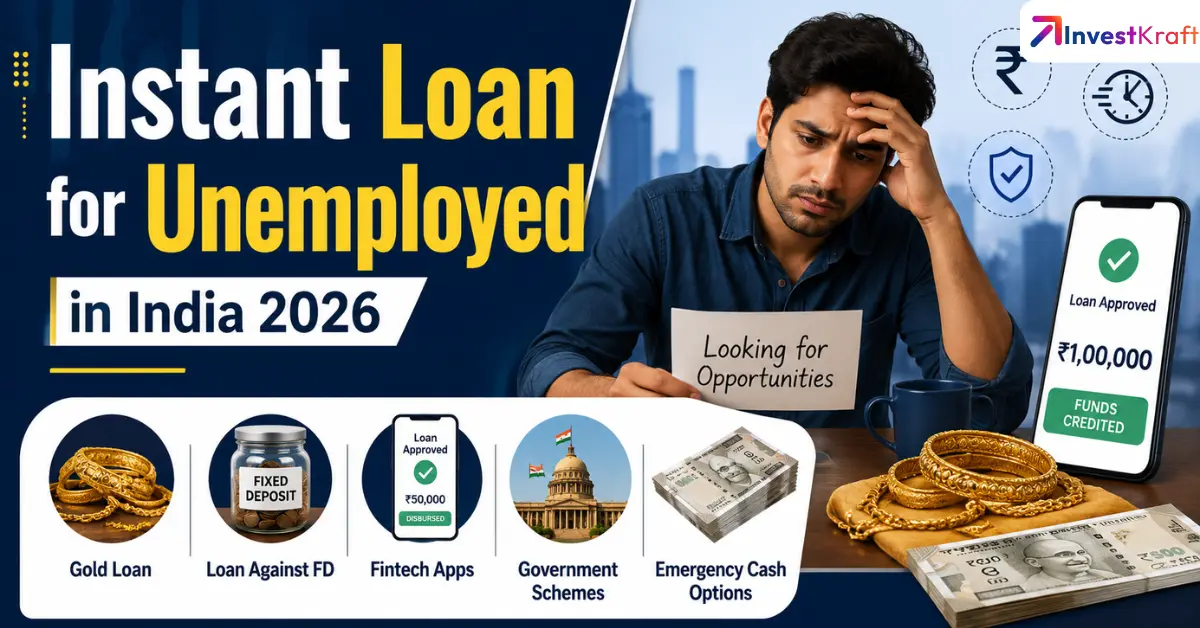
You lost your job three months ago. Or you are between freelance projects. Or you are a housewife who needs emergency funds. Or you are a fresh graduate still searching for your first role.
And now rent is due, a medical bill has arrived, or a family emergency has struck.
According to CMIE data, 9.2% of India's working-age population is currently unemployed.
That is tens of millions of people who still face rent, medical bills, and daily expenses - and still need financial help.
The standard advice - "show your salary slip" - does not apply here. But the money still needs to come from somewhere.
Here is the good news: in 2026, lenders have adapted. Whether you are a student between courses, a housewife with rental income, a gig worker between projects, or someone who has recently lost their job, there are real, verified, working options available right now.
This guide covers every legitimate route to an instant loan without a job in India in 2026 - with exact loan amounts, eligibility conditions, interest rates, and application steps.
Critical Warning Before You Start
Never use a loan app that charges upfront fees before disbursal - that is a clear fraud signal. Legitimate lenders deduct fees from the disbursed loan amount; they never ask you to pay first.
Unemployed borrowers are a primary target of loan scam apps in India. Verify any app on the RBI's Digital Lending Apps (DLA) Directory before applying. If an app promises an instant, large loan with zero verification and zero documents, it is almost certainly a scam.
What Do Lenders Look for Instead of a Salary Slip?
Understanding this is the key to getting approved. Lenders are not looking for a salary slip specifically - they are looking for evidence that you can repay.
When formal income proof is absent, lenders evaluate as follows:
All Options at a Glance for Loans for Unemployed in India 2026
The following are the various options available for loans for the unemployed in India:
Now, let us understand these options in detail.
Option 1: Gold Loan - The Fastest Route for Any Unemployed Borrower
The fastest way: pledge 12 to 15 grams of gold at Muthoot Finance or Manappuram and get money in hand within 30 to 60 minutes. You only need PAN and Aadhaar.
A gold loan is one of the most popular instant loans for unemployed people as it has minimal documentation, and most lenders do not require income proof. Gold loan bypasses everything - no salary slip, no CIBIL check, no ITR. The gold you pledge is the only security the lender needs.
1.1: Key Details in 2026
The 2026 gold loan market is divided between Banking Titans (lowest cost), NBFC Giants (speed and reach), and Fintech Disruptors (doorstep convenience).
Banks like SBI, HDFC, and ICICI offer the best rates starting at 8.75% for large ticket loans above ₹10 lakh with slightly longer processing.
Muthoot Finance and Manappuram - the two dominant NBFC gold lenders - offer faster processing with rates slightly higher.
The Unified Lending Interface (ULI) in 2026 has reduced the "request-to-disbursement" time from hours to just 15 minutes in most urban centres.
New in 2026: In a landmark move, the RBI now allows regulated entities to accept silver ornaments (up to 10 kg) and silver coins (up to 500 grams) as collateral - opening up credit access for millions of households who hold silver as their primary savings.
1.2: Gold Loan - Lender Comparison
Lender
Interest Rate
LTV
Speed
SBI Gold Loan
8.75% p.a.
Up to 75%
45 to 90 minutes
HDFC Gold Loan
9.50% p.a.
Up to 75%
Same day
Muthoot Finance
12% to 24% p.a.
Up to 75%
30 to 60 minutes
Manappuram Gold Loan
12% to 28% p.a.
Up to 75%
30 minutes
IIFL Gold Loan
11% to 27% p.a.
Up to 75%
30 minutes
1.3: How to apply
Walk into any Muthoot, Manappuram, or bank branch with your gold jewellery, PAN, and Aadhaar.
The gold is weighed and assessed in front of you.
Loan amount is calculated at up to 75% of the gold's value.
Funds are transferred to your bank account within the hour - or given as cash for smaller amounts.
Doorstep gold loan: Most major lenders, including Muthoot and Rupeek, now operate an "Uber-style" model where a loan officer comes to your home, assesses the gold, and disburses within the same visit.
Best for: Anyone with idle gold jewellery who needs emergency cash - the amount, urgency, and zero income requirement make this the single best option for most unemployed borrowers.
Option 2: Loan Against Fixed Deposit - Your Own Money Backs the Loan
If you have an active Fixed Deposit - either your own or a family member's - banks offer loans against it at very low interest rates with same-day disbursal.
Banks lend 75% to 90% of the FD value as a loan. The FD continues to earn interest throughout the loan period. The loan interest rate is typically 1% to 2% above the FD rate - so effectively, you are borrowing your own money at a net cost of 1% to 2%.
No CIBIL check. No income proof. No salary slip. Your FD receipt is the only collateral - and your deposit continues to earn interest while you use the borrowed funds.
Best for: Anyone with an existing FD who needs immediate liquidity without breaking the deposit and losing interest.
Option 3: Fintech Apps - For Unemployed Borrowers With a Bank Statement
Several fintech platforms assess your bank statement - not your salary slip - to evaluate your loan eligibility. If your account shows regular incoming credits (freelance payments, rental deposits, family transfers, or any consistent inflow), you may qualify.
Lenders have adapted. Whether you are a student, a housewife, a gig worker between projects, or someone who recently lost their job, knowing how to get a loan without a job starts with understanding what lenders check instead of a salary slip.
3.1: Fintech Apps for Unemployed Borrowers in 2026
The following are some of the most popular fintech apps for unemployed borrowers in India in 2026 with their features:
3.2: What these apps check
Regular credits appearing in the last 3 to 6 months of bank statements
No dishonoured ECS or bounced cheques
A CIBIL score of 700 or above (strongly preferred)
Clean repayment history on any previous loans
Key limitation: Most of these apps technically require "some income source" - freelancing, rentals, part-time earnings, or family support transfers. Truly zero-income borrowers with no bank activity will struggle to qualify even on fintech platforms.
Best for: Freelancers, gig workers, housewives with rental income, and recently unemployed individuals with good CIBIL and recent bank activity.
Option 4: Add a Co-Applicant - The Most Reliable Unsecured Route
You can significantly increase your approval chances by adding a salaried family member - spouse or parent - as a co-applicant. The loan is then approved based on their stable income profile.
This is the most reliable route to an unsecured personal loan when you have no income. The bank evaluates your co-applicant's salary, CIBIL score, and FOIR - and if these are satisfactory, approves the loan in the combined application.
4.1: What you need?
A direct family member willing to be a co-applicant - spouse, parent, sibling
Their salary slips, bank statements, and Form 16
Their CIBIL score should be 700 or above (750+ preferred)
Their FOIR (existing EMI-to-income ratio) is below 50%
Loan amounts possible: Depends entirely on the co-applicant's income. On a ₹50,000 monthly income, you could jointly qualify for ₹3 to ₹5 lakh in a personal loan.
Best for: Housewives, students, and recently unemployed individuals with a financially strong family member willing to co-apply.
Option 5: Government Schemes - For Self-Employment and Business Start-Up
This is where most unemployed people search - and where the most confusion exists.
PM MUDRA Yojana and PM Rozgar Yojana (PMRY) are NOT personal emergency loans for rent or medical bills.
They are business loans for starting or expanding a small business or self-employment venture. If you need urgent personal cash, these schemes will not help you. But if you need funds to start a business and become self-employed, these are genuinely excellent options. Some of the best schemes are as follows:
5.1: Pradhan Mantri Mudra Yojana (PMMY)
Loans up to ₹20 lakh for non-corporate, non-farm micro-enterprises
No collateral required (for amounts up to ₹10 lakh)
Three categories: Shishu (up to ₹50,000), Kishore (₹50,001 to ₹5 lakh), Tarun (₹5 lakh to ₹10 lakh), Tarun Plus (₹10 to ₹20 lakh).
PMRY can be availed by those looking to start their entrepreneurial journey in business, manufacturing, trade, or the service sector.
The project cost is ₹2 lakh for the business sector and ₹5 lakh for the service and industry sectors.
15% subsidy on the project cost is available.
Age limit: 18 to 35 years; relaxed for SC/ST/women/ex-servicemen.
5.3: PMEGP (PM Employment Generation Programme)
Up to ₹50 lakh for manufacturing, ₹20 lakh for the service sector
Subsidy up to 35% for rural applicants, 25% for urban
Administered by KVIC - apply at the KVIC official portal
5.4: National Backwards Classes Finance and Development Corporation
Loans up to ₹15 lakh for self-employment ventures, available to individuals from backward classes with a viable business plan through designated banks.
5.5: State-Specific Schemes
Tamil Nadu NEEDS Programme: 25% rebate on loans for unemployed graduates. West Bengal Unemployment Loan: ₹50,000 to unemployed youth aged 18 to 45 for starting businesses. Agriculture graduates: government-partnered agriculture loans in multiple states.
Best for: Unemployed youth with a business idea, trade skill, or service concept - not for personal emergency cash.
Option 6: Loan Against Property - Large Amounts Without Formal Income
If you own residential or commercial property - either outright or with a low outstanding loan - a Loan Against Property (LAP) is available without formal salary proof at several lenders.
Amount: Up to 70% of the property's market value
Interest rate: 8.50% to 11% per annum
Tenure: Up to 15 years.
CIBIL needed: 650 and above
Income proof: Flexible - bank statements and alternative income evidence are accepted at many NBFCs.
LAP gives access to significantly larger amounts than any unsecured option - making it viable for major emergencies, medical bills, or business capital.
Best for: Property-owning unemployed borrowers needing large amounts (₹5 lakh to ₹1 crore) at reasonable interest rates.
How to Get ₹3,000 to ₹20,000 Urgently Without a Job
These are the most searched amounts - here is the most practical answer for each:
Need ₹3,000 urgently: Download mPokket, upload Aadhaar and PAN, provide bank account and loan disbursed in minutes. No income proof or CIBIL score required for amounts this small.
Need ₹10,000 urgently: mPokket, Pocketly, or KreditBee - all approve ₹10,000 within minutes to hours on bank statement verification. Alternatively: pledge 5 to 6 grams of gold at Muthoot for same-day cash.
Need ₹20,000 urgently: Get ₹20,000 urgently through RBI-registered loan apps like KreditBee, Navi, Kissht, Moneyview, or CASHe. These apps usually require only PAN, Aadhaar, and a bank account, and the amount is credited within minutes to a few hours after approval. Or: pledge 10 to 12 grams of gold at any Muthoot branch.
Need ₹50,000 urgently: Gold loan (25 to 30 grams) or loan against FD. Alternatively, fintech platforms like Stashfin, Moneyview, or Airtel Finance with a CIBIL score of 700+ and clean bank statements.
What to Avoid: Fraudulent Loan Apps Targeting Unemployed Borrowers
Unemployed borrowers are specifically targeted by fraudulent apps. Here are the exact red flags:
Upfront fee before disbursal: Any app that asks for a processing fee, security deposit, or insurance payment before disbursing funds is a scam. Legitimate RBI-registered lenders always deduct fees from the disbursed amount - never ask you to pay first.
No NBFC partner named: If the app does not clearly name its lending partner, it is not legitimate.
Access to your contact list: Used to harass friends and family for recovery. Deny this permission immediately.
Promises of ₹5 lakh with zero verification: No legitimate lender gives large unsecured loans with zero KYC.
Interest rates above 3% per month: While high, 3% per month is the RBI Digital Lending guideline threshold. Apps charging 5% to 10% per month are predatory.
Verify any app: Search it on the RBI DLA Directory before downloading.
Smart Alternatives to Loans for Unemployed Borrowers
Before borrowing, consider these alternatives that do not create debt:
Provident Fund (PF) Withdrawal: If you were previously employed and have an EPF account, you can withdraw up to 75% of your PF balance after one month of unemployment - completely interest-free, on the EPFO portal at epfindia.gov.in.
PPF Partial Withdrawal: After 5 years of PPF account operation, partial withdrawals are permitted - interest-free and tax-free.
Mutual Fund Redemption: If you have SIP investments, partial redemption gives instant liquidity - often better than borrowing at 24% interest.
PMJJBY / PMSBY Claims: If an unemployment event was triggered by illness or accident, check insurance claim eligibility under Pradhan Mantri Jeevan Jyoti Bima Yojana or Pradhan Mantri Suraksha Bima Yojana.
Summary
Getting a loan without a job in India in 2026 is possible - but requires choosing the right option for your specific situation. Here is the complete recap:
Gold Loan: Fastest option - 30 to 60 minutes, no income proof, no CIBIL check. Best for emergency cash with idle gold.
Loan Against FD: Cheapest option - net cost of 1% to 2%. Best if you have an existing fixed deposit.
Fintech Apps (mPokket, KreditBee, Moneyview): Best for small amounts (₹5,000 to ₹2 lakh) with a 700+ CIBIL and an active bank account showing some inflows.
Co-Applicant Loan: Most reliable unsecured route - borrow based on a salaried family member's profile.
Government Schemes (PMMY, PMEGP, PMRY): Best for starting a business - not for personal emergency cash. Apply at the Udaymimitra Portal or the Jansamarth Portal
Loan Against Property: Best for large amounts (₹5 lakh+) when you own property.
PF Withdrawal: The smartest first step - your own money, zero interest, no repayment.
The golden rule for unemployed borrowers: Always exhaust your own assets (PF, FD, mutual funds, gold) before borrowing from an external lender. If you must borrow, verify the NBFC partner, read the Key Fact Statement, and never pay an upfront fee.
Frequently Asked Questions
Can I get a loan if I am unemployed in India?
Yes - gold loans, loans against FD, fintech apps (with bank statements), co-applicant loans, and government business schemes are all accessible without formal employment proof.
Can I get a loan in 5 minutes?
Yes - the fastest way is to pledge gold at Muthoot Finance or Manappuram and get money within 30 to 60 minutes; fintech apps like mPokket and KreditBee can disburse small amounts within minutes for eligible profiles.
How to get ₹20,000 urgently without a salary slip?
Get ₹20,000 urgently through apps like KreditBee, Navi, Kissht, or Moneyview using just PAN, Aadhaar, and a bank account - or pledge 10 to 12 grams of gold at any Muthoot branch for same-day cash.
How to get ₹3,000 urgently as an unemployed person?
Download mPokket, upload PAN and Aadhaar, provide bank account details - ₹3,000 is disbursed within minutes with no income proof or CIBIL score required for amounts this small.
Is the MUDRA loan available for unemployed individuals?
PMMY Mudra loans are for starting or expanding a small business - not for personal emergency expenses; if you have a business idea, apply at udyamimitra.in or jansamarth.in.
What is the safest loan option for an unemployed person with zero income?
A gold loan is the safest - no CIBIL check, no income proof, the gold is your security, and you get cash within an hour; a loan against FD is equally safe and cheaper if you have an existing fixed deposit.
Can a housewife get an instant loan without income proof?
Yes - through a co-applicant loan using her spouse's income, a gold loan against household jewellery, or fintech apps if her bank account shows regular incoming transfers; mPokket and Pocketly are commonly used by housewives for small amounts.
Sources
All information verified from official and authoritative sources:
FinanceHelpCheck - How to Get a Loan Without a Job in India: 8 Real Options 2026 (March 18, 2026): financehelpcheck.com/how-to-get-a-loan-without-a-job
MoneyView - Personal Loans for Unemployed in India: moneyview.in/loans/personal-loans-for-unemployed
Aditya Birla Capital - Urgent Cash Loans for Unemployed in India: adityabirlacapital.com/abc-of-money/urgent-cash-loans-for-unemployed-in-india
MoneyView - Indian Government Business Loans for Startups and Unemployed: moneyview.in/loans/indian-government-business-loans-for-startup-and-unemployed-peoples
PolicyBazaar - Government Personal Loan Schemes 2026 (July 4, 2025): policybazaar.com/investment-plans/government-personal-loan-schemes
RBI - Digital Lending Apps Directory and Digital Lending Directions 2025: rbi.org.in
EPFO - EPF Withdrawal for Unemployed Members: epfindia.gov.in
JanSamarth Portal - Government Scheme Loan Applications: jansamarth.in
Disclaimer: Loan eligibility, interest rates, and scheme details are as of May 2026 and subject to change. Government scheme terms vary by state and are revised periodically. Always verify the NBFC partner before applying to any digital lending app. This article is for informational purposes only and does not constitute financial advice. Borrow only what you can repay.
Author: Diwakar Kumar Singh
Diwakar Kumar Singh is a BFSI specialist and finance writer with over 7 years of hands-on experience in financial research, content creation, and analysis.
A Gold Medalist in MBA (Marketing) from IMT, he combines deep analytical skills with practical insights gained from evaluating companies, IPOs, unlisted shares, financial ratios, and investment opportunities. Diwakar has personally analysed hundreds of financial instruments and market scenarios, which he uses to break down complex topics into clear, actionable advice.
He has authored numerous in-depth finance articles, published multiple books internationally, and contributed to research publications. His work focuses on helping everyday investors and readers make better-informed financial decisions through well-researched, evidence-based explanations that are always grounded in real-world application rather than theory alone.


 care@investkraft.com
 +91-9599071040
 +91-9797971876