If you have ever paid ₹800 for a doctor's consultation, ₹1,200 for a blood test, and another ₹600 for medicines - all in the same week - you already know the pain OPD cover is built to solve.
Yet most people buying health insurance in India have no real idea what OPD means, whether their own policy includes it, or why their ₹10 lakh sum insured did nothing to help with last month's dermatologist visit.
This blog breaks down everything - OPD full form, how OPD differs from hospitalisation cover, what a typical policy actually pays for, real 2026 cost data, and a step-by-step claims process.
So you can decide, with confidence, whether OPD cover is worth adding to your plan.
Quick Answer Box
Before we start with the details, let us first understand some basic questions that are asked about OPD:
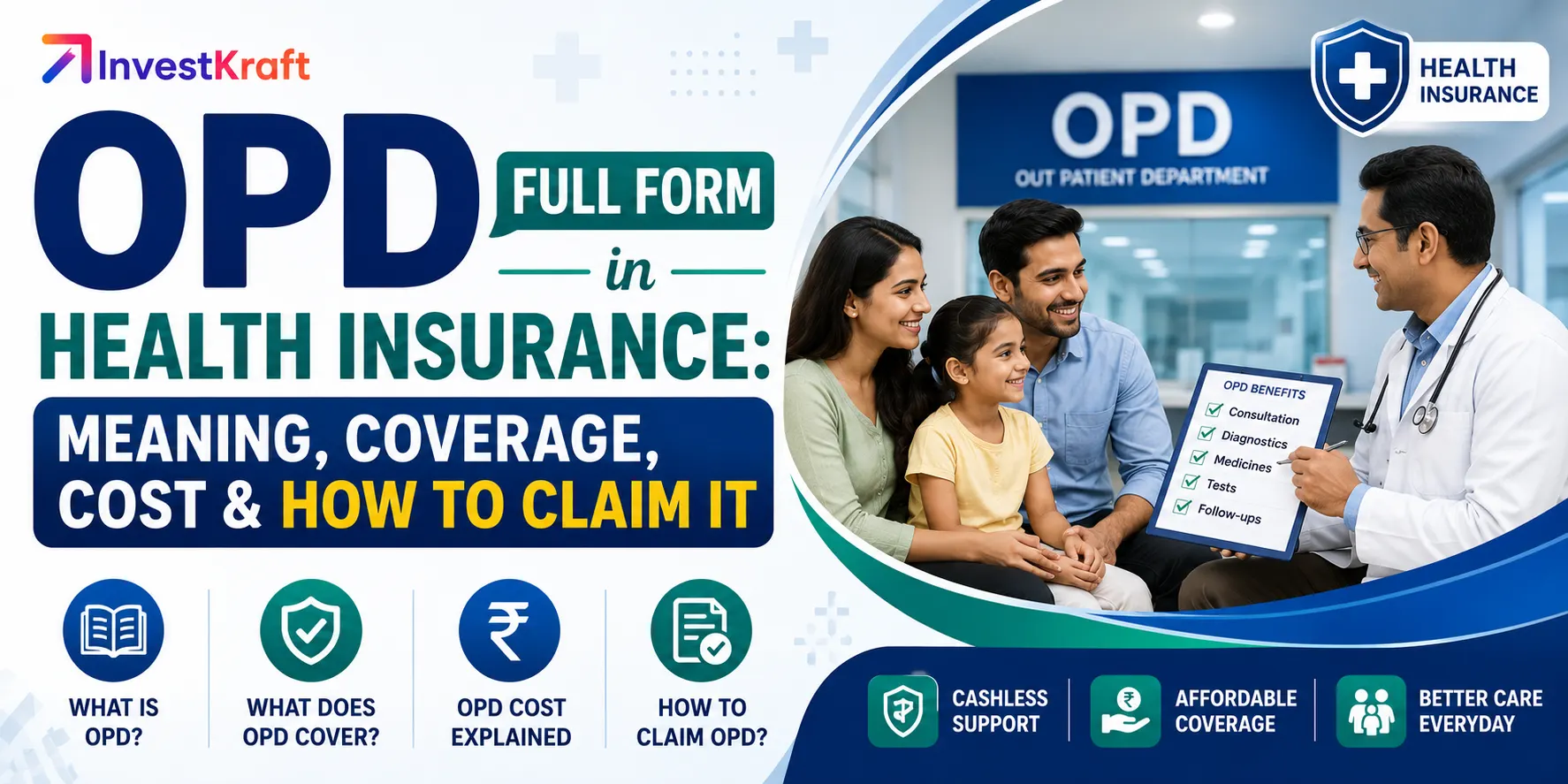
OPD full form: Out-Patient Department
What it means in insurance: Coverage for medical expenses that don't require hospital admission - consultations, tests, medicines, minor procedures
Typical annual limit: ₹5,000 to ₹25,000 per family on most Indian health insurance policies with OPD coverage
Is it included by default?: No - OPD cover is not included in all health insurance plans and is usually a rider or add-on
Claim type: Mostly reimbursement, though some insurers now offer cashless OPD at select clinics
OPD Meaning in Healthcare
OPD stands for Out-Patient Department. In a hospital, it is the section - covering areas like general medicine, orthopaedics, gynaecology, and more - where you walk in, consult a doctor, and walk out the same day.
No admission, no hospital bed, no overnight stay.
Think of it this way: if you are wheeled into a hospital and kept for observation or surgery, that is In-Patient Department (IPD) territory. If you simply visit a doctor's cabin, get examined, collect a prescription, and leave - that is OPD.
In the context of health insurance, this distinction matters enormously, because most Indian health insurance policies are built almost entirely around IPD - meaning your day-to-day doctor visits, unless you specifically have OPD cover, come entirely out of your own pocket.
OPD vs IPD vs Day Care Treatment
Let us understand the differences between these commonly used terms in detail from the table below:
Parameter
OPD
IPD
Day Care Treatment
Hospital stay required?
No
Yes, typically 24+ hours
No - completed within 24 hours but classified separately from OPD
Examples
Doctor consultation, blood test, minor dressing
Surgery, accident treatment, ICU care
Cataract surgery, dialysis, chemotherapy sessions
Default insurance cover
Usually excluded unless a rider is bought
Covered under standard sum insured
Usually covered under standard sum insured
Claim type
Mostly reimbursement
Often cashless at network hospitals
Often cashless at network hospitals
Typical annual cap
₹5,000–₹25,000
Full sum insured
Full sum insured
The confusion between OPD and day care treatment is common - and it is worth remembering the core rule:
Day care procedures need hospital admission (even briefly, and often for anaesthesia or monitoring), while OPD never involves admission at all.
How the OPD Process Works?
Let us see the step-by-step process on how OPD actually works:
Step 1: Registration - You book an appointment or walk in and register at the hospital/clinic's OPD counter, sharing basic details and symptoms.
Step 2: Consultation - A general physician or specialist examines you and may prescribe tests or medication.
Step 3: Diagnostics (if needed) - You are sent for blood work, imaging, or other tests, often within the same facility.
Step 4: Prescription & Pharmacy - Medicines are dispensed either at the hospital pharmacy or an external chemist.
Step 5: Payment - Unlike IPD, most OPD visits require you to pay upfront, whether or not you have insurance.
Step 6: Claim Submission (if insured) - You submit consultation and diagnostic bills, along with the prescription, to your insurer for reimbursement - or use a cashless OPD network if your policy offers one.
Step 7: Follow-up - Many chronic conditions require repeat OPD visits, which is exactly where the cost - and the value of OPD cover - adds up.
Types of OPD Services in Indian Hospitals
The following are the various categories of OPD services in Indian hospitals:
General OPD: Routine check-ups, common illnesses, referrals to specialists
Specialist OPD: Cardiology, dermatology, orthopaedics, gynaecology, ENT, and similar departments
Diagnostic OPD: Pathology labs, imaging centres, and diagnostic-only visits
Emergency OPD: Walk-in urgent care that doesn't escalate to admission
Telemedicine OPD: Video or phone consultations, increasingly common and increasingly covered by newer policies
Telemedicine OPD deserves special mention here because it is the fastest-growing category.
Post-2020, most major hospital chains and insurers built out video-consultation infrastructure, and many newer OPD riders now explicitly include a set number of free or discounted teleconsultations per year - useful for quick follow-ups that don't warrant an in-person visit, especially for people in smaller towns with limited specialist access nearby.
What Does OPD Cover Include?
A comprehensive OPD rider or plan typically covers:
Average Cost of an OPD Visit in India in 2026
Outpatient costs vary sharply by city tier and hospital type:
City Tier
General Physician Consultation
Specialist Consultation
Basic Diagnostic Panel
Metro (Delhi, Mumbai, Bengaluru)
₹500 – ₹1,200
₹800 – ₹2,500
₹800 – ₹2,000
Tier-2 cities
₹300 – ₹700
₹500 – ₹1,500
₹500 – ₹1,200
Tier-3/rural
₹150 – ₹400
₹300 – ₹800
₹300 – ₹700
India's medical costs were rising at roughly 14% a year in 2024, among the highest rates in Asia, and outpatient expenses have kept pace.
Data from KPMG and FICCI suggests over 62% of India's total healthcare expenditure goes toward outpatient services like consultations, diagnostics, and medicines - a striking reminder that hospitalisation cover alone leaves a large gap in most people's actual medical spending.
OPD Coverage in Health Insurance
Most Indian health insurance policies exclude OPD by default, treating hospitalisation (IPD) as the primary - and often only - risk they protect against. Where OPD is available, it comes in one of a few structures:
OPD rider on an existing policy: An add-on to your base health plan, usually the most cost-effective route for existing policyholders
Comprehensive health plan with built-in OPD: Bundles OPD, IPD, and sometimes maternity/wellness benefits into a single premium
Employer-sponsored group plan with OPD: The most common way working professionals in India actually get meaningful OPD cover, since the employer typically absorbs most of the cost
Standalone OPD plan: Offered by a few insurers, though less common and usually capped lower
Cashless vs Reimbursement
Unlike hospitalisation claims, which are often cashless at network hospitals, OPD claims are mostly reimbursement-based - you pay first, then submit bills and prescriptions to your insurer.
A small but growing number of insurers now offer cashless OPD at select network clinics and pharmacies.
Standard OPD Cover vs Comprehensive OPD Cover: Which Should You Buy?
Now, from the table below, let us see which OPD cover is best for you:
Families with children, chronic conditions, or elderly members
OPD Insurance Sub-limits, Annual Caps & Waiting Periods
OPD cover almost never runs on the same sum insured as your hospitalisation benefit. Instead, insurers carve out a separate sub-limit:
Annual cap per family: Typically ₹5,000 to ₹25,000, the most common structure
Per-consultation cap: Often ₹500 to ₹2,000 per doctor visit on some plans
Diagnostic and pharmacy sub-caps: Separate smaller limits specifically carved out for tests and medicines within the overall OPD allowance
Waiting period: Generally 30 to 90 days from policy start on retail plans, though some insurers impose a waiting period of 2–3 years before OPD benefits kick in - so always check this before assuming instant access
Reset Time: The OPD limit resets annually on your policy renewal date, and once exhausted, further OPD expenses are paid out of pocket until the next cycle - while your main hospitalisation cover keeps working independently
Tax Benefit on OPD Expenses Under Section 80D
Health insurance premiums - including the portion paid for an OPD rider - generally qualify under Section 80D of the Income Tax Act. For FY 2025-26 (AY 2026-27):
Category
Deduction Limit
Self, spouse, children (all under 60)
₹25,000
Self, spouse, children (any member is a senior citizen, 60+)
₹50,000
Parents (below 60)
₹25,000
Parents (either parent is a senior citizen)
₹50,000
Maximum possible deduction (taxpayer + parents both senior citizens)
₹1,00,000
A ₹5,000 preventive health check-up deduction is also available, but it sits inside these limits rather than adding to them - and it is the one component of Section 80D you are allowed to pay for in cash.
This benefit is available only under the old tax regime, so if you have moved to the new regime, you will not be able to claim it.
From FY 2026-27, these provisions shift to Section 126 of the Income Tax Act 2025, but the limits and rules stay the same.
Who Should Buy Health Insurance With OPD Cover?
Whoever you are, whatever your age is, health insurance nowadays is a must, but health insurance with OPD cover, then the following categories must buy:
Young family with small children: Paediatric visits, vaccinations, and minor illnesses are frequent in the first few years - an OPD rider can offset a meaningful chunk of annual spend.
Senior citizens: Regular specialist consultations, diagnostic monitoring, and ongoing prescriptions make OPD cover one of the highest-utility add-ons for this group
Someone managing a chronic condition: Diabetes, thyroid disorders, or hypertension usually mean quarterly or monthly consultations and tests - precisely the recurring cost OPD cover is designed to absorb.
Understanding OPD Cover with Health Insurance From a Real World Example
Meera, a 34-year-old marketing manager in Pune, initially skipped OPD cover to save on premium, thinking her ₹10 lakh hospitalisation policy had her "fully covered."
That year, her son had two bouts of viral fever, she needed three dermatologist visits for a recurring skin issue, and her mother-in-law required monthly diabetes check-ups during a visit.
By December, she'd spent close to ₹19,000 out of pocket - none of it reimbursable, because none of it involved hospitalisation.
The next renewal, she added a ₹20,000 OPD rider for a modest premium increase, and within the first six months had already claimed back more than half the rider's annual limit.
Her hospitalisation cover never had to be touched - but the OPD rider quietly did the heavy lifting all year.
How to Claim OPD Expenses?
The following are the steps to claim OPD expenses:
OPD Cover: Individual Plans vs Family Floater vs Group/Corporate Insurance
Let us understand various OPD covers from the following table:
Type
How OPD Limit Works
Best For
Individual plan
Fixed OPD sub-limit per person
Single earners, unmarried individuals
Family floater
Nuclear families wanting flexibility
Nuclear families wanting flexibility
Group/corporate insurance
Often the most generous OPD cover, employer-funded
Salaried employees - usually the easiest entry point to real OPD benefits
Top Insurers Offering OPD Cover in India
Let us see some of the top insurers offering OPD cover in India:
Insurer / Plan
OPD Sub-limit
Notable Feature
Manipal Cigna ProHealth Prime Advantage
₹20,000 / ₹30,000 / ₹50,000 (choice of tiers)
Cashless-only OPD via network providers; 20% sub-limit reserved for pharmacy
Always verify current sub-limits, co-payment clauses, and network lists before purchasing - insurers revise these terms periodically.
Common Mistakes to Avoid When Buying OPD Insurance
The following are some of the most common mistakes people make when buying OPD cover for their health insurance:
Not checking the waiting period: Some plans make you wait months, or even years, before OPD becomes claimable
Ignoring per-consultation caps: ₹2,000 specialist bill against a ₹600 per-visit cap means you absorb the difference
Assuming OPD is cashless everywhere: It usually isn't; confirm the claim process before you need it
Skipping the fine print on exclusions: Cosmetic treatments, alternative therapies, and pre-existing condition consultations are commonly excluded
Buying OPD cover you will never use: If your household rarely visits doctors outside emergencies, a high-premium comprehensive OPD plan may not be worth it; match the cover to your actual usage pattern
A simple gut check before buying: Pull up your last 12 months of medical spending - consultations, tests, medicines - and compare that number against the rider's premium plus its annual cap.
If your actual OPD spending consistently runs close to or above the cap, the rider pays for itself.
If it does not, a smaller, cheaper rider (or none at all, with the savings redirected to a slightly higher hospitalisation sum insured) may serve you better.
Summary
OPD (Out-Patient Department) cover fills the exact gap that standard hospitalisation insurance leaves open - the doctor visits, tests, and medicines that make up a huge share of real-world healthcare spending in India but never involve an overnight hospital stay.
It typically comes as a rider with an annual sub-limit of ₹5,000 - ₹25,000, works mostly on a reimbursement basis, and carries its own waiting periods and per-visit caps.
For families with young children, senior citizens, or anyone managing a chronic condition, it is often one of the highest-utility, most frequently used parts of a health insurance policy - even if it never makes headlines the way a ₹10 lakh hospitalisation cover does.
Compare OPD-inclusive health insurance plans on InvestKraft to find one that matches your family's actual healthcare pattern, not just your worst-case scenario.
Disclaimer
This article is for informational purposes only and does not constitute financial or insurance advice. Sub-limits, waiting periods, and terms vary by insurer and policy - please read the policy wording carefully or consult an InvestKraft advisor before purchasing.
Frequently Asked Questions
Q1. What is the full form of OPD in medical insurance?
OPD stands for Out-Patient Department - treatment or consultation that doesn't require hospital admission.
Q2. What is the difference between OPD and IPD?
OPD covers same-day consultations and tests with no admission; IPD covers treatment requiring hospitalisation, typically 24 hours or more.
Q3. Is OPD treatment covered under normal health insurance?
Not by default - most standard policies cover only IPD, and OPD needs a separate rider or a comprehensive plan.
Q4. What is the OPD sub-limit in health insurance?
A separate annual cap, typically ₹5,000–₹25,000, distinct from your main hospitalisation sum insured.
Q5. Can I claim OPD expenses without hospitalisation?
Yes - that's the entire purpose of OPD cover; hospitalisation is never required to claim it.
Q6. What documents are needed for an OPD insurance claim?
Doctor's prescription, original consultation bill, diagnostic reports, and pharmacy bills.
Q7. Is OPD cover worth buying as an add-on?
Usually yes if you or your family visit doctors frequently; less so if your household rarely needs non-emergency care.
Q8. What is cashless OPD treatment?
A facility where the insurer settles the bill directly with an empanelled clinic, so you don't pay upfront - still uncommon compared to reimbursement-based OPD.
Q9. Does health insurance cover dental and eye OPD consultations?
Only if explicitly listed in the policy; many plans exclude cosmetic dental work and basic vision check-ups by default.
Q10. What is the waiting period for OPD cover in health insurance?
Generally 30–90 days on retail plans, though some insurers impose 2–3 years before OPD benefits become active.
Q11. Can OPD expenses be claimed under Section 80D?
The premium paid for an OPD rider qualifies for deduction, but individual OPD bills themselves are not separately deductible.
Q12. What is the average cost of an OPD consultation in India?
Roughly ₹300–₹2,500 depending on city tier and whether it's a general physician or specialist.
Q13. Is OPD covered in Ayushman Bharat/government health schemes?
Ayushman Bharat (PM-JAY) primarily covers hospitalisation; OPD coverage is limited and varies by state-level scheme implementation.
Q14. What is the difference between OPD and day care procedure?
OPD never involves hospital admission; day care procedures require brief admission (often for anaesthesia or monitoring) even if completed within 24 hours.
Q15. Which insurance companies offer the best OPD health insurance plans in India?
Manipal Cigna, Niva Bupa, Royal Sundaram, and Star Health are among the more prominent insurers offering dedicated OPD cover, though the "best" one depends on your sub-limit needs and network access.
Sources
Star Health – OPD Full Form & How OPD Works in Health Insurance Policies
Star Health – OPD Health Insurance Overview
PolicyBazaar – OPD Coverage Under Star Health Insurance
PolicyBazaar – Best Health Insurance Plans with OPD Benefits
Author: Diwakar Kumar Singh
Diwakar Kumar Singh is a BFSI specialist and finance writer with over 7 years of hands-on experience in financial research, content creation, and analysis.
A Gold Medalist in MBA (Marketing) from IMT, he combines deep analytical skills with practical insights gained from evaluating companies, IPOs, unlisted shares, financial ratios, and investment opportunities. Diwakar has personally analysed hundreds of financial instruments and market scenarios, which he uses to break down complex topics into clear, actionable advice.
He has authored numerous in-depth finance articles, published multiple books internationally, and contributed to research publications. His work focuses on helping everyday investors and readers make better-informed financial decisions through well-researched, evidence-based explanations that are always grounded in real-world application rather than theory alone.


 care@investkraft.com
 +91-9599071040
 +91-9797971876