Imagine investing just ₹1,000 a month for your daughter - and watching it grow into over ₹5 lakh by the time she is ready for college. No stock market risk. No tension about market crashes. Just a government-guaranteed promise that your daughter's future is secure.
That is exactly what the Sukanya Samriddhi Yojana (SSY) does.
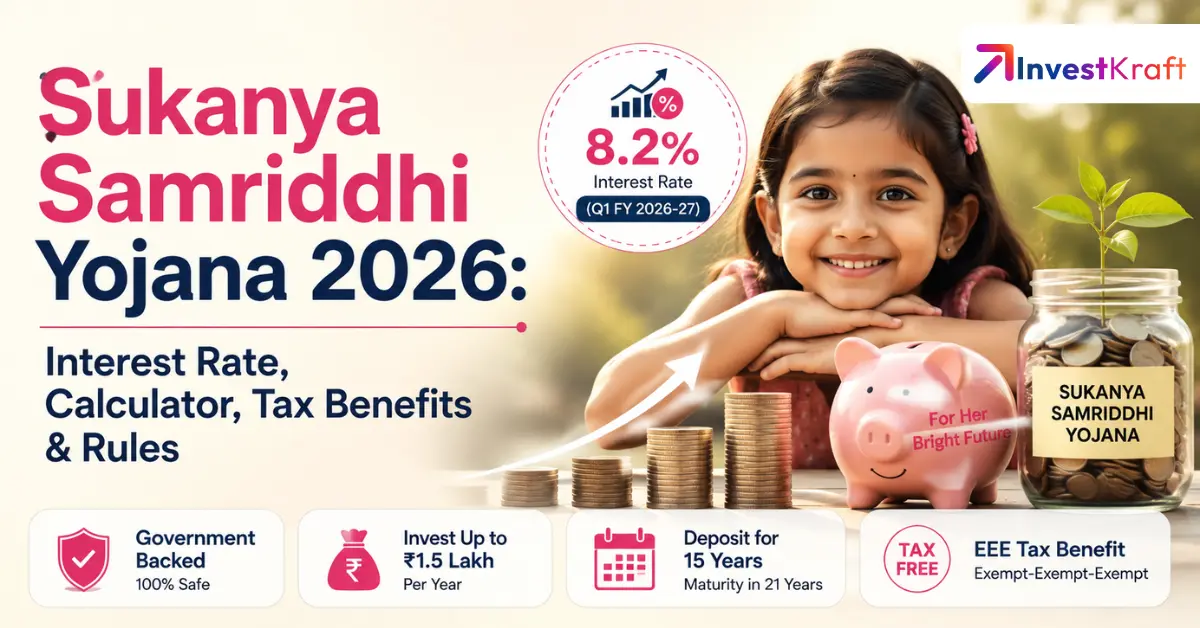
Launched in 2015 under the Government of India's flagship Beti Bachao, Beti Padhao initiative, Sukanya Samriddhi Yojana is one of the best long-term savings schemes available to Indian families today. It offers an interest rate of 8.2% per annum - higher than PPF, higher than most bank fixed deposits, and completely tax-free from start to finish.
The Ministry of Finance, on March 30, 2026, announced that the Sukanya Samriddhi Yojana interest rate for Q1 of FY 2026-27 (April to June 2026) shall remain unchanged at 8.2% per annum.
Whether you are opening an account for a newborn daughter or still evaluating your options, this is the only guide you need. We cover everything - eligibility, interest rates, tax benefits, withdrawal rules, how to apply online and at the post office, calculations for different investment amounts, and much more.
What is Sukanya Samriddhi Yojana?
The Sukanya Samriddhi Yojana (SSY) is a fixed-income small savings scheme introduced by the Indian government in 2015. It is a government-backed savings scheme designed exclusively for the girl child, offering an interest rate of 8.2% - one of the highest among small savings plans in India.
In simple words, a parent or legal guardian opens a dedicated savings account in a girl child's name. They deposit money every year for 15 years. The account continues to earn interest for 21 years from the date of opening - and the entire maturity corpus, including all the interest earned, comes back to the family completely tax-free.
It is not just a savings scheme. It is a structured financial plan for your daughter's education and marriage - backed by the full faith and credit of the Government of India.
Key Features of the Sukanya Samriddhi Yojana
The following table shows the most important features of the Sukanya Samriddhi Yojana at a glance in 2026:
Feature
Details
Launched Under
Beti Bachao, Beti Padhao Initiative
Launched In
Thu, January 1, 2015
Managed By
Ministry of Finance, Government of India
Interest Rate (Q1 FY 2026-27)
8.2% per annum, compounded annually
Minimum Annual Deposit
₹250
Maximum Annual Deposit
₹1.5 lakh
Deposit Period
15 years from account opening
Maturity Period
21 years from account opening
Tax Status
EEE - Exempt, Exempt, Exempt
Where to Open
Post offices and authorised commercial banks
Eligibility
Girl child below 10 years of age
Accounts Per Family
Maximum 2 (or 3 in case of twins/triplets)
Sukanya Samriddhi Yojana Interest Rate in 2026
The Sukanya Samriddhi Yojana interest rate in 2026 is 8.2% per annum, compounded annually and reviewed quarterly. This is higher than many fixed deposits and even beats PPF, which currently offers 7.1%.
The interest for the Sukanya Samriddhi Yojana account is calculated on the lowest balance for the calendar month and is credited once, at the end of each financial year.
Important: To maximise your interest, always deposit before the 5th of April every financial year. Deposits made after the 5th miss out on that month's interest calculation - a small timing detail that adds up significantly over 15 years.
Who is Eligible for the Sukanya Samriddhi Yojana in 2026?
Eligibility is simple and clearly defined:
The girl child must be below 10 years of age at the time of account opening.
The account must be opened by a parent or legal guardian.
The girl child must be a resident Indian at the time of account opening.
If the account holder becomes a non-resident or non-citizen, interest stops accruing from that date, and the account must be closed if residency conditions are no longer met.
What if my daughter is 9 years and 11 months old?
You can still open the account as long as she has not completed 10 years of age on the date of application. Open it immediately - do not wait.
What about adopted daughters?
Yes. Legal guardians of adopted girl children can open an Sukanya Samriddhi Yojana account, provided they can furnish legal adoption documents.
How Much to Invest - The Deposit Rules
Minimum: ₹250 per financial year Maximum: ₹1,50,000 per financial year
You can deposit any amount above ₹250 in multiples of ₹100. There is no restriction on how many times per year you deposit - you can make a single lump-sum deposit or spread it across multiple smaller deposits throughout the year.
If the minimum deposit of ₹250 is not made in a year, a fine of ₹50 will be imposed on the account. The account can be regularised by depositing the minimum amount plus the penalty.
Deposit Period vs Maturity Period - A Common Confusion Clarified:
This is one of the most misunderstood aspects of the Sukanya Samriddhi Yojana.
You deposit for only 15 years. The account continues to earn interest for 21 years from the date of opening. So for the last 6 years of the account's life, your money earns interest at 8.2% per annum without any fresh deposit from your side.
This is the power of the scheme - you stop putting money in after 15 years, and the corpus keeps compounding for 6 more years.
Sukanya Samriddhi Yojana Calculator: How Much Will You Get?
Use these tables to understand what different monthly investment amounts grow into at maturity (8.2% interest, 21-year tenure):
If you invest ₹1,000 per month (₹12,000 per year):
Total Deposited (15 years)
Maturity Amount (21 years)
Interest Earned
₹1,80,000
Approximately ₹5.4 lakh
Approximately ₹3.6 lakh
If you invest ₹2,000 per month (₹24,000 per year):
Total Deposited
Maturity Amount
Interest Earned
₹3,60,000
Approximately ₹10.8 lakh
~₹7.2 lakh
If you invest ₹5,000 per month (₹60,000 per year):
Total Deposited
Maturity Amount
Interest Earned
₹9,00,000
Approximately ₹27 lakh
~₹18 lakh
If you invest a maximum ₹12,500 per month (₹1.5 lakh per year):
Total Deposited
Maturity Amount
Interest Earned
₹22,50,000
Approximately ₹72 lakh
~₹49.5 lakh
If a parent deposits ₹1.5 lakh every year for 15 years in the Sukanya Samriddhi Yojana, then after 21 years on maturity, they get around ₹72 lakh. The total investment is only ₹22.5 lakh, while the interest earned is more than ₹49 lakh.
Note: These are approximate figures at 8.2% per annum. Use an online Sukanya Samriddhi Yojana Calculator - available at nsiindia.gov.in, paisabazaar.com, and bankbazaar.com - for exact calculations specific to your deposit amount, start age, and financial year of opening.
Tax Benefits of Sukanya Samriddhi Yojana
Sukanya Samriddhi Yojana enjoys the EEE (Exempt-Exempt-Exempt) tax status - the gold standard of tax treatment in India. Only a handful of schemes offer this.
Sukanya Samriddhi Yojana enjoys the Exempt-Exempt-Exempt (EEE) tax status, which is the most favourable in tax-saving schemes. Contributions qualify for Section 80C deduction up to ₹1.5 lakh per year. Interest earned on the Sukanya Samriddhi Yojana account balance annually is fully exempt under Section 10 of the Income Tax Act. Final proceeds, including interest and principal amount, are exempt from income tax.
Three Layers of Tax Benefits with SSY:
Tax Benefit
What It Means
Maximum Saving
Section 80C Deduction
Annual deposit reduces your taxable income
Up to ₹1.5 lakh per year
Tax-Free Interest
All interest earned every year is completely tax-free
No limit
Tax-Free Maturity
The entire corpus at maturity - principal + interest - is tax-free
No limit
Example
A parent in the 30% tax bracket investing ₹1.5 lakh per year saves ₹45,000 in income tax annually under Section 80C alone. Over 15 years of deposits, that is ₹6.75 lakh in tax savings - just from the 80C deduction, before counting the tax-free interest and maturity benefit.
What about the New Tax Regime?
The Section 80C deduction is available only under the old tax regime. Under the new tax regime, the 80C deduction is not available. However, the interest and maturity proceeds remain completely tax-free regardless of which regime you choose.
How to Open a Sukanya Samriddhi Yojana Account
You can open a Sukanya Samriddhi Yojana account at two types of locations:
Option 1 - Post Office (Most Common): Any branch of India Post across the country accepts Sukanya Samriddhi Yojana account applications. This is the most widely accessible option, especially in smaller cities, towns, and rural areas.
Option 2 - Authorised Commercial Banks: You can open a Sukanya Samriddhi Yojana account with a participating bank or a Post Office branch. It is more convenient to open a Sukanya Samriddhi Yojana account with the bank where you already hold a savings account if it is one of the participating banks.
Authorised Banks for Sukanya Samriddhi Yojana Account Opening
Step-by-Step Process to Open Sukanya Samriddhi Yojana Account
Understand the steps below carefully, to open a SSY account:
Step 1: Visit your nearest post office or authorised bank branch.
Step 2: Collect the Sukanya Samriddhi Yojana Account Opening Form (Form-1). For banks, forms can be downloaded from the respective bank's website.
Step 3: Fill the form completely. Provide the girl child's name, date of birth, parent/guardian details, and nomination details.
Step 4: Attach the required documents (listed below).
Step 5: Make the initial deposit - minimum ₹250, maximum ₹1.5 lakh.
Step 6: Collect the passbook. Your Sukanya Samriddhi Yojana passbook is proof of account and records all deposits and interest credits.
Can I open Sukanya Samriddhi Yojana online?
Currently, Sukanya Samriddhi Yojana account opening requires a physical visit to a post office or bank branch to submit documents and make the initial deposit. However, once the account is opened:
You can download the IPPB (India Post Payments Bank) app on your smartphone to make online payments towards your Sukanya Samriddhi Yojana account. Through this app, you can set standing instructions so that a specified amount will be transferred online to your Sukanya Samriddhi Yojana account automatically.
Most authorised banks also allow you to link your Sukanya Samriddhi Yojana account to their net banking and mobile banking platforms for online deposit transfers after the account is opened.
Documents Required for Sukanya Samriddhi Yojana
The following are the documents required for SSY account opening:
Document
Who It Belongs To
Sukanya Samriddhi Yojana Account Opening Form (Form-1)
For twins or triplets: A medical certificate from the hospital confirming the multiple birth is required along with the standard documents, to allow opening a third Sukanya Samriddhi Yojana account.
Partial Withdrawal Rules - Accessing Money Before Maturity
Sukanya Samriddhi Yojana is designed for the long term - but the government has built in a sensible partial withdrawal provision for higher education.
Withdrawal limit is 50% of the account balance as of the previous financial year's end. This withdrawal can only be used for educational or marriage expenses. The age limit is that this withdrawal is allowed only when the child has crossed 18 years or passed the 10th Standard, whichever is earlier.
Key Withdrawal Rules:
Rule
Details
Maximum withdrawal
50% of balance as of end of previous financial year
Eligible age
After daughter turns 18 OR after Class 10 pass
Purpose
Higher education expenses only (for partial withdrawal)
Instalment option
Can be withdrawn as a lump sum or in annual instalments (maximum 5 years)
Documents needed
Proof of admission to a recognised educational institution, fee receipts
Example: If your Sukanya Samriddhi Yojana account balance at the end of March 2030 is ₹8 lakh and your daughter has passed Class 10 in 2030, you can withdraw up to ₹4 lakh for her college admission and tuition fees.
Premature Closure Rules
The account normally runs for 21 years. Premature closure is allowed only in specific circumstances:
Sukanya Samriddhi Yojana can be prematurely closed only in the following situations:
As per official government guidelines, after the girl turns 18, an application for closure can be submitted between 1 month before marriage and 3 months after marriage, along with age proof.
Death: If the girl child dies, the balance will be paid to the guardian upon submission of the death certificate. Medical emergencies - premature closure is allowed in case of life-threatening diseases of the account holder or death of the guardian.
General premature closure: If closure is made for reasons other than the above, the account will earn interest at the post-office savings account rate, which is lower than the Sukanya Samriddhi Yojana interest rate.
Summary of Premature Closure Scenarios:
Reason
Condition
Interest Rate Applied
Girl's marriage
After she turns 18; application 1 month before to 3 months after marriage
Full Sukanya Samriddhi Yojana rate
Death of girl child
Death certificate required
Full Sukanya Samriddhi Yojana rate
Life-threatening illness
Medical documents required
Full Sukanya Samriddhi Yojana rate
Death of guardian
Supporting documents required
Full Sukanya Samriddhi Yojana rate
Any other reason
After 5 years from opening
Post Office Savings Account rate (currently ~4%) - a significant penalty
Important: If you close the account for any reason other than the four above, you lose the high Sukanya Samriddhi Yojana interest rate for that period. This is a strong deterrent against arbitrary closure - and rightly so.
Transferring Your Sukanya Samriddhi Yojana Account
The account can be transferred to anywhere in India, and from or to post offices and banks, free of cost on furnishing proof of shifting of residence of either the guardian or the account holder. If transfer is without proof of residence change, a fee of ₹100 is charged to the post office or bank to which the transfer is made.
This is particularly useful for families who relocate due to job transfers. You are never locked to one branch.
Comparison of Sukanya Samriddhi Yojana vs Other Popular Savings Instruments
Now, let us see how SSY compares against other popular saving schemes:
Feature
Sukanya Samriddhi Yojana
PPF
Fixed Deposit (Bank)
Mutual Fund (Equity)
Interest Rate (2026)
8.20%
7.10%
6.5% to 7.75%
Market-linked
Government Guarantee
Yes
Yes
Up to ₹5 lakh (DICGC)
No
Tax on Deposits
Exempt under 80C
Exempt under 80C
No exemption (unless tax-saver FD)
ELSS exempt under 80C
Tax on Interest
Fully exempt
Fully exempt
Taxable as income
LTCG taxable above ₹1.25 lakh
Tax on Maturity
Fully exempt
Fully exempt
Taxable
LTCG taxable
Who Can Invest
Only for girl child below 10
Any individual
Any individual
Any individual
Lock-In
21 years
15 years
5 years (tax-saver FD)
3 years (ELSS)
Partial Withdrawal
Yes - after age 18
Yes - after 7th year
Not before maturity
Anytime (post lock-in)
Note: For parents saving specifically for a daughter's education and/or marriage, Sukanya Samriddhi Yojana is unmatched - in terms of interest rate, tax efficiency, and government backing. The one limitation is the long lock-in and girl-child-specific eligibility, which makes it a complement rather than a replacement for other savings instruments.
Common Mistakes to Avoid With Sukanya Samriddhi Yojana
The following are the common mistakes you must avoid with SSY scheme:
Missing the annual minimum deposit: If you fail to deposit at least ₹250 in a financial year, the account becomes inactive and attracts a ₹50 penalty. Reactivate it by depositing the minimum plus the fine.
Depositing after the 5th of April: For maximum interest in a financial year, always deposit before the 5th of April. Deposits after the 5th miss that month's interest.
Opening more than 2 accounts: Unless twins or triplets are involved, a family can open only 2 Sukanya Samriddhi Yojana accounts - one per girl child. Opening a third account (other than for twins/triplets) is not permitted.
Confusing deposit period with maturity period: You deposit for 15 years. The account matures after 21 years. Do not withdraw before 21 years (except under permitted rules), expecting the account to have run its full course.
Forgetting to update the passbook: Regularly update your Sukanya Samriddhi Yojana passbook at the post office or bank to track interest credits and the growing corpus.
Not linking online payments: Many families forget that they can make recurring automatic transfers via IPPB app or their bank's net banking once the account is open. Set up standing instructions to never miss a deposit.
Smart Tips to Maximise Your Sukanya Samriddhi Yojana Returns
You can follow these tips to maximise your SSY returns:
Open the account as early as possible: The earlier you open, the more compounding cycles your money goes through. An account opened for a 1-year-old will have 20 years of compounding. One opened at age 9 will have only 12 years of active deposits before the age-based withdrawal window.
Deposit the maximum ₹1.5 lakh every year if you can: The growth from ₹22.5 lakh invested to ₹72 lakh at maturity is extraordinary. If you cannot invest the maximum, invest whatever you can - even ₹500 a month makes a meaningful difference over 21 years.
Always deposit before April 5. This ensures you get the interest for the full month of April - and every month thereafter - for that financial year.
Combine Sukanya Samriddhi Yojana with other investments: Sukanya Samriddhi Yojana is excellent for a long-term, guaranteed, tax-free corpus. Complement it with SIP investments in equity mutual funds for higher growth potential on additional savings.
Use it under the old tax regime for Section 80C benefits: If you are on the old tax regime, the ₹1.5 lakh Sukanya Samriddhi Yojana deposit can effectively replace or supplement your other 80C investments (like ELSS or tax-saver FDs) - with the added advantage of complete tax-free returns.
Summary
Sukanya Samriddhi Yojana in 2026 remains one of the safest, most rewarding, and most tax-efficient savings instruments available to Indian parents. Here is the complete recap:
What it is: A government-backed small savings scheme exclusively for girl children under 10 years, designed to build a large corpus for education and marriage.
Interest rate: 8.2% per annum, compounded annually - confirmed for Q1 FY 2026-27 (April to June 2026). Higher than PPF, most bank FDs, and other small savings schemes.
How much to invest: Minimum ₹250 to maximum ₹1.5 lakh per financial year. Invest for 15 years; the account matures at 21 years.
Tax benefits: Full EEE status - deposits deductible under Section 80C, interest completely tax-free, maturity amount completely tax-free.
Withdrawal: Up to 50% of balance allowed after the daughter turns 18 or passes Class 10, for education expenses. Full closure allowed on marriage after age 18.
Where to open: Any post office across India or an authorised bank (SBI, HDFC, ICICI, PNB, Axis, and others). Account opening requires a physical visit; deposits can be made online after opening.
Documents needed: Birth certificate of girl child, Aadhaar and PAN of parent/guardian, address proof, and passport-size photographs.
Best for: Any parent with a daughter below 10 years of age who wants a guaranteed, tax-free, government-backed long-term savings plan.
The single most important action you can take today: if your daughter is below 10 years of age and you do not have an Sukanya Samriddhi Yojana account yet, open one this week. Every month you wait is a month of 8.2% compounded returns you cannot get back.
Frequently Asked Questions
What is the Sukanya Samriddhi Yojana?
Sukanya Samriddhi Yojana is a government-backed savings scheme launched in 2015 under Beti Bachao, Beti Padhao, designed exclusively for the financial security of a girl child - offering 8.2% interest, EEE tax status, and a 21-year maturity.
What is the amount of ₹1,000 per month in Sukanya Samriddhi Yojana?
If you invest ₹1,000 per month (₹12,000 per year) for 15 years, your total deposit is ₹1.80 lakh - which grows to approximately ₹5.4 lakh at maturity after 21 years at 8.2% interest, with the entire corpus completely tax-free.
How many years do you need to pay for Sukanya Samriddhi Yojana?
You need to make deposits for only 15 years from the date of account opening - the account continues to earn interest until it matures at 21 years from opening, so your money grows for 6 additional years without any new deposits.
Who is eligible for Sukanya Samriddhi Yojana in 2026?
Any girl child who is an Indian citizen and below 10 years of age is eligible; the account must be opened by her biological parent or legal guardian, with a maximum of 2 accounts per family (or 3 in case of twins or triplets in the second birth).
Can I open a Sukanya Samriddhi Yojana account at the post office?
Yes - any branch of India Post across India accepts Sukanya Samriddhi Yojana applications; you can also open the account at authorised commercial banks including SBI, HDFC Bank, ICICI Bank, Axis Bank, PNB, and Bank of Baroda, and make subsequent deposits online via the IPPB app or net banking.
What is the Sukanya Samriddhi Yojana interest rate in 2026?
The Sukanya Samriddhi Yojana interest rate for Q1 FY 2026-27 (April to June 2026) is 8.2% per annum, compounded annually - confirmed by the Ministry of Finance on March 30, 2026, and unchanged from the previous quarter.
Is there any tax benefit on Sukanya Samriddhi Yojana under the new tax regime?
Under the new tax regime, the Section 80C deduction on deposits is not available - but the interest earned and the maturity amount remain completely tax-free regardless of which tax regime you choose; the 80C deduction of up to ₹1.5 lakh per year is available only if you opt for the old tax regime.
Sources
All information in this article has been sourced from official and verified sources:
Ministry of Finance, Government of India - SSY Interest Rate Notification for Q1 FY 2026-27 (March 30, 2026): finmin.nic.in
National Savings Institute - Sukanya Samriddhi Account Scheme: nsiindia.gov.in
India Post - SSY Account Opening at Post Offices: indiapost.gov.in
Income Tax Department - Section 80C and Section 10 provisions: incometaxindia.gov.in
Disclaimer: The interest rate of 8.2% is confirmed for Q1 FY 2026-27 (April to June 2026) and is subject to quarterly revision by the Ministry of Finance. Tax benefits are available under the old tax regime and are subject to the provisions of the Income Tax Act, 1961, which may be amended. This article is for informational purposes only and does not constitute financial or investment advice. Always verify current scheme terms at an authorised post office, bank branch, or the official National Savings Institute website before investing.
Author: Diwakar Kumar Singh
Diwakar Kumar Singh is a BFSI specialist and finance writer with over 7 years of hands-on experience in financial research, content creation, and analysis.
A Gold Medalist in MBA (Marketing) from IMT, he combines deep analytical skills with practical insights gained from evaluating companies, IPOs, unlisted shares, financial ratios, and investment opportunities. Diwakar has personally analysed hundreds of financial instruments and market scenarios, which he uses to break down complex topics into clear, actionable advice.
He has authored numerous in-depth finance articles, published multiple books internationally, and contributed to research publications. His work focuses on helping everyday investors and readers make better-informed financial decisions through well-researched, evidence-based explanations that are always grounded in real-world application rather than theory alone.


 care@investkraft.com
 +91-9599071040
 +91-9797971876










.webp)