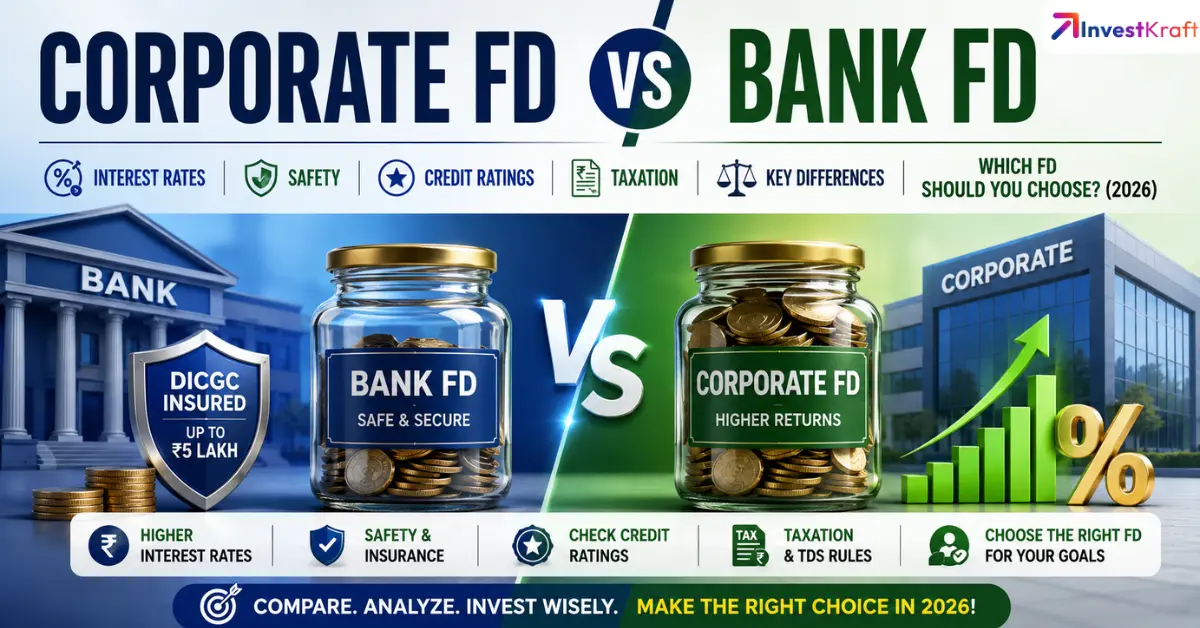
Corporate fixed deposits are term deposits offered by companies and NBFCs to raise money from investors, while bank FDs are deposits accepted by banks from customers.
Corporate FDs usually offer higher interest rates than bank FDs, but they also carry higher risk because they are not covered by the same deposit insurance protection as bank FDs.
We will read in detail the key differences between corporate FDs and Bank FDs in this blog.
What Is a Corporate FD?
A corporate FD is a fixed deposit scheme offered by a company or NBFC for a fixed tenure at a fixed interest rate. These deposits are popular because they often offer better yields than regular bank FDs, especially when issued by high-rated companies.
Corporate FDs are generally used by issuers to raise capital for business purposes, and investors receive interest either at maturity or through periodic payouts depending on the chosen plan.
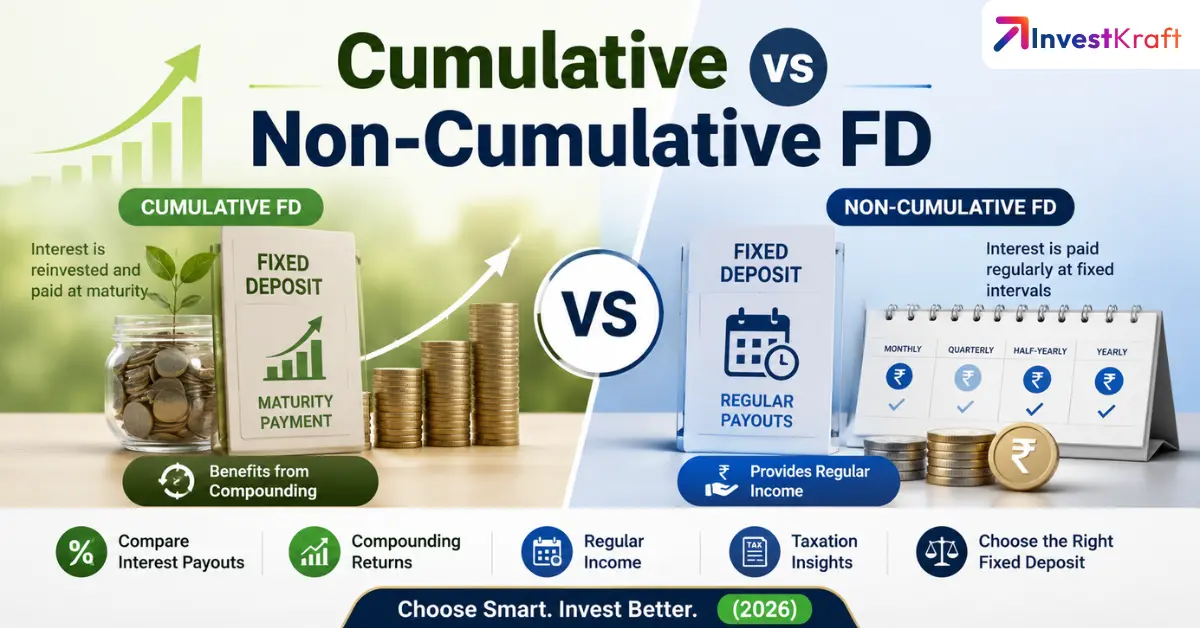
Many issuers offer both cumulative and non-cumulative options, so investors can choose between growth and regular income.
How Bank FDs Are Different
Bank FDs are deposits placed with scheduled banks, and they are usually considered safer because they come with DICGC insurance coverage up to ₹5 lakh per depositor per bank. This insurance makes bank FDs the more conservative choice for capital preservation.
Bank FDs also tend to have more uniform regulations and stronger liquidity confidence because they are part of the formal banking system.
Corporate FDs can still be good products, but the safety depends more on the issuer’s financial strength and credit rating.
Main Differences Between Corporate FD & Bank FD
The following are the main differences between corporate FD and Bank FD:
Feature
Corporate FD
Bank FD
Issuer
Company or NBFC
Bank
Interest rate
Usually higher, often around 1% to 3% more
Usually lower than corporate FDs
Safety
Depends on issuer and credit rating
Safer due to DICGC insurance up to ₹5 lakh
Insurance
No government-backed deposit insurance like bank FDs
DICGC protection up to ₹5 lakh per depositor per bank
Credit rating
Very important; AAA and AA ratings are preferred
Not typically compared the same way for deposit safety
Payout options
Cumulative and non-cumulative available
Also available in cumulative and non-cumulative forms
Premature withdrawal
Often allowed with penalty, or locked in for non-callable options
Usually allowed with penalty
Risk level
Higher than bank FD
Lower than corporate FD
Why Corporate FDs Offer Higher Returns
Corporate FDs generally pay more because investors are taking on more credit risk. Since the deposit is not backed by the same insurance protection as a bank FD, issuers compensate investors with better interest rates.
In practice, the spread can be meaningful for income-focused investors. Many corporate FDs quote rates in the 7% to 9% range depending on issuer quality, tenure, and payout structure.
FD Interest Rate Table: Banks vs Corporate / NBFC FDs
Now, let us compare the interest rates of Bank FDs and Corporate FDs from the table below:
Bank FDs
Bank / Institution
Approx. FD Interest Rate Range
Notes
Indian Bank
2.80% to 6.95% p.a.
Rates vary by tenure; senior citizens get an extra 0.50% p.a.
SBI
About 3.05% to 7.05% p.a.
Widely used benchmark bank FD range
ICICI Bank
About 2.75% to 7.10% p.a.
Rates vary by tenure and deposit amount
HDFC Bank
About 3.00% to 6.00%+ p.a.
Commonly seen among large private banks
Axis Bank
About 3.50% to 6.10% p.a.
Tenure-based rate structure
Kotak Mahindra Bank
About 3.00% to 5.60% p.a.
Lower end for shorter tenures
Bank of Baroda
About 3.50% to 5.70% p.a.
Public sector bank FD range
Punjab National Bank
About 3.50% to 5.75% p.a.
Public sector bank FD range
IDFC FIRST Bank
Up to about 7.40% p.a.
Higher-rate private bank among recent comparisons
Bandhan Bank
Up to about 7.40% p.a.
Often appears in higher-yield bank FD lists
Corporate / NBFC FDs
Corporate / NBFC
Approx. FD Interest Rate Range
Notes
Shriram Finance
About 7.00% to 8.10% p.a.
Higher-yield NBFC FD option +1
Muthoot Capital Services
Up to about 8.50% p.a.
Among the highest-yielding NBFC FDs mentioned recently
Sundaram Finance
About 7.50% to 8.00% p.a.
Popular corporate FD issuer
Bajaj Finance
About 6.70% to 7.30% p.a.
Large NBFC with widely tracked rates
ICICI Home Finance
About 6.70% to 7.30% p.a.
Corporate/NBFC-style deposit product
LIC Housing Finance
About 6.70% to 7.30% p.a.
Lower than the very top NBFC rates, but still above many bank FDs
Shivalik Small Finance Bank
Up to about 8.30% p.a.
High-rate deposit option in the recent comparison list
Slice Small Finance Bank
Up to about 7.75% p.a.
Deposit range in recent comparison list
Safety and Credit Rating
The most important factor in a corporate FD is the issuer’s credit rating.
AAA and AA-rated issuers are generally preferred because they indicate stronger repayment ability and lower default risk.
Investors should be extra careful with lower-rated issuers, even if the rate looks attractive. A slightly higher return does not always justify a weaker balance sheet or lower repayment comfort.
Tax and TDS Rules
Interest earned from corporate FDs is fully taxable under income tax rules, just like interest from bank FDs.
However, one important difference is that corporate FD interest is often subject to TDS once interest from a single company crosses ₹5,000 in a financial year.
The overview also notes that Form 15G/15H may not work in the same way for avoiding TDS on corporate FDs as it does with bank deposits.
That makes tax planning important, especially for investors who rely on periodic payout products.
Which FD Should You Choose?
Corporate FDs may suit investors who want higher returns and are comfortable evaluating credit quality.
They are often better for people who can lock money away and want to earn more than what standard bank FDs usually pay.
Bank FDs are better for conservative investors, emergency funds, and anyone who values deposit insurance and higher comfort over extra yield.
For many investors, a mix of both can be a practical way to balance return and safety.
A corporate FD is a fixed deposit offered by a company or NBFC to raise funds from investors at a fixed interest rate.
Are corporate FDs safe?
They can be safe if the issuer has a strong credit rating, but they are riskier than bank FDs because they do not have DICGC insurance.
Why do corporate FDs pay higher interest?
They usually pay more because investors take on more credit risk compared with bank FDs.
Do corporate FDs have insurance like bank FDs?
No, corporate FDs do not carry the same government-backed insurance protection that bank FDs get through DICGC.
Which corporate FD ratings are considered better?
AAA and AA-rated corporate FDs are generally preferred because they indicate lower credit risk.
Is corporate FD interest taxable?
Yes, interest from corporate FDs is fully taxable as income from other sources.
Should I choose a corporate FD or a bank FD?
Choose a corporate FD for higher returns if you are comfortable with more risk, and a bank FD if safety and insurance matter more.
Sources
Ujjivan Small Finance Bank: Corporate FDs vs Bank FDs
Groww: Differences between Corporate Fixed Deposit and Bank FD
Airtel Finance: Corporate FD vs Bank FD
Paisabazaar: Corporate Fixed Deposits
Nivesh: Company Fixed Deposit vs Bank Fixed Deposit
ET Money: Corporate Fixed Deposit
Disclaimer
This article is for general informational purposes only and should not be treated as financial, tax, or investment advice. Corporate FD interest rates, credit ratings, payout rules, tax treatment, and premature withdrawal penalties can change depending on the issuer and the prevailing regulations. Please verify the latest terms with the issuer or a qualified financial advisor before investing.
Author: Diwakar Kumar Singh
Diwakar Kumar Singh is a BFSI specialist and finance writer with over 7 years of hands-on experience in financial research, content creation, and analysis.
A Gold Medalist in MBA (Marketing) from IMT, he combines deep analytical skills with practical insights gained from evaluating companies, IPOs, unlisted shares, financial ratios, and investment opportunities. Diwakar has personally analysed hundreds of financial instruments and market scenarios, which he uses to break down complex topics into clear, actionable advice.
He has authored numerous in-depth finance articles, published multiple books internationally, and contributed to research publications. His work focuses on helping everyday investors and readers make better-informed financial decisions through well-researched, evidence-based explanations that are always grounded in real-world application rather than theory alone.


 care@investkraft.com
 +91-9599071040
 +91-9797971876