You run your own business. Money flows in - sometimes in large amounts, sometimes irregularly. You pay your bills, manage your clients, and keep things running.
But when you walk into a bank and ask for a personal loan, the first question is: “Where is your ITR for the last 2 to 3 years?”
And just like that, the door closes.
It is a common belief that freelancers and self-employed individuals cannot get a personal loan without an ITR filing. Most banks and NBFCs build their lending framework around salaried income and require two to three years of tax returns. Freelancers may not fit in that framework - they tend to have irregular income, and taxes may not be filed if earnings fall below the taxable threshold.
But the door is not as closed as you think.
Getting a personal loan for self-employed individuals without ITR documents is not as difficult as it seems. We will explain each and every method to get a personal loan for self-employed individuals without ITR. But before that, let us see some of the latest developments and updates related to self-employed loan without ITR.
Latest Highlights: Self-Employed Loan Without ITR in 2026
Self-employed individuals can get a personal loan without ITR by providing bank statements, GST registration, business proof, and alternative income documents - many NBFCs and fintech lenders offer collateral-free loans based on credit score and turnover.
For gig workers on platforms like Swiggy, Zomato, or Urban Company, in-app earnings reports now serve as income proof at many digital lenders in 2026.
Account Aggregator framework is now active across 50+ banks - lenders can digitally fetch your business bank statement with your consent in seconds, replacing manual ITR submission.
Saarathi AI now matches self-employed borrowers with 110+ lenders based on real eligibility, even without ITR - compare offers in one place before formally applying.
Why ITR Matters to Lenders - And Why It Is Not the Only Option
ITR tells a lender three things:
How much do you earn
Whether your income is stable
Whether you are tax-compliant.
Each of these can be demonstrated through alternative evidence.
Instead of ITR, lenders may use other documents to verify income and repayment ability. Digital lending platforms and NBFCs now use flexible verification methods, making it easier for salaried individuals, freelancers, and small business owners to access credit.
Who Can Apply for a Personal Loan Without ITR?
Salaried employees, freelancers, gig workers, and small business owners may be eligible for loans without ITR.
This covers a very wide range of self-employed Indians:
Borrower Type
Why No ITR
Alternative Available
New freelancer (under 1 year)
No full-year filing yet
Bank statement + client invoices
Small trader/shopkeeper
Income below the taxable limit
GST returns + bank statement
Gig worker (Swiggy, Zomato, Urban Co.)
No formal employer
In-app earnings report + bank credits
Cash-income self-employed
Difficult to document
Business bank account + business proof
New business owner
Less than 2 years old
Business registration + bank statement
Professional (doctor, CA, architect)
New practice, no ITR yet
Degree + registration + bank statement
Alternative Documents That Replace ITR
The following are some of the alternative documents that can replace the ITR:
Bank statements showing regular credits for the last 6 to 12 months are the most powerful alternative to a salary slip.
GST returns if your business is GST-registered.
ITR filings if you file income tax, even self-assessment ones.
Trade or shop licence as proof of business existence.
Udyam Aadhaar registration for micro and small enterprises.
Invoice records or client payment proofs for freelancers.
Alternative Documents Ranked by Lender Acceptance
The following are the documents ranked by lender acceptance:
1. Bank Statements - 6 to 12 Months (Most Powerful)
Some lenders may consider bank statements as an alternative to ITR documents for assessing your income. Provide statements for the past few months to demonstrate your cash flow and financial stability.
What lenders look for:
Regular monthly credits above ₹15,000 to ₹25,000
Credits from identifiable business sources (client payments, platform payouts)
No prolonged zero-balance periodsNo dishonoured cheques or ECS bounces
2. GST Returns - Quarterly Filings
If your turnover exceeds ₹20 lakh (services) or ₹40 lakh (goods), you are GST registered. Your GSTR-1 and GSTR-3B filings show quarterly turnover - a direct, government-verified income indicator that most NBFCs now accept readily.
3. Form 26AS / TDS Certificate
If your clients deduct TDS from your payments (common for professionals receiving payments above ₹30,000 per transaction), the TDS shown in your Form 26AS at incometax.gov.in is official, government-verified income proof - without requiring a full ITR.
4. Business Registration Documents
GST Certificate, Shop and Establishment Act Licence, Udyam Registration, Trade Licence, or Partnership Deed - any of these prove your business exists and has been operating, providing a proxy for business stability.
5. Client Invoices and Contracts
Recent invoices showing amounts, client names, and payment terms - combined with bank credits matching these amounts - form a credible income narrative for digital lenders.
6. Gig Platform Earnings Reports
For gig workers on platforms like Swiggy, Zomato, or Urban Company, in-app earnings reports serve as income proof at many digital lenders. Download your earnings summary from the platform app - many fintech lenders now explicitly accept these.
Step-by-Step: How to Apply for Self-Employed Personal Loans
Step 1: Organise Your Alternative Income Evidence
Before applying anywhere, prepare: Last 12 months' business bank account statements (PDF), GST registration certificate + last 4 quarters' GSTR filings, 2 to 3 recent client invoices or payment receipts, Udyam/trade licence or business registration certificate, Form 26AS if TDS has been deducted on your income
Step 2: Check Your CIBIL Score
Applicants must have a credit score above 650 - assess your finances to determine a realistic loan amount and ensure monthly payments will fit within your budget.
For self-employed borrowers without an ITR, the CIBIL score becomes the primary trust signal. A score below 650 means a high rejection risk even at NBFCs. Spend 3 to 6 months improving it if needed before applying.
Step 3: Choose the Right Lender
Do not approach PSU banks first. Go directly to digital NBFCs and fintech lenders:
Lender
Why It Works Without ITR
Loan Amount
Moneyview
Alternative credit scoring using bank data
₹5,000 to ₹10 lakh
DMI Finance
Dedicated self-employed products
Up to ₹25 lakh
Bajaj Finance
Self-employed personal loan variant
Up to ₹55 lakh
PaySense
Bank statement-based income assessment
₹5,000 to ₹5 lakh
KreditBee
PAN + bank statement only needed
Up to ₹10 lakh
Fibe (EarlySalary)
Accepts alternate income sources
Up to ₹10 lakh
Kissht
Minimal paperwork, self-employed accepted
Up to ₹10 lakh
IDFC FIRST FIRSTmoney
Digital, minimal docs
Up to ₹5 lakh
For digital lenders using alternate assessment, initial loan amounts for self-employed borrowers typically start at ₹10,000 to ₹1 lakh and can grow as your repayment history builds. If you have GST registration and 2 years of ITR, you can access ₹5 lakh and above from NBFCs.
Step 4: Apply Online
Most of these lenders have fully digital applications as follows:
Enter PAN and Aadhaar
Complete eKYC
Upload bank statements or grant AA framework access
Submit supporting business documents
Receive an offer within hours.
Step 5: Accept Offer and Review Key Fact Statement
Always read the KFS (Key Fact Statement) before accepting - confirm the interest rate, APR including processing fees, prepayment conditions, and tenure. Sign digitally and receive funds.
Strategies to Boost Personal Loan Approval Odds Without ITR
The following are some of the strategies to boost personal loan approval chances:
Maintain a 750+ CIBIL Score: Most NBFCs approve applications from freelancers with a CIBIL score of 650 or above. However, interest rates can be better at 700 and above. For genuinely ITR-free applications, a 750+ score is your strongest asset - it compensates for almost everything else.
Add a Co-Applicant With Stable Income: If you have a family member or spouse with a stable income and a good credit history, you may consider applying for a personal loan with them as a co-applicant or guarantor - their income and creditworthiness can strengthen your application.
Offer Collateral for Larger Amounts: If you have valuable assets such as property, gold, or securities, you may be able to get a secured personal loan by pledging these assets as collateral.
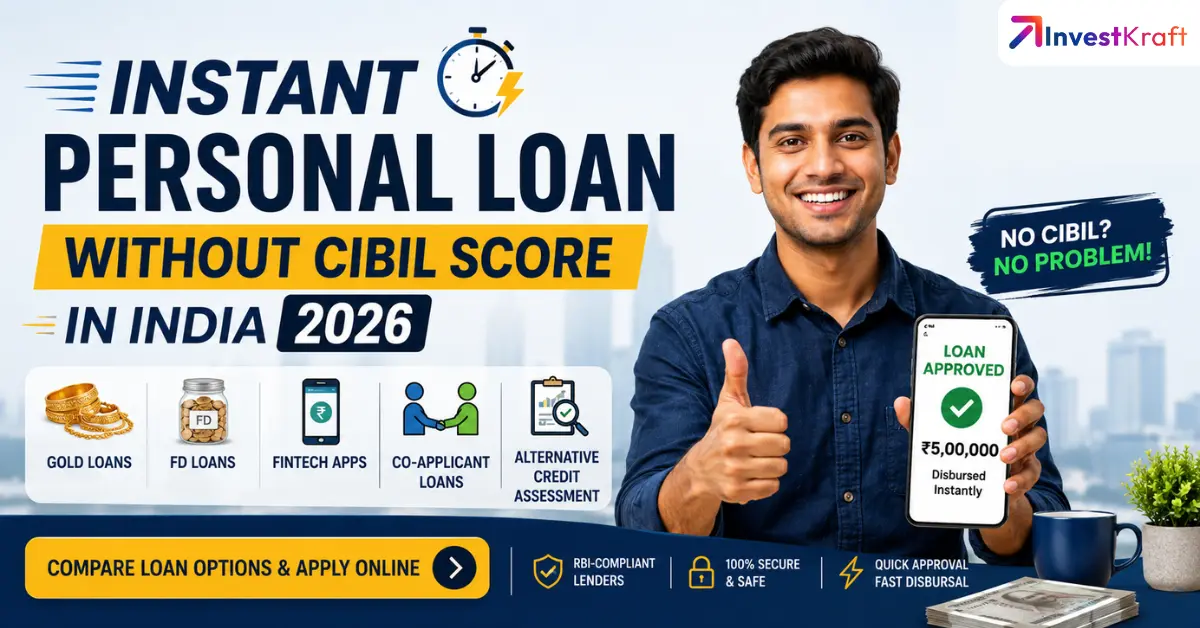
Gold loan: ₹1 lakh+ in 30 minutes, no income proof, no ITR Loan Against FD: 80% to 90% of FD value, cheapest rate Loan Against Property: Up to 70% of property value, largest amounts
Use Your Existing Bank Relationship: If you have maintained a current account at a bank for 2 to 3 years with healthy average balances, approach that bank first. They have seen your financial behaviour and may offer a pre-approved loan with fewer documents than a new lender would require.
Start Small - Build Your Credit Profile: The key insight is: start with a smaller loan from a digital lender, repay perfectly, and your credit profile grows - making larger amounts accessible over time.
A ₹50,000 loan repaid on time creates a CIBIL entry. A ₹1 lakh loan repaid perfectly 6 months later builds on that. By the third loan, you have a repayment track record that many lenders will accept in lieu of ITR.
Eligibility Criteria for Self-Employed Loan Without ITR
The following table shows the eligibility criteria for a self-employed loan without ITR:
Criteria
Requirement
Age
23 to 65 years
Citizenship
Indian resident
Business Stability
Minimum 1 to 3 years of operational experience
Monthly Income
₹15,000 to ₹25,000 (bank statement-based)
CIBIL Score
650+ for NBFCs; 700+ for better rates
PAN-Aadhaar Link
Mandatory
Business Proof
GST, Udyam, or trade licence (any one)
Bank Account
Dedicated business account preferred
Important: Start Filing ITR - Even If Not Mandatory
This is the single most impactful long-term action any self-employed borrower can take.
If your annual income is below the taxable limit (₹3 lakh under new regime, ₹2.5 lakh under old), you are not legally required to file ITR. But filing it voluntarily creates an official income record - one that opens significantly better loan terms within 2 to 3 years.
Filing ITR is free at incometax.gov.in, takes 20 to 30 minutes, and transforms your borrowing profile permanently. Do it for AY 2025-26 and AY 2026-27 starting now.
Summary
Getting a personal loan as a self-employed individual without an ITR in India in 2026 is entirely possible - with the right preparation, the right documents, and the right lender. Here is the complete recap:
Best alternative to ITR: 12 months of business bank statements showing consistent credits - accepted by virtually all digital NBFCs.
Other powerful alternatives: GST returns, Form 26AS / TDS certificates, client invoices, Udyam registration, and gig platform earnings reports.
Best lenders: Moneyview, DMI Finance, Bajaj Finance, KreditBee, Fibe, Kissht - all accept alternate income documentation.
Without any income proof: Gold loan, Loan Against FD, co-applicant route.
Key eligibility needs: CIBIL score 650+ (750+ preferred), 1 to 3 years of business operation, dedicated business bank account, PAN-Aadhaar linked.
Long-term fix: Start filing ITR voluntarily from this year - 2 years of consistent filing transforms your borrowing profile completely.
Frequently Asked Questions
Can a self-employed person get a personal loan without an ITR?
Yes - self-employed individuals can get a personal loan without ITR by providing bank statements, GST registration, business proof, and alternative income documents; many NBFCs and fintech lenders offer collateral-free loans based on credit score and turnover.
Which bank gives personal loans to the self-employed without ITR?
PSU banks rarely approve without ITR; digital NBFCs like Moneyview, DMI Finance, Bajaj Finance, KreditBee, and Fibe are the most accessible options - they use bank statement analysis and alternative data instead of ITR.
Can I get an instant ₹50,000 loan without income proof and a CIBIL?
With no income proof and no CIBIL, your best option is a gold loan (30 to 60 minutes, no income proof, no CIBIL) or Loan Against FD - both require only basic KYC (Aadhaar + PAN) and give you ₹50,000 within the same day.
What documents do self-employed individuals need for a personal loan?
Common documents include Aadhaar, PAN, bank statements, and salary slips - for self-employed without ITR, lenders accept GST returns, business registration, trade licence, client invoices, and 6 to 12 months of bank statements as alternatives.
What is the minimum CIBIL score for a self-employed person without ITR?
A recommended credit score for self-employed borrowers is 725 or above for the best terms; most NBFCs approve from 650 and above, though interest rates are higher at lower scores.
How can a freelancer prove income for a personal loan?
Freelancers should make sure their CIBIL score is good, and bank statements are clean; client invoices, payment receipts, bank statement credits, and TDS certificates from clients are the most accepted alternatives to ITR for freelancers.
What happens if I never file ITR - will I always be stuck with high-rate loans?
Start with a smaller loan from a digital lender, repay perfectly, and your credit profile grows - making larger amounts accessible over time; additionally, begin filing ITR voluntarily even if income is below the taxable threshold; two years of consistent filings will dramatically improve your loan eligibility and interest rates.
Sources
RBI - Digital Lending Directions 2025 and Account Aggregator Framework: rbi.org.in
Income Tax Department - ITR Filing Portal (Voluntary Filing): incometax.gov.in
Disclaimer: Loan eligibility, documentation requirements, and interest rates are as of June 2026 and vary by lender. Always verify current terms with the lender before applying. This article is for informational purposes only and does not constitute financial advice.
Author: Diwakar Kumar Singh
Diwakar Kumar Singh is a BFSI specialist and finance writer with over 7 years of hands-on experience in financial research, content creation, and analysis.
A Gold Medalist in MBA (Marketing) from IMT, he combines deep analytical skills with practical insights gained from evaluating companies, IPOs, unlisted shares, financial ratios, and investment opportunities. Diwakar has personally analysed hundreds of financial instruments and market scenarios, which he uses to break down complex topics into clear, actionable advice.
He has authored numerous in-depth finance articles, published multiple books internationally, and contributed to research publications. His work focuses on helping everyday investors and readers make better-informed financial decisions through well-researched, evidence-based explanations that are always grounded in real-world application rather than theory alone.


 care@investkraft.com
 +91-9599071040
 +91-9797971876