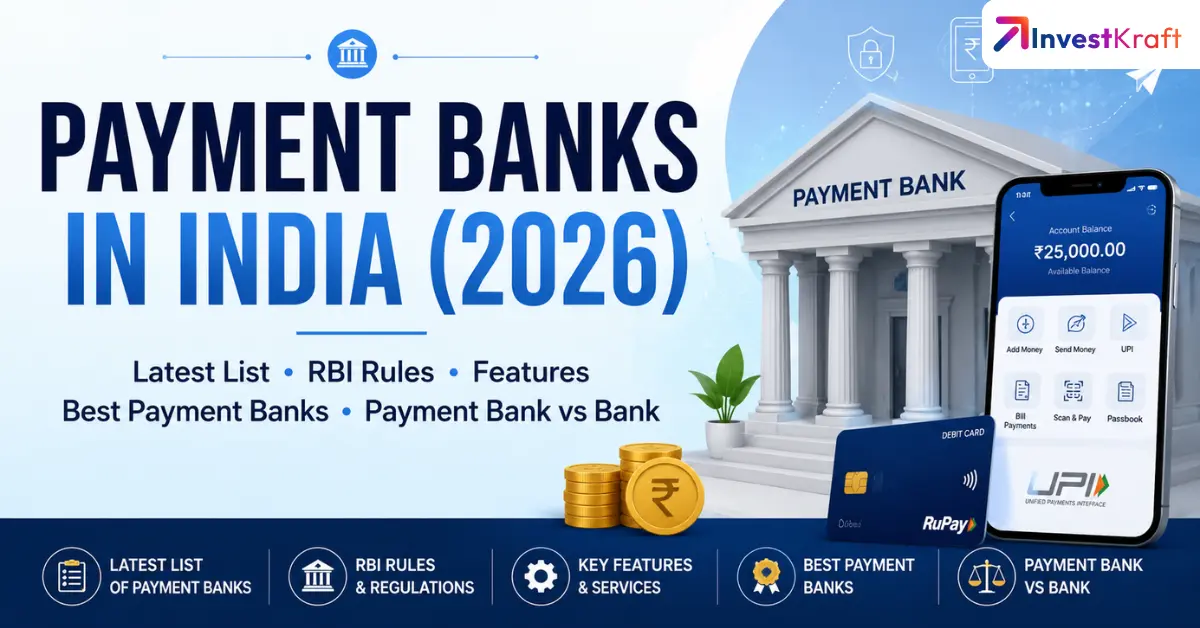
Payment banks have transformed the way millions of Indians access basic banking services. Introduced by the Reserve Bank of India (RBI), these specialized banks were created to promote financial inclusion by offering secure, affordable, and digital banking services to individuals, small businesses, migrant workers, and people living in rural and underserved areas.
Unlike traditional commercial banks, payment banks focus on providing essential banking facilities such as savings and current accounts, UPI payments, fund transfers, debit cards, and bill payments. However, they cannot offer loans or issue credit cards, making them fundamentally different from full-service banks.
As digital payments continue to grow across India in 2026, payment banks play a significant role in supporting the country's digital economy. Whether you're looking for a simple savings account, seamless UPI transactions, or easy access to banking services, understanding how payment banks work can help you choose the right banking option.
In this guide, you'll learn:
What a payment bank is
Key features and services
The latest list of payment banks in India (2026)
RBI regulations
The best payment banks in India
How payment banks compare with commercial banks
What is a Payment Bank?
A Payment Bank is a type of bank licensed by the Reserve Bank of India (RBI) to provide basic banking and digital payment services. These banks were introduced to increase financial inclusion by making banking accessible to individuals who may not have easy access to traditional banking services.
Payment banks are designed to facilitate:
Savings accounts
Current accounts
Digital payments
UPI transactions
Money transfers
Bill payments
Debit cards
Mobile and internet banking
However, unlike commercial banks, payment banks cannot lend money or issue credit cards. Their primary objective is to provide safe deposit facilities and promote cashless transactions across the country.
This banking model particularly benefits:
Rural households
Small merchants
Gig workers
Daily wage earners
Migrant workers
Students
First-time banking users
By leveraging digital technology and extensive agent networks, payment banks make banking services available even in remote areas where traditional bank branches may not exist.
Key Features of Payment Banks
Payment banks offer several essential banking services while maintaining a simple and digital-first approach.
1. Savings and Current Accounts
Customers can open savings and current accounts with simplified KYC procedures, making account opening faster and more convenient.
2. UPI and Digital Payments
Payment banks support Unified Payments Interface (UPI), allowing users to send and receive money instantly, pay merchants, and make online purchases securely.
3. Debit Cards
Most payment banks provide RuPay or Visa debit cards that can be used for ATM withdrawals, online shopping, and retail purchases.
4. Mobile Banking
Customers can manage their accounts through mobile apps, offering services such as:
Balance enquiry
Fund transfers
Bill payments
Mobile recharge
Mini statements
QR code payments
5. Domestic Money Transfers
Payment banks enable quick and secure fund transfers using:
UPI
IMPS
NEFT
Aadhaar Enabled Payment System (AePS), where applicable
6. Bill Payments
Users can conveniently pay:
Electricity bills
Gas bills
Water bills
Broadband bills
Mobile and DTH recharges
Insurance premiums
through integrated payment platforms.
7. Financial Inclusion
One of the biggest objectives of payment banks is to provide banking services to unbanked and underbanked populations across India through digital channels and local banking agents.
Services Offered by Payment Banks
Payment banks are authorized to provide several essential banking services, including:
Service
Availability
Savings Account
✔ Yes
Current Account
✔ Yes
UPI Payments
✔ Yes
Debit Card
✔ Yes
Mobile Banking
✔ Yes
Internet Banking
✔ Yes
Bill Payments
✔ Yes
Domestic Money Transfer
✔ Yes
Fixed Deposits (through partner banks, where applicable)
✔ Limited
Loans
✖ No
Credit Cards
✖ No
List of Payment Banks in India (2026)
As of 2026, the following payment banks are operational in India.
Note: The operational status and services of payment banks are subject to RBI regulations and may change over time. Always verify the latest information through the respective bank's official website before opening an account.
Which Payment Bank is Best in India?
There is no single "best" payment bank for everyone. The ideal choice depends on your banking needs.
Airtel Payments Bank is suitable for users seeking a feature-rich digital banking experience with seamless UPI and mobile services.
India Post Payments Bank (IPPB) is an excellent choice for customers in rural and semi-urban areas due to its extensive post office network and doorstep banking services.
Fino Payments Bank caters well to small businesses, merchants, and individuals looking for accessible banking services.
Jio Payments Bank integrates well with the Reliance digital ecosystem, making it convenient for existing Jio users.
NSDL Payments Bank focuses on secure and reliable digital banking solutions for individual customers.
Ultimately, the best payment bank depends on factors such as accessibility, digital features, customer service, and your preferred banking ecosystem.
Best Payment Banks in India (2026)
Choosing the best payment bank depends on your banking habits, preferred digital ecosystem, and accessibility. While all payment banks offer basic banking and digital payment services, each has its own strengths.
1. Airtel Payments Bank
Best for: Digital banking, UPI users, and frequent mobile transactions.
Launched in 2017, Airtel Payments Bank is India's first payment bank to become operational. It offers a fully digital banking experience with instant account opening, UPI payments, mobile banking, debit cards, and doorstep banking services in selected locations.
Key Highlights
Easy digital savings account opening
UPI, IMPS, and NEFT transfers
QR code payments
Personal accident insurance on eligible accounts
Wide banking point network across India
Suitable for: Customers who prefer app-based banking and quick digital payments.
2. India Post Payments Bank (IPPB)
Best for: Rural customers, senior citizens, and doorstep banking.
India Post Payments Bank (IPPB) is backed by the Government of India and operates through one of the largest postal networks in the world. Its biggest advantage is providing banking services at customers' doorsteps through postmen and Gramin Dak Sevaks.
Key Highlights
Banking through over 1.6 lakh post offices
Doorstep banking services
Aadhaar-enabled banking
QR card facility
UPI-enabled transactions
Suitable for: Customers living in rural and semi-urban areas who need convenient banking access.
3. Fino Payments Bank
Best for: Small businesses, merchants, and cash-based transactions.
Fino Payments Bank focuses on financial inclusion by offering banking services through an extensive merchant network across India. It provides savings accounts, current accounts, remittance services, UPI, and digital payments.
Key Highlights
Large merchant network
Business-friendly banking
Domestic money transfers
Bill payment services
UPI-enabled banking
Suitable for: Shop owners, micro-businesses, and individuals who frequently deal with cash deposits and transfers.
4. Jio Payments Bank
Best for: Existing Jio users and digital-first customers.
Jio Payments Bank combines digital banking with the Reliance ecosystem, allowing users to access banking services through a mobile-first platform.
Key Highlights
UPI transactions
Mobile banking
Digital savings account
Secure online payments
Integration with digital services
Suitable for: Users looking for a simple, app-based banking experience.
5. NSDL Payments Bank
Best for: Secure digital banking.
NSDL Payments Bank provides digital banking services with a focus on secure transactions and easy account management.
Key Highlights
Online account management
UPI services
Debit card
Digital payments
Secure banking platform
Suitable for: Customers who primarily use digital banking channels.
Quick Comparison of Payment Banks in India
Payment Bank
Parent Organization
Best For
UPI
Mobile Banking
Debit Card
Airtel Payments Bank
Bharti Airtel
Digital Banking
✔
✔
✔
India Post Payments Bank
Department of Posts
Rural Banking
✔
✔
✔
Fino Payments Bank
Fino PayTech
Small Businesses
✔
✔
✔
Jio Payments Bank
Reliance Industries & SBI
Digital Ecosystem
✔
✔
✔
NSDL Payments Bank
NSDL
Secure Banking
✔
✔
✔
Tip: Instead of choosing a payment bank solely based on popularity, compare account features, service charges, accessibility, customer support, and digital banking facilities before opening an account.
Payment Bank vs Commercial Bank
Many people confuse payment banks with traditional commercial banks. While both are regulated by the Reserve Bank of India, their functions and services are significantly different.
Need personal, home, education, or business loans.
Want fixed deposits, recurring deposits, or investment products.
Require credit cards and other advanced banking services.
Need comprehensive financial planning and wealth management.
For many users, the ideal approach is to use both. A payment bank can serve as a convenient account for everyday digital transactions, while a commercial bank can meet long-term financial needs such as loans, investments, and savings products.
Can You Use Both a Payment Bank and a Commercial Bank?
Yes. There is no restriction on maintaining accounts with both a payment bank and a commercial bank.
Many individuals use a payment bank for:
Daily UPI transactions
Utility bill payments
Mobile recharges
Small savings
Domestic money transfers
At the same time, they rely on a commercial bank for:
Salary accounts
Fixed deposits
Personal loans
Home loans
Credit cards
Investment services
This combination allows users to enjoy the convenience of digital banking while still accessing the broader range of financial products offered by traditional banks.
Advantages of Payment Banks
Payment banks have become an important part of India's digital banking ecosystem by making basic banking services accessible, affordable, and convenient. Here are some of their key benefits.
1. Easy Account Opening
Most payment banks allow customers to open an account digitally with simplified Know Your Customer (KYC) verification. This reduces paperwork and makes banking accessible to first-time users.
2. Convenient Digital Banking
Payment banks offer mobile and internet banking services that allow users to:
Transfer money instantly
Check account balance
Pay utility bills
Recharge mobile and DTH services
Scan QR codes for merchant payments
Access banking services 24×7
This makes them ideal for people who prefer cashless transactions.
3. Financial Inclusion
One of the primary objectives behind introducing payment banks was to provide banking facilities to underserved sections of society.
Payment banks help extend banking services to:
Rural households
Small merchants
Daily wage workers
Migrant labourers
Self-employed individuals
First-time banking customers
Banks like India Post Payments Bank (IPPB) have significantly expanded banking access through their extensive post office network.
4. Secure Digital Payments
Payment banks support secure payment systems such as:
These services make everyday transactions fast, convenient, and secure.
5. Low Banking Costs
Compared to many traditional banking products, payment banks generally have:
Low account maintenance requirements
Affordable transaction charges
Minimal documentation
Easy accessibility through mobile applications
This makes them suitable for customers looking for simple and cost-effective banking.
6. Ideal for Everyday Banking
Payment banks are well suited for routine financial activities such as:
Receiving salary or allowances (where supported)
Shopping payments
Utility bill payments
UPI transactions
Mobile recharges
Domestic money transfers
For customers who mainly use digital payments, payment banks offer a convenient alternative for daily banking needs.
Limitations of Payment Banks
While payment banks provide essential banking services, they are not designed to replace full-service commercial banks. Understanding their limitations can help you choose the right banking option.
1. Cannot Offer Loans
The biggest limitation is that payment banks are not permitted to provide lending services.
If you require credit facilities, you'll need to approach a commercial bank, small finance bank, or NBFC.
2. No Credit Cards
Payment banks can issue debit cards but are not allowed to issue credit cards.
Customers looking for credit-based spending or reward programs will need a commercial bank or card issuer.
3. Limited Investment Products
Unlike traditional banks, payment banks generally do not provide a wide range of investment options such as:
Fixed Deposits (directly)
Recurring Deposits
Mutual Funds
Demat Accounts
Portfolio Management Services
Some payment banks may offer selected products through partnerships, but they do not function as full-service investment providers.
4. Limited Banking Services
Payment banks are primarily intended for payments, deposits, and remittances.
Customers requiring advanced banking services, including foreign exchange, wealth management, trade finance, or corporate banking, should consider commercial banks.
RBI Regulations for Payment Banks (2026)
Payment banks operate under the regulatory framework established by the Reserve Bank of India (RBI). These regulations ensure customer protection, financial stability, and secure banking operations.
Here are some of the key regulatory points.
RBI Licensing
Only entities that receive an RBI licence under the Banking Regulation Act can operate as payment banks in India.
Applicants must meet the eligibility criteria prescribed by the RBI and comply with ongoing regulatory requirements.
Permitted Activities
Payment banks are allowed to:
Accept savings and current account deposits within the limits prescribed by RBI.
Provide ATM and debit card services.
Facilitate UPI, IMPS, NEFT, and other payment systems.
Offer internet and mobile banking.
Distribute selected third-party financial products, subject to applicable regulations.
Restricted Activities
Payment banks are not permitted to:
Provide loans or advances.
Issue credit cards.
Undertake large-scale lending activities.
Engage in complex investment banking operations.
These restrictions ensure that payment banks remain focused on payments, deposits, and financial inclusion.
KYC Compliance
All payment banks must comply with RBI's Know Your Customer (KYC) and Anti-Money Laundering (AML) guidelines.
Customers are generally required to complete identity verification using officially accepted documents such as:
A payment bank is a specialized bank licensed by the Reserve Bank of India (RBI) to provide basic banking services such as savings accounts, current accounts, UPI payments, debit cards, money transfers, and bill payments. However, payment banks are not allowed to provide loans or issue credit cards.
Q. Which is the best payment bank in India?
The best payment bank depends on your requirements.
Airtel Payments Bank – Best for digital banking and UPI transactions.
India Post Payments Bank (IPPB) – Best for rural banking and doorstep services.
Fino Payments Bank – Suitable for merchants and small businesses.
Jio Payments Bank – Good for users within the Jio digital ecosystem.
NSDL Payments Bank – Suitable for secure digital banking.
Instead of choosing based on popularity, compare services, charges, accessibility, and customer support before opening an account.
Q. How many payment banks are there in India in 2026?
As of 2026, the major operational payment banks in India include:
Airtel Payments Bank
India Post Payments Bank (IPPB)
Fino Payments Bank
Jio Payments Bank
NSDL Payments Bank
The operational status of payment banks may change based on RBI approvals and regulatory developments.
Q. Can payment banks provide loans?
No. Payment banks are not permitted to provide loans, advances, or credit facilities under the RBI's licensing framework. If you need a personal loan, home loan, business loan, or vehicle loan, you must approach a commercial bank, small finance bank, or NBFC.
Q. Is India Post Payments Bank a payment bank?
Yes. India Post Payments Bank (IPPB) is a payment bank established under the Department of Posts, Government of India. It offers savings accounts, UPI services, money transfers, debit cards, and doorstep banking through the country's extensive postal network.
Q. Is Airtel Payments Bank safe?
Yes. Airtel Payments Bank is licensed and regulated by the Reserve Bank of India (RBI). It follows RBI guidelines related to KYC, cybersecurity, and customer protection. Eligible deposits are also covered under the Deposit Insurance and Credit Guarantee Corporation (DICGC) scheme, subject to applicable limits.
Q. Who regulates payment banks in India?
All payment banks in India are regulated by the Reserve Bank of India (RBI). They must comply with RBI regulations related to licensing, customer protection, KYC norms, payment systems, and banking operations.
Conclusion
Payment banks have emerged as an important part of India's digital banking ecosystem by making basic financial services accessible to millions of people. They offer convenient solutions for savings, UPI payments, bill payments, money transfers, and everyday banking, particularly for individuals who prefer digital transactions or have limited access to traditional bank branches.
While payment banks cannot provide loans or credit cards, they continue to play a significant role in promoting financial inclusion and supporting India's transition toward a cashless economy.
Before opening an account, compare the available payment banks based on their digital features, service charges, accessibility, customer support, and the banking services you use most often. If your financial needs extend to loans, fixed deposits, or investment products, maintaining an account with both a payment bank and a commercial bank can offer the best of both worlds.
Author: Diwakar Kumar Singh
Diwakar Kumar Singh is a BFSI specialist and finance writer with over 7 years of hands-on experience in financial research, content creation, and analysis.
A Gold Medalist in MBA (Marketing) from IMT, he combines deep analytical skills with practical insights gained from evaluating companies, IPOs, unlisted shares, financial ratios, and investment opportunities. Diwakar has personally analysed hundreds of financial instruments and market scenarios, which he uses to break down complex topics into clear, actionable advice.
He has authored numerous in-depth finance articles, published multiple books internationally, and contributed to research publications. His work focuses on helping everyday investors and readers make better-informed financial decisions through well-researched, evidence-based explanations that are always grounded in real-world application rather than theory alone.


 care@investkraft.com
 +91-9599071040
 +91-9797971876