You need ₹5 lakh urgently. You have a personal loan offer at 14% per annum. You also have ₹12 lakh sitting in mutual funds.
Two options. Which is smarter?
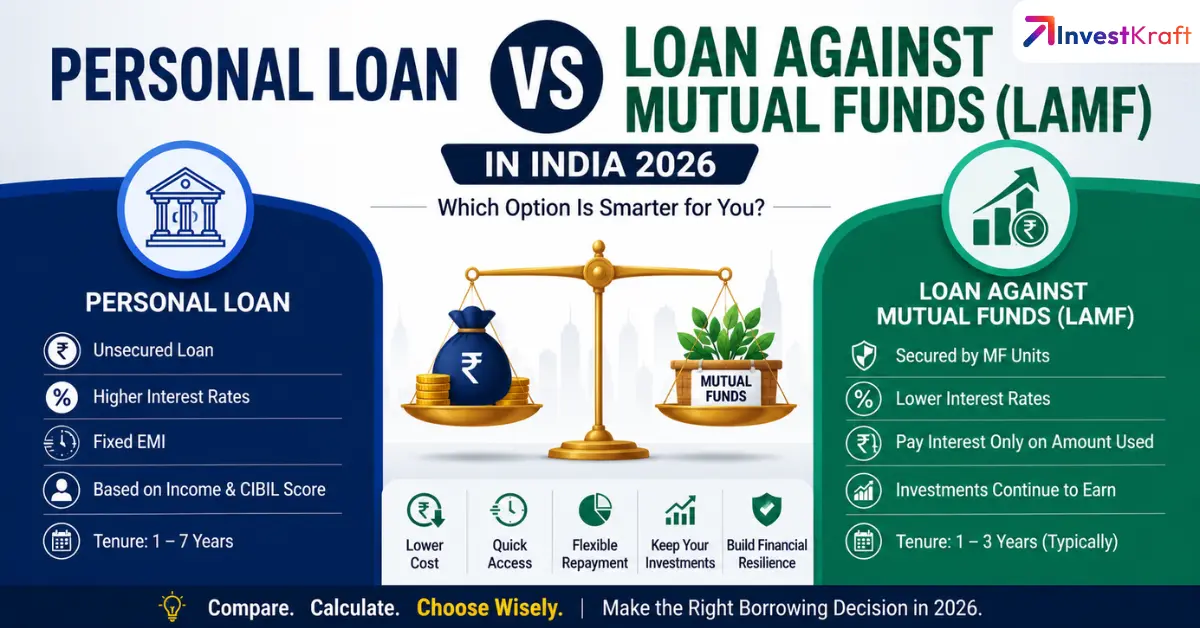
Loan Against Mutual Funds (LAMF) and personal loans both provide quick liquidity without forcing you to liquidate investments or drain savings. LAMF leverages your portfolio as collateral for lower-cost borrowing, while personal loans rely on your income for unsecured, predictable funding. Choosing wisely depends on your cash flow, risk tolerance, and financial goals in 2026's high-interest environment.
This guide gives you the complete comparison - with numbers, use cases, and a clear decision framework.
What is LAMF (Loan Against Mutual Funds)?
Loan Against Mutual Funds (LAMF) allows mutual fund investors to leverage their existing mutual fund investments to raise funds. This product provides liquidity without redeeming existing mutual fund investments. LAMF is usually offered in the form of an overdraft facility where a credit limit is sanctioned based on the pledged funds.
The lien is marked on your MF units - you still own them, they still earn returns, but the lender can liquidate them if you default.
For debt mutual funds, the loan amount is 80% of the current NAV; for equity mutual funds, it is 50% to 60% of the NAV.
Complete Head-to-Head Comparison
Feature
LAMF
Personal Loan
Type
Secured - MF units pledged
Unsecured - no collateral
Interest Rate
8% to 12% p.a.
9.99% to 24% p.a.
Interest Charged On
Only the amount withdrawn (overdraft)
Full disbursed amount from Day 1
Loan Amount
50% to 80% of MF portfolio NAV
Based on income and CIBIL score
Max Amount (individual)
Up to ₹20 lakh (equity) / ₹1 crore (debt)
Up to ₹40 to ₹50 lakh
Repayment
Flexible - interest only; principal anytime
Fixed EMI every month
Tenure
1 to 3 years typically
1 to 7 years
Processing Speed
Minutes to hours (digital)
Minutes to 72 hours
CIBIL Score Required
Lower threshold - collateral compensates
700+ for good rates
Market Risk
Yes - NAV drop can trigger a margin call
None
Investments Continue
Yes - MF units earn returns
Not applicable
Tax Implications
None on loan itself
None on loan itself
Interest Rate Reality Check - The Most Important Number
While personal loans in India usually come with interest rates ranging from 12% to 24%, loans against mutual funds start at just 10.5% per annum.
But there is a subtler financial advantage that most borrowers miss entirely.
The real advantage shows up when you consider: no prepayment penalty means if you repay in 6 months, you pay interest for only 6 months. Your mutual fund units keep earning returns - if your fund earns 12% during the year, the effective cost of borrowing becomes even lower.
Practical illustration - ₹5 lakh needed for 6 months:
Metric
LAMF at 10.5%
Personal Loan at 14%
Interest paid (6 months)
~₹26,250
~₹43,750 (on full amount)
MF portfolio still earns (12% p.a. on ₹10 lakh)
₹60000
N/A
Net effective cost
₹26,250 − portfolio gains = near zero
₹43,750 full cost
When you account for your portfolio continuing to earn, LAMF's effective cost is dramatically lower than the headline interest rate suggests.
Eligibility: Where LAMF Has a Huge Advantage
Personal loans have strict eligibility criteria:
You need a good credit score of typically 700+
Stable income proof, and you may be rejected based on your employer profile or existing loan obligations.
LAMF has simpler eligibility - if you have mutual fund holdings of sufficient value, you can get a loan regardless of your employer, salary structure, or credit history. The collateral speaks for itself. This makes LAMF particularly powerful for:
Self-employed individuals who struggle with income documentation
Retirees and senior citizens who have accumulated MF portfolios but have no salary
Borrowers with moderate CIBIL scores who would get penalised with high personal loan rates
Investors who do not want to disturb their long-term SIP compounding by redeeming
The Overdraft Advantage - Pay Only for What You Use
This is one of LAMF's most underappreciated features.
A personal loan gives you ₹5 lakh and charges interest on all ₹5 lakh from Day 1 - whether you have spent it or not.
An LAMF overdraft gives you a credit limit of ₹5 lakh. You withdraw ₹1.5 lakh today, ₹1 lakh next month - and pay interest only on what you actually use.
For a business owner managing uneven cash flows, this difference is enormous.
Repayment flexibility favours LAMF for volatile cash flows - service interest monthly, repay principal at will. Personal loans enforce discipline through EMIs, suiting budgeted expenses like home renovations.
The Risks of LAMF - A Transparent Assessment
LAMF introduces market-linked risks absent in personal loans.
Pledged units remain yours and capture NAV growth, but sharp equity dips - for example, a 20% correction - breach LTV thresholds of typically 50% to 70%, triggering margin calls.
Lenders demand additional collateral or partial repayment; non-compliance allows unit sales at lows, disrupting compounding and realising losses.
If the borrower defaults on repayments or the fund's value drops sharply and the required margin is not restored, the lender has the right to sell (liquidate) pledged units to recover the outstanding amount.
Who faces the least risk: Borrowers who pledge debt mutual funds (lower volatility, 80% LTV) rather than equity funds (high volatility, 50% LTV). If you are pledging equity funds, keep significant headroom in your portfolio value relative to the loan amount.
A personal loan carries zero market risk. Your loan amount is fixed from Day 1, regardless of market conditions.
Does LAMF Affect Your Credit Score?
Here's how LAMF affects your credit score:
LAMF generally offers lower interest rates due to the collateral involved. Generally, there are no tax implications when you take a loan against mutual funds or a personal loan. LAMF repayment is usually done via EMIs - if not paid, the mutual fund units may be liquidated.
LAMF does appear on your CIBIL report as a secured loan account. However, its impact is typically lower than a personal loan because:
The secured nature signals lower default risk to credit bureaus.
The overdraft structure means utilisation fluctuates naturally.
Timely interest payments create a positive repayment track record
Missing LAMF payments, however, will negatively impact your CIBIL score - just as any loan default would.
Where to Get LAMF in India in 2026
Platform
Max Amount
MF Types Accepted
Approval
InvestKraft (investkraft.com)
Varies
Equity and Debt
Instant digital
ICICI Bank
₹20 lakh (equity) / ₹1 crore (debt)
Most AMFs
Digital, existing customers
Bajaj Finserv
Up to ₹10 crore
Equity and Debt
Fast digital
Groww Credit
Up to ₹1 crore
Equity and Debt
App-based
Mirae Asset
Up to ₹1 crore (debt)
Own schemes + others
Digital
HDFC Bank
Based on the portfolio
Select AMFs
Net banking
Kotak Securities
High limits
Wide AMF list
Digital
The Decision Framework: LAMF or Personal Loan?
Choose LAMF When
You already hold mutual funds of at least 2x the amount you need
The need is short-term - 6 months to 2 years
Your cash flow is irregular - overdraft structure suits you better
Your CIBIL score is moderate, and personal loan rates would be penalised
You want to preserve your investment compounding
Choose a Personal Loan When
You do not have mutual fund investments
You need a larger amount than your MF portfolio can support (50% LTV on equity is restrictive)
The need is long-term - 3 to 7 years
You want predictable fixed EMIs for budgeting
Markets are currently volatile, and pledging equity funds feels risky
You want zero market-linked risk on your repayment obligationsYou can start investing in mutual funds at InvestKraft as well.
Summary
When you need money urgently, LAMF and personal loans are both quick options - but they work very differently, and the cost difference can be significant.
Here is the complete decision recap:
Interest rate: LAMF wins - 8% to 12% vs 10% to 24% for personal loans.
Overdraft advantage: LAMF wins - pay interest only on what you use.
No collateral needed: Personal loan wins - your MF portfolio is not at risk.
Larger amounts: Personal loan wins - income-based, up to ₹50 lakh without MF holding constraint.
Eligibility flexibility: LAMF wins - collateral compensates for low CIBIL or irregular income.
Compounding preserved: LAMF wins - your SIPs and investments continue earning.
The smartest use of both: if you have significant mutual fund investments and a short-term need - LAMF first, always. If your need is large, long-term, or your MF portfolio cannot cover it, take a personal loan.
Frequently Asked Questions
Is LAMF better than a personal loan?
Yes, LAMF is usually cheaper than a personal loan, since it is a secured loan, lenders charge lower interest rates; the loan amount depends on the type and value of your mutual funds.
Which loan is better than a personal loan?
For investors with MF holdings, LAMF is better - lower rate, overdraft flexibility, and portfolio keeps growing; for secured needs, a home loan or loan against property is cheaper; personal loans win only when no collateral is available.
Does LAMF affect your credit score?
LAMF repayment is usually done via EMIs - if not paid, the mutual fund units may be liquidated; like any loan, timely repayment builds your credit score while missed payments damage it.
What are LAMF loans?
LAMF or Loan Against Mutual Funds allows mutual fund investors to leverage existing investments for liquidity - usually offered as an overdraft facility where a credit limit is sanctioned based on pledged fund units, without requiring redemption of investments.
What happens if my mutual fund's NAV falls after taking LAMF?
Sharp equity dips breach LTV thresholds, triggering margin calls - lenders demand additional collateral or partial repayment; non-compliance allows unit sales at market lows, disrupting compounding and realising losses.
Can I get LAMF if I am self-employed with no salary slip?
Yes - LAMF has simpler eligibility; if you have mutual fund holdings of sufficient value, you can get a loan regardless of your employer, salary structure, or credit history because the collateral speaks for itself.
How much LAMF can I get against my equity mutual funds?
Against equity mutual funds, you can get up to 50% of the Net Asset Value (NAV) with a maximum limit of ₹20 lakh at ICICI Bank; against debt mutual funds, up to 80% with significantly higher limits available.
Sources
Groww Credit - Loan Against Mutual Funds vs Personal Loan (November 2025): credit.groww.in/blog/lamf-vs-personal-loan
ICICI Bank - Loan Against Mutual Funds: icici.bank.in/personal-banking/loans/loan-against-securities/mutual-funds
Paisabazaar - LAMF Interest Rates and Eligibility: paisabazaar.com/loan-against-securities/mutual-funds
Disclaimer: Interest rates and LTV ratios are as of May 2026 and subject to change. LAMF is subject to market risk - NAV fluctuations can trigger margin calls. This article is for informational purposes only and does not constitute financial or investment advice. Consult a qualified financial advisor before making any borrowing decision.
Author: Diwakar Kumar Singh
Diwakar Kumar Singh is a BFSI specialist and finance writer with over 7 years of hands-on experience in financial research, content creation, and analysis.
A Gold Medalist in MBA (Marketing) from IMT, he combines deep analytical skills with practical insights gained from evaluating companies, IPOs, unlisted shares, financial ratios, and investment opportunities. Diwakar has personally analysed hundreds of financial instruments and market scenarios, which he uses to break down complex topics into clear, actionable advice.
He has authored numerous in-depth finance articles, published multiple books internationally, and contributed to research publications. His work focuses on helping everyday investors and readers make better-informed financial decisions through well-researched, evidence-based explanations that are always grounded in real-world application rather than theory alone.


 care@investkraft.com
 +91-9599071040
 +91-9797971876