India has more than 50 crore informal sector workers. Street vendors, gig workers, carpenters, plumbers, small shopkeepers, daily wage earners, freelancers, and cash-paid employees. They work every single day. They earn. They save. They dream of owning a home.
And then a bank tells them: no salary slip, no ITR, no loan.
For decades, this was a wall that millions of Indians could not get past. The assumption was simple and unfair: if you cannot show formal income documents, you cannot repay a loan.
In 2026, this thing has changed.
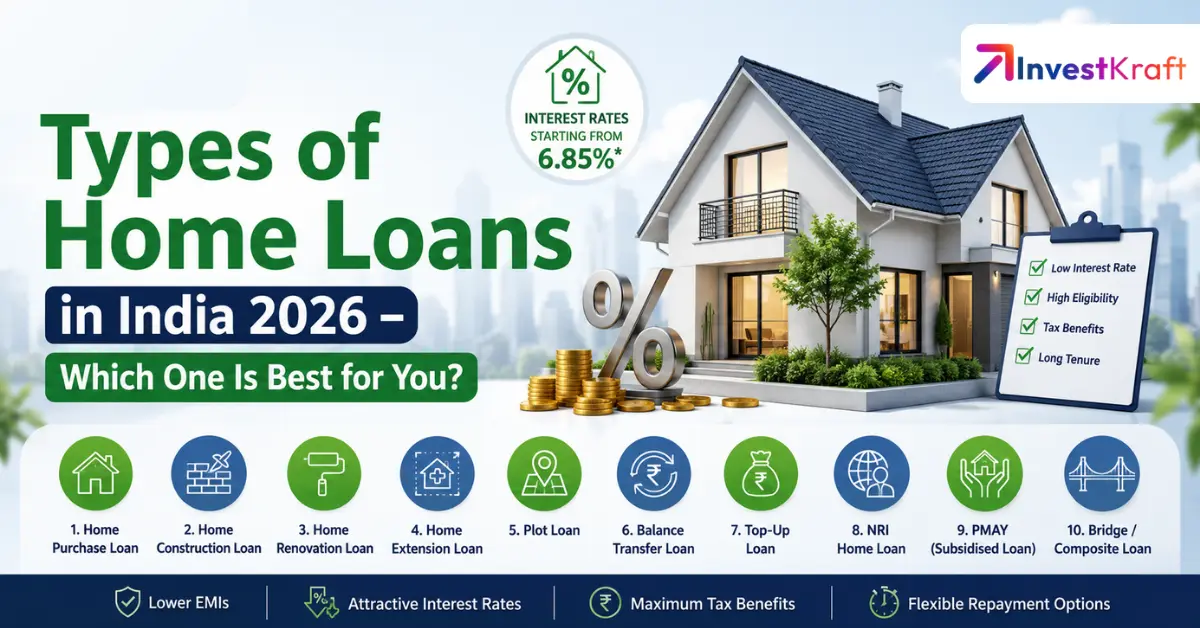
Several lenders now offer custom products, tailored to your specific requirements and financial status, that can help you get a home without income proof.
For example, under PNG Housing’s Unnati Home Loan, borrowers can avail loans up to ₹35 lakh with minimal documentation. Programs like HDFC Reach are now available specifically for people without proper income documents, helping micro-entrepreneurs and offering non-traditional income sources to buy homes through different evaluation methods and flexible eligibility rules.
This guide covers every possible strategy, including dedicated loan products from SBI, HDFC, PNB Housing, and leading NBFCs, to help informal earners, self-employed individuals, and cash-income borrowers get the home loan they deserve.
Who Needs a Home Loan Without Income Proof?
These are borrowers that every major lender is now actively trying to reach:
If you fall into any of these categories, you are not alone, and you are not out of options.
What Banks Actually Want to See (Even Without Formal Documents)
Before exploring strategies, understand what lenders are really assessing. Income proof documents are just a means to evaluate two things:
Can you repay the loan? (Repayment capacity)
Will you repay the loan? (Credit behaviour and intent)
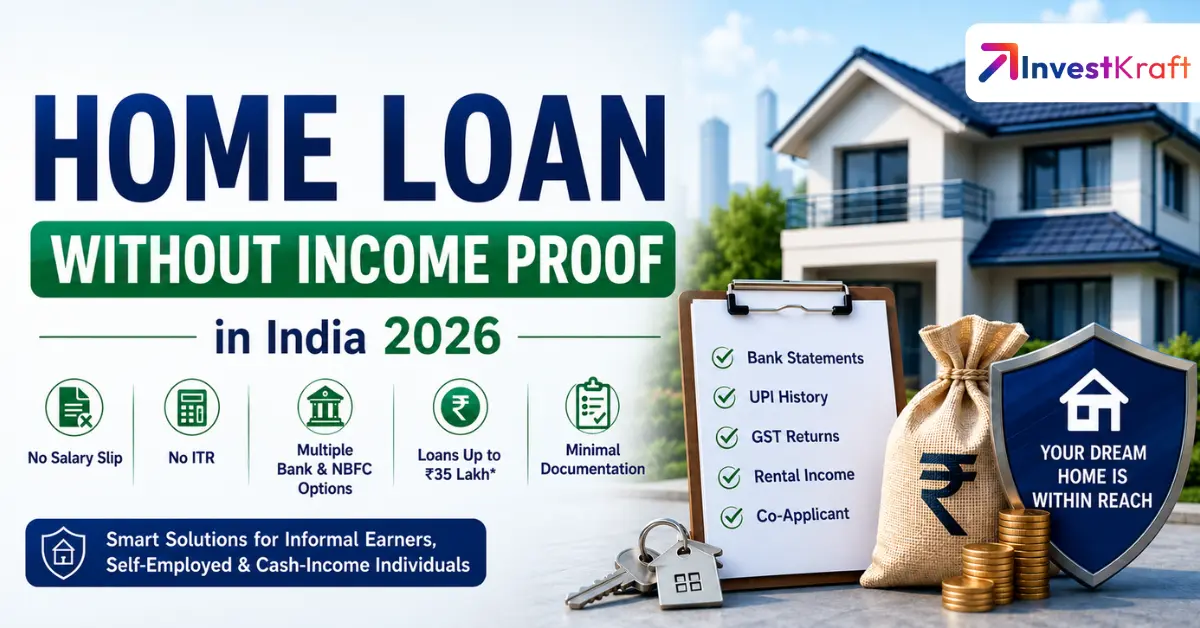
If you can demonstrate these two things through alternative means - bank statements, UPI history, property ownership, a co-applicant, or a strong CIBIL score then many lenders will consider your application even without a traditional salary slip or ITR.
Lenders assess your banking behaviour - regular savings, consistent account balances, and good financial habits go a long way in proving your reliability. Now, let us take a closer look at some of the most effective strategies in getting a home loan without income proof:
Method 1: Use Alternative Documents to Prove Income
This is the first and most important step - replacing the missing formal documents with equally credible alternatives.
1.1 Bank Account Statements - 12 to 24 Months
Consistent, regular deposits into your bank account are powerful evidence of income. SBI's Aashray Home Loan accepts a satisfactorily maintained running bank account or UPI transaction history for a minimum period of 24 months as proof of financial stability - without requiring any formal salary slip or ITR.
What lenders look for in bank statements:
Regular monthly credits of approximately similar amounts
No prolonged periods of zero activity
Reasonable savings balance relative to the loan EMI
No dishonoured cheques or ECS returns
1.2 UPI and Digital Transaction History
This is a 2026-specific development. SBI Aashray specifically accepts digital footprints of income - including UPI transaction history - for individuals who do not have documented income proof.
If you make regular business transactions through UPI, PhonePe, Google Pay, or Paytm, these digital trails now count as income evidence at select lenders. Print a 12 to 24-month UPI transaction summary from your payments app and present it with your application.
1.3 Rental Income Proof
If you own property and earn rental income, registered lease agreements, rent receipts, and bank credits from your tenant are acceptable income proof at most lenders. Even partial income through rent, combined with other alternative documents, can establish repayment capacity.
1.4 GST Returns and Business Records
If you run a small business registered under GST, your GST returns are a credible substitute for ITR. They show turnover, business activity, and consistency of operations - all of which lenders use to assess repayment capacity.
Please note that for unregistered businesses, you need sales invoices, purchase orders, ledger books, or business bank account statements to serve a similar purpose at many NBFCs and HFCs.
1.5 Form 26AS - Tax Deducted at Source Record
Even if you have not filed ITR, your Form 26AS (available from the income tax portal) shows TDS deducted on payments received. This indirectly confirms income and can support your application.
Method 2: Choose the Right Lender and Dedicated Loan Product
This is critical. Most standard bank home loans require formal income proof - but several lenders have built specific products for informal earners. Applying to the wrong lender wastes time and damages your CIBIL score through hard inquiries.
Here are the dedicated products you should approach first:
2.1 SBI Aashray Home Loan - For Urban Informal Earners
SBI Aashray Home Loan is available to individuals with regular but minimal or nil documented source of income in urban areas - individuals who do not have income proof but have digital footprints of income.
The scheme covers small traders, shopkeepers, skilled and semi-skilled workers and artisans in the unorganised sector, members of Self-Help Groups, beneficiaries of PM SVANidhi, PM Vishwakarma, PMMY, and Stand-Up India schemes, all beneficiary groups under PMAY-U 2.0, and gig workers.
Key Details
Maximum loan amount: ₹20 lakh (maximum project cost ₹45 lakh in metro cities and ₹30 lakh in other centres).
Gross annual household income: up to ₹6 lakh. Age: 21 to 60 years.
UPI transaction history or a bank account maintained for a minimum of 24 months is required.
2.2 HDFC Reach Home Loan - For Micro-Entrepreneurs and Informal Salaried
HDFC Reach Home Loans are available for salaried individuals with a minimum income of ₹10,000 per month and for self-employed with a minimum income of ₹2 lakh per annum.
HDFC Reach primarily targets micro-entrepreneurs and people with other non-traditional sources of income, using alternative appraisal methods and lenient eligibility criteria.
HDFC Reach accepts income assessed through field visits, bank statement analysis, and business assessment - not just formal documents. It covers plumbers, electricians, small retailers, contractors, and professionals who are paid in cash or informally.
2.3 PNB Housing Finance - Roshni and Unnati Schemes
PNB Housing's Unnati Home Loan lets borrowers avail loans up to ₹35 lakh with very little paperwork - specifically designed for borrowers without a formal revenue stream or ITR history.
PNB Housing's Roshni scheme targets customers without a formal income stream and covers up to 90% of the property value in eligible cases - making it accessible even for those with limited down payment capacity.
Canara Bank's Apna Ghar scheme accepts alternative income assessment for applicants in the informal sector, including bank statement-based underwriting and field income verification.
As mentioned in our earlier blog, ICICI HFC's Apna Ghar Dreamz accepts applications even with a CIBIL score below 650, with minimal documentation and no ITR required - one of the most accessible products for informal earners in the affordable housing segment.
2.6 Aadhar Housing Finance, Aavas Financiers, and HomeFirst Finance
These specialised, affordable housing NBFCs have built their entire business model around borrowers without formal income proof.
If you are applying for a no-income-proof home loan, you can submit bank statements showing regular income flow, UPI and digital payment histories, GST registration, business documents, rental income proofs, or add a financially strong co-applicant - these alternatives work well when applying for a without income proof loan.
Aavas Financiers offers a Cash Salaried Plus product for borrowers paid in cash, using cash salary letters from employers, bank deposit patterns, and field verification instead of formal payslips.
SvatantraMHFC offers housing loans under the CLSS scheme that do not require ITR or income proof for loan processing - specifically for EWS and LIG applicants.
2.7 Lenders and Their No-Income-Proof Products
Let us get a snapshot of various lenders and their home loan products without income proofs from the following table:
Method 3: Add a Co-Applicant With Formal Income
If one member of your family has formal, documented income - a salaried spouse, an employed sibling, or a parent with ITR - adding them as a co-applicant transforms your application.
3.1: The lender evaluates the combined profile:
The co-applicant's formal income and CIBIL score serve as the primary repayment assurance.
Your alternative income evidence (bank statements, UPI history) supports the combined picture
The loan amount eligibility is calculated on combined income, increasing how much you can borrow
3.2: Important Conditions:
The co-applicant must ideally be a direct family member - spouse, parent, or sibling
The co-applicant will be a joint borrower - equally responsible for EMI repayment
Both borrowers must sign the loan agreement and property documents
The co-applicant's CIBIL score and income must be strong - adding a co-applicant with a poor credit profile does not help
Women co-applicants get an additional 0.05% rate concession at most banks and stamp duty reductions across several states - a meaningful combined saving over 20 years.
Method 4: Make a Higher Down Payment - Reduce the Lender's Risk
To boost eligibility for a mortgage loan without income proof, apply for a lower loan amount or make a higher down payment.
Standard LTV (Loan-to-Value) ratios allow up to 90% financing. But for borrowers without formal income proof, coming in with a larger down payment signals financial capacity and reduces lender risk significantly.
4.1: Let us understand how approval likelihood varies with your down payment from the table below:
Your Down Payment
LTV You are Asking For
Approval Likelihood Without Income Proof
10% (standard)
90%
Very low
20% to 25%
75% to 80%
Moderate
30% to 40%
60% to 70%
Good - most NBFCs will consider
40% or more
60% or less
High - even some banks may reconsider
A higher down payment directly reduces the principal borrowed, which also reduces your EMI, further improving the repayment capacity calculation.
Strategy 5: Maintain a Strong CIBIL Score
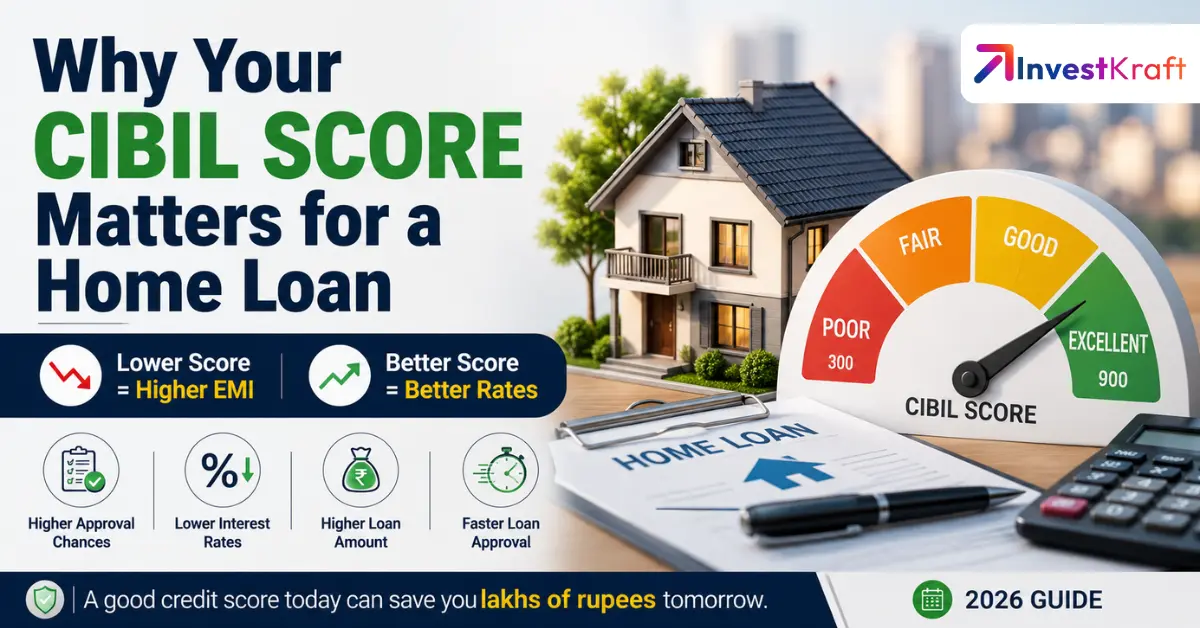
A credit score above 750 adds significant weight to your home loan without income proof application.
Your CIBIL score is a track record of how you have managed debt in the past. For a lender who cannot verify your formal income, a 780 CIBIL score says: this person has consistently repaid past credit obligations, which is credible evidence of financial discipline even without an ITR.
A high CIBIL score combined with alternative income evidence and a higher down payment is one of the strongest possible profiles for a no-income-proof application.
More specifically, if you have maintained a savings or current account at a bank for 3 to 5 years or more, with consistent balances and activity, that bank has the most complete picture of your financial behaviour.
A long-standing relationship with your bank means:
They can assess your average monthly balance over 3 to 5 years.
They can see your payment history for any existing EMIs
They understand your seasonal income patterns (important for traders and farmers).
Branch managers have the discretion to recommend cases for credit committee consideration
Approach your primary bank's branch manager directly - explain your profile, present alternative documentation, and ask about products designed for informal income borrowers.
Strategy 7: Use Collateral or Assets to Secure the Loan
Another flexible option is a loan against property without income proof, where you can borrow up to 80% of your property's market value, even if you lack traditional salary slips or ITRs.
If you own a valuable asset - a property, significant gold holdings, a Fixed Deposit, or an LIC policy - pledging it as additional collateral alongside the primary property significantly reduces lender risk and improves approval chances.
Assets commonly accepted as additional collateral:
Existing residential or commercial property (owned free of encumbrance)
Fixed Deposits (from you or a family member)
LIC policy with a high surrender value
National Savings Certificates, KVP, PPF (some lenders)
Gold deposits or gold holdings (at HFCs)
Documents to Prepare When Applying Without Standard Income Proof
Even without formal salary slips or ITR, you need to provide a well-organised file. The more documentation you offer, the better your chances.
1. Core Documents
Aadhaar Card
PAN Card
Passport-size photographs
Address proof (utility bill, Aadhaar, or bank statement)
2. Alternative Income Evidence
12 to 24 months' bank statements showing regular deposits
UPI transaction summary for 12 to 24 months
GST returns for the last 2 years (if GST registered)
Business invoices, purchase orders, or sales ledger
Rental income proof - registered lease agreement and rent receipts
Cash salary letter from employer (for cash-paid salaried employees)
Trade licence or business registration certificate
3. Supporting Financial Strength Evidence
Fixed Deposit receipts, NSC, KVP, or other savings instruments
Property documents of any other owned property
Insurance policies with surrender value
Proof of investments - mutual funds, shares, etc.
4. Property Documents
Sale Agreement
Title Deed
Approved Building Plan
NOC from the builder or housing society
Property tax receipts
What to Expect - Terms and Conditions for No-Income-Proof Loans
Be realistic about what these loans look like compared to standard home loans:
Feature
Standard Home Loan
No Income Proof Home Loan
Interest Rate
7.25% to 8.75%
8.50% to 12.00%
Maximum Loan Amount
Up to ₹10 crore
Up to ₹20 to ₹35 lakh typically
LTV Ratio
Up to 90%
60% to 80% typically
Processing Fee
0.35% to 0.50%
0.50% to 1.50%
Tenure
Up to 30 years
Up to 20 to 25 years
Documentation
Formal salary slips and ITR
Alternative income evidence
The higher interest rate on no-income-proof loans is the primary trade-off. Over 20 years, a 2% rate premium on ₹20 lakh costs approximately ₹7 to ₹9 lakh in extra interest.
However, for someone who has no other path to homeownership, this is a worthwhile trade - especially since refinancing to a lower rate becomes possible once a formal income record is established.
The Path Forward: Build Your Income Record Over Time
Getting a home loan without income proof is a starting point - not a permanent financial state.
Once you take a loan through an NBFC or special scheme and repay it consistently for 12 to 24 months:
Your CIBIL score improves significantly
Your bank account shows a long, clean repayment history
Some lenders may accept your consistent EMI payments as income evidence
You may become eligible for a balance transfer to a mainstream bank at 7.25% to 8.00%
Additionally, if you are not already doing so, begin filing your Income Tax Return (ITR) every year, even if your income is below the taxable threshold.
ITR filing is free, takes 20 minutes on the income tax portal, and creates the formal income record that will unlock significantly better loan terms within 2 to 3 years.
Summary
Getting a home loan without income proof in India in 2026 is not a pipe dream - it requires the right strategy, the right lender, and the right documentation alternative. Here is the complete recap:
Alternative Documents: 24-month bank statements, UPI transaction history, GST returns, rental income proof, business records, and cash salary letters are accepted by multiple lenders.
Dedicated Loan Products: SBI Aashray (up to ₹20 lakh, UPI-history based), HDFC Reach (field income assessment), PNB Housing Unnati/Roshni (up to ₹35 lakh, minimal docs), ICICI HFC Apna Ghar Dreamz (no ITR required), Aavas Cash Salaried Plus, and HomeFirst Finance.
Co-Applicant: Add a family member with formal income as a co-applicant - their ITR and salary slips cover the income documentation gap.
Higher Down Payment: Offer 30% to 40% down payment to reduce LTV and lender risk - significantly improving approval chances.
CIBIL Score: Maintain 750+ - compensates partially for missing income documents.
Banking Relationship: Approach your primary bank with 3 to 5 years of account history first.
Can I get a home loan without income proof in India?
Yes, it is possible - several lenders now offer tailored products including PNB Housing's Unnati Home Loan for up to ₹35 lakh with minimal documentation, SBI Aashray using UPI transaction history, and HDFC Reach for micro-entrepreneurs using alternative appraisal methods.
Which bank gives home loans without income proof in India?
SBI Aashray accepts individuals with minimal or nil documented income using 24-month UPI or bank account history - making it the most accessible mainstream bank option; HDFC Reach, PNB Housing Unnati and Roshni, and ICICI HFC Apna Ghar Dreamz are among the other leading options.
Can I get an SBI home loan without income proof?
Yes - SBI's Aashray Home Loan specifically targets small traders, shopkeepers, skilled workers, artisans, gig workers, and PMAY beneficiaries who have regular income but minimal or nil documented proof, accepting a satisfactorily maintained bank account or UPI transaction history for 24 months as the primary income verification.
Can I get an HDFC home loan without income proof?
Yes - HDFC Reach Home Loans are available for salaried individuals with a minimum income of ₹10,000 per month and for self-employed individuals with a minimum income of ₹2 lakh per annum, using field-based income assessment and alternative documentation rather than formal salary slips or ITR.
What can I use instead of income proof for a home loan?
You can submit bank statements showing regular income flow, UPI and digital payment histories, GST registration, business documents, rental income proofs, or add a financially strong co-applicant - these alternatives work well when applying for a no-income-proof home loan.
What is the interest rate on home loans without income proof?
Home loans without income proof typically carry higher interest rates starting from 8.50% to 12.00% per annum - compared to 7.25% to 8.75% for standard income-documented loans; the premium reflects the higher perceived risk, but can be refinanced lower once a formal income record is established.
Should I start filing ITR to improve my home loan eligibility?
Absolutely - filing ITR every year, even if your income is below the taxable threshold, is free on the income tax portal and creates the formal income record that unlocks significantly better interest rates and higher loan amounts within 2 to 3 years; it is the single most impactful long-term action an informal income earner can take to improve home loan eligibility.
Sources
All information verified from official and authoritative sources:
SBI Aashray Home Loan - Official Product Page: homeloans.sbi.bank.in/products/view/aashray-home-loan
HDFC Reach Home Loans - Official Product Page: hdfc.com/housing-loans/hdfc-reach-home-loans
PNB Housing Finance - Unnati and Roshni Home Loan: pnbhousing.com/blog/home-loan-eligibility-criteria-documents-roshni-home-loan-explained
ICICI HFC - Apna Ghar Dreamz for Low Documentation: icicihfc.com
Aavas Financiers - Cash Salaried Plus Product: aavas.in/cash-salaried-plus
SvatantraMHFC - Home Loan Without ITR Under CLSS: svatantramhfc.com/housing-loan/loan-for-home-purchase
HomeFirst Finance - Home Loan Without Income Proof: homefirstindia.com/blog/article/home-loan-without-income-proof
BankBazaar - SBI Home Loan for Non-Salaried 2026: bankbazaar.com/home-loan/sbi-home-loan-non-salaried.html
Income Tax Department - ITR Filing Portal: incometax.gov.in
Disclaimer: Loan products, maximum loan amounts, eligibility criteria, and documentation requirements are as of May 2026 and are subject to change at the discretion of individual lenders. Interest rate ranges are indicative. Always verify current scheme terms directly with the specific lender or a qualified housing finance advisor before applying.
Author: Diwakar Kumar Singh
Diwakar Kumar Singh is a BFSI specialist and finance writer with over 7 years of hands-on experience in financial research, content creation, and analysis.
A Gold Medalist in MBA (Marketing) from IMT, he combines deep analytical skills with practical insights gained from evaluating companies, IPOs, unlisted shares, financial ratios, and investment opportunities. Diwakar has personally analysed hundreds of financial instruments and market scenarios, which he uses to break down complex topics into clear, actionable advice.
He has authored numerous in-depth finance articles, published multiple books internationally, and contributed to research publications. His work focuses on helping everyday investors and readers make better-informed financial decisions through well-researched, evidence-based explanations that are always grounded in real-world application rather than theory alone.


 care@investkraft.com
 +91-9599071040
 +91-9797971876